Hot Feet and Cool Reason—Investigating the Firewalking Phenomenon
The handling of fire and flame, and the apparent immunity to their effects, have been matters of much interest to humanity for many centuries. Countless “Human Salamanders” have astonished crowds at mediaeval fairs, and fire-eaters still attract attention in this age of technology, wherever and whenever they perform. While the “mystery” behind manipulating torches and blowing flames from the mouth is quite well solved and understood, there is one specific variety of “playing with fire” that remains baffling to many: those performers who actually walk upon burning embers and substantially-hot stones. And behind that mystery might well be found some useful secrets of technology, human physiology and psychology, or even natural immunity.
The puzzle is two-fold: first, how physical damage to the body tissues is avoided; and second, how the firewalker is able to withstand what would seem to be unbearable pain. Severe burning of the skin and subsequent carbonization would seem to be the inevitable result of exposure to these temperatures, yet these phenomena are not observed. A raw steak dropped on a hot frying-pan can be observed to literally cook, thus it would seem that any study of this matter should concentrate first on why no actual burning takes place, as well as why there should be no pain, either. But more about raw steak later.
Are conditions such that burning is inevitable? Certainly, the measured temperatures seem to be sufficient. Temperatures of more than 340° Celsius (644° Fahrenheit) and even higher are reached in some of these performances. The melting point of lead is 327° Celsius, so anything that can melt lead can surely melt your feet! The explanation is to be found in the matter of heat transference. This can take place in three ways—by radiation, by contact transfer, and by convection—the first two being the most relevant to my story. Having been present at fire-walking ceremonies in Sri Lanka in 1983, I can testify to the enormous radiant power of the fire that was used. The effect on the unshielded face was so dramatic that observers held their hands up to shield their faces from the uncomfortable sensation. Daring a little more, I was able to hold my hand within six inches of the embers for only a few seconds, at the very most; longer would have burned me, I feel sure. Yet the young men who then walked those coals did so deliberately and slowly, not hopping over them, but literally “strolling.” They were not burned, as I determined by examining their feet the instant they stepped off the embers, and further evidence of that fact was shown later that evening, as those same performers went through their barefoot ethnic dance routines for us, showing no signs of any injury—or even tenderness—whatsoever.
Various explanations for the success of firewalkers have been offered by the practitioners. At the Sri Lanka firewalking event, the young men told me that in order to succeed at the firewalk, for some period of time before they had to abstain from alcohol, eating pork, using profanity, and sexual involvement. However, the very next night, courtesy of Sir Arthur C. Clarke, who was then the chancellor of Moratuwa University and thus could arrange such events, we were treated to a demonstration at the campus in which four young men—students all—drank raw whiskey, freely consumed pork rolls, reeled off a number of strong Singhalese oaths (or so we were assured) and boasted to us of their recent (and perhaps hyperbolized) bedroom accomplishments. They then walked a three-meter length bed of red-glowing coals, and only one of them suffered a very minor blister on one toe.
Generally, spiritual reasons are given for success in this feat, and it is said in many cultures to be one that demonstrates religious faith. In Japan, where the Shinto priests—and often visitors—walk on hot rocks, it is said to be a demonstration of religious purity. In Hawaii and the Fiji Islands, the act is related to ancient tribal ceremonies that are essentially religious. Thus it has been argued that—leaving aside suppositions of actual religious modalities, which are not subject to scientific scrutiny—the psychological attitudes involved can produce physiological changes in body chemistry that give the fire-walkers some sort of immunity to otherwise damaging forces. Personally, I doubt this explanation since I favor a solution that relies upon demonstrable physical factors, but any proper investigation must pursue all possible avenues of approach.
One possible solution was outlined in the August, 1977 issue of Scientific American by Jearl Walker. Reporting temperatures of as much as 650° Celsius (1202° Fahrenheit) during firewalking demonstrations, Walker described a little-known phenomenon called the Leidenfrost (alt. Leydenfrost) Effect, first reported in 1756. When drops of water are introduced onto a flat metal plate at approximately 200 to 250° Celsius (482° Fahrenheit), they assume flat shapes that do not touch the plate, but float about on a layer of their own vapor. You can witness this by watching water whizzing around the surface of a hot frying pan or pancake griddle. Walker postulated that a firewalker is literally insulated from the fire by vapor from his own body, and the Sri Lankan performers were observed to stand on dampened soil before launching themselves onto the fire-bed. However, though I can picture (barely) the “vapor” solution for one walking on hot flat surfaces, it would not seem to hold for the same walk performed on irregular surfaces that more closely resemble coarse gravel. More importantly, the vapor thus generated would be at a temperature of 100° Celsius or more, thus the tissue would be directly and closely adjacent to that temperature. Though the rate of heat transfer might be less through the medium of water vapor, the Leidenfrost Effect does not appear, to me, to adequately provide any insulative factor.
It isn’t the temperature of the material that matters, it is the capacity of the material to transfer the heat into the dead skin on the bottom of your feet.
There are various modalities used for firewalking: glowing embers, hot rocks (sometimes porous lava stones) and actual flaming logs are three different materials, and must all be considered. An ash-covered wood fire has been the surface of choice for the firewalking fad that sprang up in the U.S. in past decades. Adequate and relatively simple technology exists to examine the firewalking phenomenon. I suggest three approaches:
- Measurement of temperatures by means of (a) heat-sensitive paints and (b) pyrometers—both radiant and contact types. The paint would serve to validate the parameters of the pyrometer probes, and could be applied directly to the feet of the walkers and to the hot surface upon which the walk is performed. Contact pyrometer leads should be attached directly to the feet, to be read out either by remote recording or direct cable connection. Similarly, contact thermocouples should be placed on the hot surface.
- Detailed simultaneous and synchronized video records should be made, in both close-up and macro-formats. Simultaneous and similarly synchronized videoed infrared scans should be obtained. All three varieties of firewalking described above should be studied (embers, rocks, and logs), so that comprehensive data can be obtained for a definitive report.
- Samples of ash, embers, wood, and rocks, must be obtained, so that tests—insulating values, conductivity, specific heat, etc., of these materials can provide a complete physical picture.
As for the contact transfer of heat, I found that I was able to very quickly press the palm of my hand down upon the embers without damage. This supports the current theory that firewalkers are not burned by the coals or the stones because these materials are poor conductors of heat. That is, it isn’t the temperature of the material that matters, it is the capacity of the material to transfer the heat into the dead skin on the bottom of your feet. And ash-covered burning wood and some kinds of heated porous stones are poor conductors of heat.
Why investigate this phenomenon? Because there just may well be some previously unrecognized physical force at work here. Whether we discover a physiological factor or a psychological element that prepares the firewalker for the trial, we are richer for the discovery. There is no doubt about it; certain persons do walk upon red-hot coals and/or stones with their unprotected bare feet and they suffer no pain or damage as a result. This might appear to be a miracle, a view that I personally reject by its very definition. There are perfectly good and logical reasons for this phenomenon, and I want to see that it is very thoroughly investigated and that an explanation is provided that will stand examination by competent, qualified, persons.
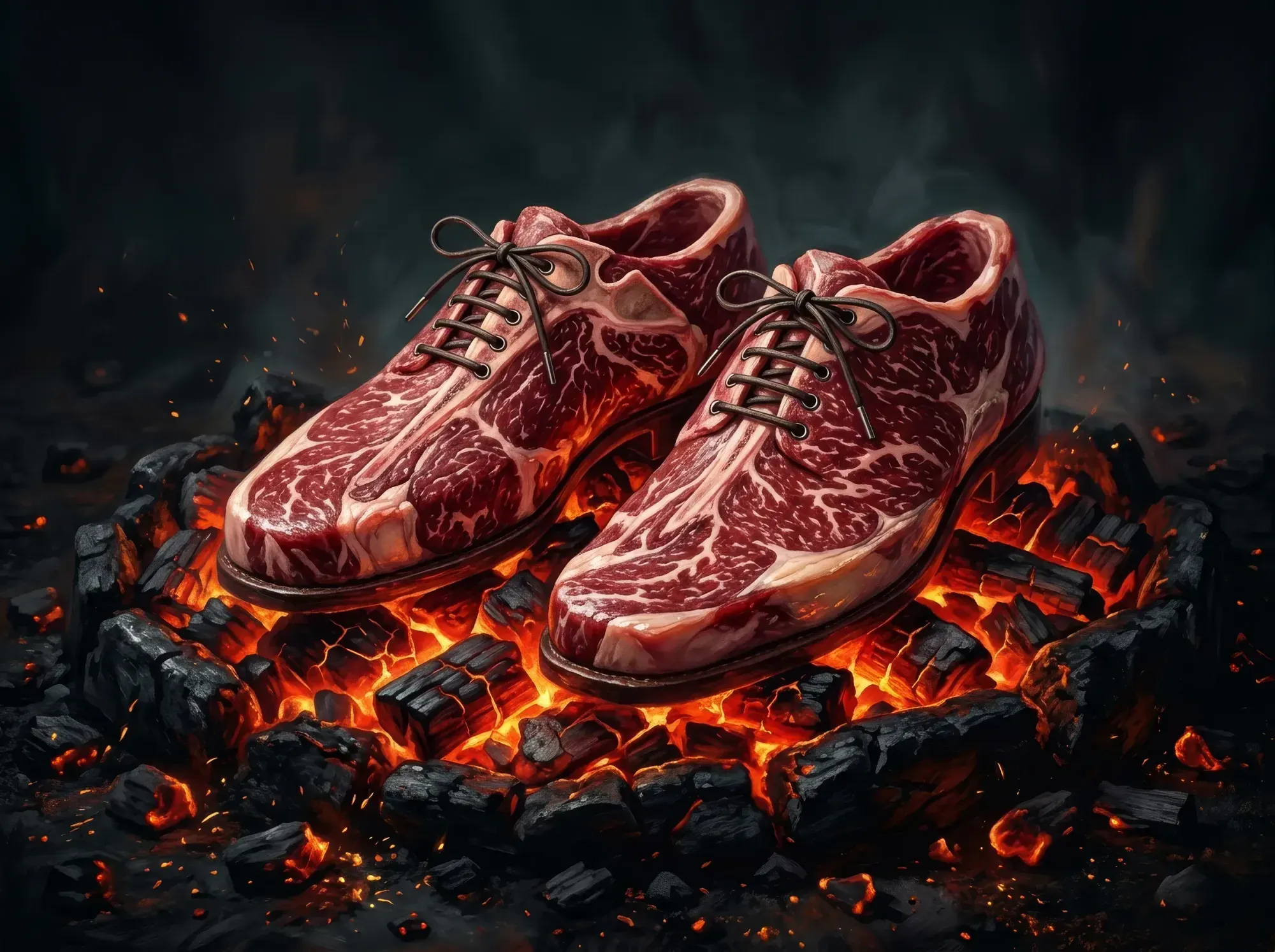
Strapping two body-temperature round steaks to his feet, [he] traversed a bed of glowing coals. The meat remained unsinged.
Physicist and firewalking expert Dr. Bernard Leikind uses the example of a cake baking in an oven to explain how materials have different capacities to transfer heat. Suppose a cake has baked in an oven at 400°. When you put your hand into the oven it is not burned by the 400° air. If you tap the top of the 400° cake you are not burned. But if you touch the 400° metal cake pan, you will be burned almost instantly. All three materials—the air, the cake, and the metal cake pan are the same temperature—400°. But air and cake are poor conductors of heat, whereas metal is a good conductor of heat—thus you will be burned if you touch it.
Leikind is also known for his test of the theory that it is consciousness that protects a firewalker’s feet from burns. He reasoned that raw steaks are not conscious, and strapping two body-temperature round steaks to his feet, traversed a bed of glowing coals. The meat remained unsinged.
I suspect the steaks would have been seared had he walked across a bed of red-hot frying pans, and that no matter how positive your thoughts, no matter what sort of trance you are in, no matter what type of New Age spiritual energy you wish to call forth to your aid, your feet would also be burned by walking on red hot metal.
As for my personal qualifications to research these matters from another angle, being a performer myself I am perhaps uniquely suited to approach these wonder-workers and gain their confidence. This expectation was borne out in Sri Lanka, when I was able to get much closer to the firewalkers than might otherwise have been the case.
Any discovery about the world—particularly about our own species—is of value; it would be a loss to ignore the opportunity to investigate an ability that may shortly become only a legend. Space biology, oceanography, or just general physiological and psychological studies relating to ongoing exploration of humanity’s parameters dictate that such an opportunity not be lost.