How Social & Sexual Equality Influence the Health & Wealth of Nations
What do social and sexual equality have to do with the health and wealth of countries around the world? The prevailing view in social science has been that gender equality is a universally desirable goal—one that will help solve a myriad of existing problems and benefit everyone.1 Unfortunately, there has been no systematic examination of whether there may be costs as well.
Many scholars, after looking at the relevant data, have concluded that wealth drives health, as higher income provides access to better nutrition, clean water, sanitation, and quality health services. Others argue that the causal relation between wealth and income might operate in the opposite direction because healthier people are more productive workers, and that healthier people with lower mortality invest more in education and physical capital.2, 3 So which view is correct?
The available evidence suggests that across countries, wealthy individuals are healthier than poorer ones, and also that wealthier countries have healthier populations on average than poorer ones. However, the evidence that population-wide health is higher in more egalitarian societies than in ones with greater economic inequality is less consistent.4 Some studies have also found that greater gender equality is associated with higher Gross Domestic Product (GDP), and this association is presumably because increasing women’s educational attainment provides a larger and better-educated workforce.5, 6, 7
Women report more feelings and symptoms of depression, and receive more diagnoses of depression in countries that have better living conditions (higher GDP, for example).
While many studies assess the physical health of individuals or populations, only a few have looked at mental health or fertility, as these are certainly an important aspect of a nation’s health. Recent reports show that the total fertility rate in many parts of the world, including the United States, is below replacement level. Rapid declines in fertility in many countries are associated with higher GDP and increased female education, as well as increased life expectancy at birth.8 Studies of the relationship between gender inequality, living conditions, and sex differences have found that women report more feelings and symptoms of depression, and receive more diagnoses of depression in countries that have better living conditions (higher GDP, for example).9
So, is gender equality a luxury belief that increases the wealth of nations, but at the same time is associated with decreased fertility and poorer female mental health?
Sex, Sexual Orientation, and Gender
Before attempting to answer this question, it is essential to clearly distinguish between three overlapping terms: sex, sexual orientation, and gender.10
- Sex refers to biological differences between human males and females attributable to gametic variation. That simply means males generally produce sperm that are numerous, small, and mobile, while females produce eggs that are much larger, much fewer in number, and immobile.11 Additionally, the vast majority of human males have an X and a Y sex chromosome (XY), whereas almost all human females have two X chromosomes. (Sex chromosome abnormalities, such as XO, XXX, XYY, and XXYY occur in only 1 in 1,000 or fewer cases.) These differences are usually, though not always, mirrored by differences in external genitalia.
- Sexual Orientation refers to a person’s cognitive, behavioral, and emotional preferences for sexual and romantic partners.12 The relative influence of genetic, environmental, and hormonal factors, and their interaction over the course of development in forming sexual orientation is still to be determined.
- Gender is a social construct that is influenced by mores, traditions, and institutions. It refers to a person’s identity and sociocultural role. Therefore, by definition, gender is a more fluid concept than sex (and even than sexual orientation).
Although the distinction between sex and sexual orientation is more apparent in the scientific literature, numerous studies and publications do not distinguish between sex and gender. In this article the word sex denotes the two biological categories (except when we are citing previous authors or databases and they have misappropriated the word gender for what we have defined above as sex) without having actually assessed that psychosocial construct psychometrically.
How Biogeography and Social Factors Shape Sexual Equality
To explore what predicts differences in levels of egalitarianism, one group of researchers performed a cross-cultural analysis13 that compared the subnational polities (i.e., Autonomous Regions and States) of Italy, Spain, and Mexico. Measures of inequality included both general economic inequality and sex-specific health (e.g., prevalence of certain types of cancers and heart disease), as well as opportunity (for example, differences in economic and political participation and in education). Both social and sexual equality were highly correlated among those polities. Their analysis found that greater sexual equality was predicted by two main factors:
- Populations having an average slow life history, indicated by longer average life expectancy, greater average height and body weight, more male-biased sex ratios among adults, higher marriage rates, later ages at first marriage and childbirth, as well as lower birth and infant mortality rates (fast life history being indicated by the opposite set of characteristics);
- Regions at higher elevations and latitudes, which tend to have colder climates.
Further down the hypothesized chain of causation,14 regions with higher levels of egalitarianism also tended to have greater human capital—both economic strength (reflected in higher incomes, GDP per capita, employment rates, and lower poverty rates) and educational achievement (with higher rates of literacy and educational attainment). Human capital was also higher in those places where the economy was more diversified (that is, it was not overly dependent on just one industry). While regions with more variation in life strategies and cognitive abilities also tended to score higher on human capital, areas with higher humidity and rainfall were associated with lower levels.
Overall, these results suggest that both social and sexual egalitarianism appear to be among the likely outcomes of a slow life history strategy and higher latitudes and altitudes. They both predict and foster the development of human capital in the subnational polities of Italy, Spain, and Mexico.
Another cross-cultural analysis15 examined how social and sexual equality relate to human capital across 66 recognized nation-states.16 Again, both types of equality were predicted by slow life history (meaning populations that tend to mature later, live longer, and invest more in long-term outcomes), as well as with environmental factors such as humidity and precipitation. By contrast, social and sexual equality tended to be lower in places with higher population density and greater exposure to parasites.
Sexual equality, in turn, was stronger in countries that were more peaceful, both between groups and within them.
Social equality was also more common in regions with temperate broadleaf deciduous forests (that is, areas with forests whose trees lose their leaves in the fall and regrow them in the spring; typically found in climates with warm summers, cold winters, and regular rainfall). Additionally, social equality itself was again linked to greater sexual equality.
Sexual equality, in turn, was stronger in countries that were more peaceful, both between groups and within them. Peace between groups, whether within a country or between countries, was indicated by having fewer internal conflicts, less political unrest and instability, lower military spending, fewer weapons and soldiers, better relationships with neighboring countries, and less hostility toward foreigners. Peace within groups was indicated by having lower crime rates, less corruption, fewer homicides and violent offenses, and limited civilian access to weapons.
As with the earlier analysis of regions within Italy, Spain, and Mexico, both social and sexual egalitarianism appear to be among the consequences of a slow life history strategy and are important contributors to the development of human capital. Human capital was also positively linked to factors such as economic diversification, peaceful societal conditions, environmental factors such as rainfall and humidity, the slow life history factor, and it also tended to be higher in more densely populated areas.
Researchers have also looked at the role of ecological factors in the emergence of sexual equality. Cross-national examinations indicate that countries with greater sexual equality also have more significant levels of civil and political freedom, democratization, and resource distribution.17 In turn, sexual inequality is positively associated with the severity of infectious diseases. Further analyses examined the correlation between sexual equality and mean national scores on a measure of peoples’ inclination toward short-term versus long-term romantic and sexual relationships.
Initially, the models indicated that nations having greater sexual equality are less sexually restrictive. However, reanalyzing the data by sex revealed that the association was true only for women, which suggests sexual equality operates predominantly on the sexual behavior of women rather than on that of men. While interesting, these bivariate correlational analyses are limited. There are only two variables, other predictors are ignored, and extreme outliers can have a disproportionate effect. Further empirical studies are needed to determine whether there are any additional sociopolitical and ecological variables that mediate the association between infectious diseases, democratization, gender equality, and sociosexual behaviors.
Gender Equality and Fertility Rate
More recently, another study examined two alternative models based on a sample of 132 nations. The first model considered the following sequence:
- number and severity of parasitic infections predicting sexual inequality;
- sexual inequality predicting income inequality;
- income inequality predicting GDP per capita;
- GDP predicting prevalence of anxiety;
- prevalence of anxiety predicting prevalence of depression;
- prevalence of depression predicting prevalence of eating disorders; and
- prevalence of eating disorders predicting total fertility rates.
The second model introduced the following change:
- number and severity of parasitic infections predicting GDP per capita;
- GDP per capita predicting income inequality;
- income inequality predicting sexual inequality; and
- sexual inequality predicting anxiety.
After comparing both analyses, the first model provided a simpler and more efficient explanation, suggesting that nations with a higher risk of parasitic infections also have higher sexual inequality. In turn, greater sexual inequality increases income inequality. Additionally, more sexual and income inequalities reduce a nation’s GDP per capita. However, a higher GDP per capita increases the prevalence of anxiety across nations. As expected, nations with a higher prevalence of anxiety also show a higher prevalence of depression. The models also indicated that depression, anxiety, and higher GDP lead to a higher prevalence of eating disorders. Lastly, the prevalence of eating disorders, depression, anxiety, as well as high GDP per capita all appear to reduce the total fertility rate of nations. In contrast, greater sexual inequality increases the total fertility rate.
Greater wealth is associated with increases in the prevalence of certain mental disorders.
Taken together, this analysis suggests that there are several ecological trade-offs, as well as compromises that people face when it comes to reproduction, survival, and resource allocation. First, countries with greater sexual equality are characterized by greater economic equality, and are wealthier. However, greater wealth is associated with increases in the prevalence of certain mental disorders. It’s possible this could be simply because wealthier nations can invest more in mental health services and so more accurately diagnose individuals suffering from these conditions.
More research is needed to determine whether these values are inflated due to wealthier nations’ greater investment in health services. If not, it would provide further evidence of trade-offs. For example, a higher prevalence of mental disorders in conjunction with greater wealth appears to reduce a nation’s fertility, with nations below the replacement level having a declining population. Although the effect was of medium magnitude, these models also suggest that countries with greater sexual inequality experience higher fertility rates. Consequently, rather than viewing the wealth of nations as an ecological panacea, these analyses identified fundamental opposing contributions of sexual inequality and wealth to different dimensions (mental health, fertility) of the health of nations.
Living Conditions and the Gender Equality Paradox
The traditional social sciences predict that greater social and sexual equality should reduce sex differences. Nevertheless, several cross-national studies indicate that in developed nations that have stronger and more mature economies, and where the majority of the population has access to healthcare and education, and both men and women participate in social, political, and economic institutions, the magnitude of sex differences in a variety of personality, cognitive, and behavioral traits is more pronounced than in developing countries.
This phenomenon has been termed the Gender Equality Paradox.18 A recent meta-analysis reported that in developed nations, sex differences were especially noticeable across personality traits such as risk taking, trust, reciprocity, altruism, forgiveness, being a “morning person” rather than an “evening person,” and excessive investment in interpersonal relationships and a strong need for social acceptance and approval, often at the expense of personal needs and independence. The evidence indicates that in wealthier, healthier, and better-educated nations, the gap in depression rates between men and women also tends to be larger than in developing nations.
Sex differences in the intensity of physical aggression between romantic partners decrease in countries that have better living conditions.
Studies on the Gender Equality Paradox in cognitive abilities suggest that while men and women living in developed countries show only minor differences in mathematical abilities (with men scoring slightly higher than women, on average) compared to developing countries, the gap becomes much larger when looking at verbal abilities and memory. In these areas, again on average, women tend to score higher than men. Additionally, male and female differences in sexual behavior and mate preferences are attenuated in developed nations. Similarly, sex differences in the intensity of physical aggression between romantic partners decrease in countries that have better living conditions.
Above and beyond the latter sex differences in individual traits, epidemiological studies of violence also suggest there are regional differences in the rate of intentional homicide per 100,000 people between men and women.19 According to the United Nations Office on Drugs and Crime (UNODC) report of 2019 (see Figure 1), although across all nations men had a higher homicide rate than women, in some regions these differences were more pronounced. For example, whereas Europe, Oceania, Asia, and, to a lesser extent, North America feature slight sexual variation in homicide rates, regions such as the Caribbean, Central America, and South America show significant sex differences in homicide rates.20
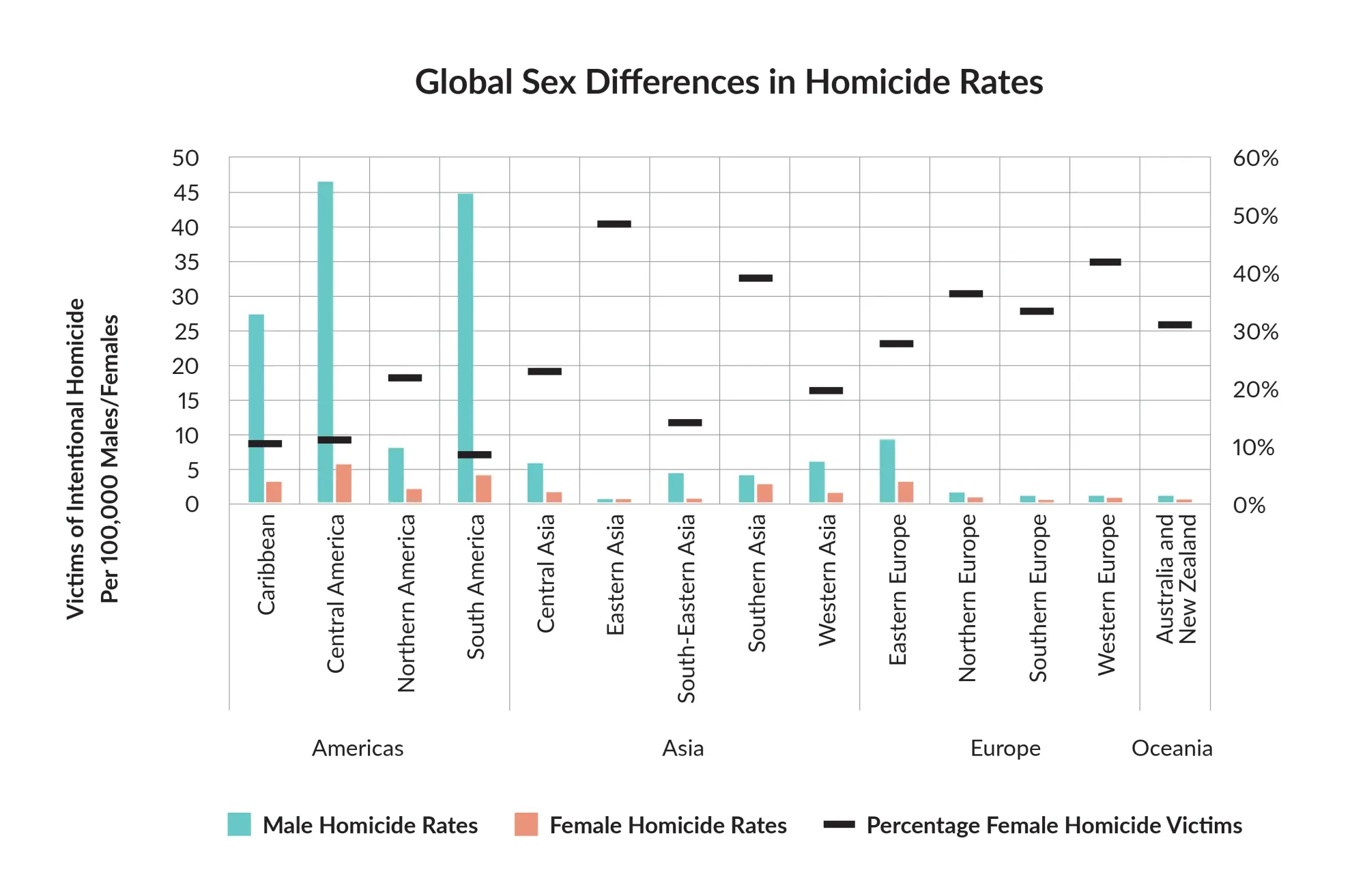
The report also highlights age-related patterns, with most male homicides being committed between the ages of 18 and 30. As a result, differences between men and women in rates of homicide are especially noticeable among populations that are, on average, younger, as shown by the elevated rates in regions such as the Caribbean, Central America, and South America. Nevertheless, sex differences in lethal violence, in conjunction with potentially lower sexual equality, are not a phenomenon restricted to complex societies such as nation-states. A study of the percentage of lethal aggression in small-scale societies in lowland Amazonia21 demonstrated that men were more often the target of lethal aggression occurring between communities than were women.
Such results strongly indicate that better living conditions may operate differently on sex differences, depending on the trait. While better conditions increase the gap between men and women in several personality traits (“The Gender Equality Paradox”), they reduce that gap for the prevalence of intersexual aggression. Consequently, the empirical evidence does not entirely agree with either exclusively hereditarian views on human sex differences nor with the environmentalist position that all behavioral variation between men and women is a product of socialization and cultural influences. Instead, a more nuanced approach is needed where studies on the gender equality paradox are performed on a case-by-case basis. And that requires developing additional alternative hypotheses about the influence of socioecological conditions in either amplifying or attenuating underlying sex differences.
Provisional Conclusions
So, do social and sexual equality influence the health and wealth of nations? The evidence presented here suggests that the answer is yes, but not exactly in the way many have assumed. Sexual equality, unsurprisingly, contributes to the wealth of nations, which is to be expected given that it increases educational opportunities for women as well as access to a greater range of occupations, and so both enriches and diversifies the workforce and that increases GDP. However, as recent media stories have highlighted, some of the wealthiest nations are not the healthiest if measured by rates of chronic illness, mental illness, and low fertility.
Sexual equality may be a driver of greater wealth, despite the clear indications that it is associated with lower fertility, and some evidence of it being a factor in specific measures of poorer mental health.
Our analysis also links some of these metrics, in particular mental health and fertility, to sexual equality. In fact, this model suggests that sexual equality may be a driver of greater wealth, despite the clear indications that it is associated with lower fertility, and some evidence of it being a factor in specific measures of poorer mental health. In terms of the gender equality paradox, the degree of sex differences in mental health (specifically for depression and anxiety) seems to increase with increasing sexual equality.
What mechanisms drive this relationship is yet to be determined. The fertility connection seems more straightforward in some ways, as one aspect of the demographic transition is increased access to education for women, which leads to their choosing to delay the age of motherhood and to have fewer children.22 However, it is not clear just why sexual equality would drive the fertility rate down to below replacement levels, as seen in a wide range of developed countries from South Korea to most of the European Union.23 There may be other factors that interact to produce this concerning result, for example, the lowering of sperm counts.
Bottom line—while sexual and social equality do seem to boost a nation’s wealth and general health, the effects of sexual equality on fertility and on certain aspects of mental health seem to point in the opposite direction.