How to Convince People You Are Psychic
In his story Murders in the Rue Morgue, Edgar Allen Poe relates how the protagonist is amazed that super-detective Auguste Dupin has observed his silent behavior and by this means alone has successfully deduced exactly what he was thinking. He then concludes:
There are few persons who have not, at some period of their lives, amused themselves in retracing the steps by which particular conclusions of their own minds have been attained. The occupation is often full of interest; and he who attempts it for the first time is astonished by the apparently illimitable distance and incoherence between the starting-point and the goal. What, then, must have been my amazement when I heard the Frenchman speak what he had just spoken, and when I could not help acknowledging that he had spoken the truth.
What Poe’s protagonist has just demonstrated is the fine art of “cold reading,” whereby certain cunning rascals are able to apparently know more than their victims might expect, to come up with facts, names, numbers, and other details—even involved scenarios—that would seem to be unavailable by mere guessing. This is accomplished by three means: making careful observations, throwing out hints and developing the answers, and directly asking questions. It sounds rather less mysterious when you put it this way, but when properly applied, it works very well. A major weakness of the method is that, given an accurate record of the event, an astute analyst will solve the means.
In November of 2002, ABC-TV’s Primetime series featured a demonstration by the renowned British mentalist Ian Rowland, who employed cold reading techniques with 20 volunteers. He was tasked by ABC with duplicating the results of spirit mediums, of getting messages from the dead. In a teaser on their Web page, ABC noted:
Communicating with the dead has found a growing television audience in recent years, with nationally syndicated shows like Crossing Over With John Edward and Beyond With James Van Praagh. The show’s hosts claim to be able to connect with the deceased relatives or friends of audience members, and often reveal family stories and details with startling accuracy. In many cases, the audience members believe they have just received a message from their loved one beyond the grave.
Video clips of John Edward and James Van Praagh doing their “dead people are giving me messages” routines were shown, and then hostess Diane Sawyer asked: “How do they convince people they can contact the dead?” Note that she didn’t ask: “How do they contact the dead?” She asked how they convinced people that they contact the dead. That was a good sign. According to ABCNEWS.com:
Rowland says he can produce a similar effect to the TV mediums’ shows by using a technique known as “cold reading.” He shows how the technique works in a demonstration he has performed around the world. To test Rowland’s claims, Primetimehired him to give his demonstration to an audience of 20 volunteers who had indicated they were open to the possibility of communication with the dead. The volunteers were told it was an experiment to test Rowland’s psychic abilities.
The volunteers were not informed that Rowland was a mentalist, and Primetime made no claim that they were testing Rowland’s psychic abilities, but were testing whether he could replicate the results of spirit mediums by using cold reading techniques. It truly was an experiment. Rowland wrote me that he was kept in the dark concerning any and all data about the volunteers:
Prior to Primetime, I’d tried cold reading as a tarot reader, as an astrologer, and as a clairvoyant, and in all these cases cold reading had proved remarkably successful in producing results very similar to those produced by so-called genuine psychics... However, before Primetime, I had never been given the chance to try cold reading as a spirit medium, to apparently communicate with the dead in the currently vogueish “hotline to heaven” manner.
Rowland told Primetime that “we should be able to show things which people connect with, which seem to describe people who have died and moved on to the afterlife.”
Right there, we have the biggest reason for the success of the cold readers: their victims just want to pretend, to feel good, to have their delusions fortified.
The 10-minute segment shown of the 30-minute experiment produced at least two people in the audience who thought they’d made a connection with the other side during the session. Rowland said that he’d made “connections” for seven of the participants. One of them, after being told that it was all a fake, said:
To me it doesn’t matter, because I believe we get the signs we need in the way we need them, and if you’re cold reading or really talking to the other side, as long as I got a sign to me that made it feel real, my hope that it was real, will make it real.
Right there, we have the biggest reason for the success of the cold readers: their victims just want to pretend, to feel good, to have their delusions fortified. If they get some hope for belief in an afterlife, and for possible communication with the dead, they go willingly to the abattoir, like sheep. This hope was not affected by revealing to them—as Rowland did after the session—that the experience was not real for him, and that he was using cold reading techniques to elicit their responses. Rowland, in fact, has an acerbic stance on the subject: “Belief in psychic stuff has always been with us and is likely to flourish in the fertile soil of uncritical mass media attention. There is no way of combating this.”
On this point I must respectfully, but strongly, disagree with Ian. My personal experience, as I combat the fakers who so victimize the suckers, is that some of those taken in can be enlightened on this matter, and I have many communications from individuals who have crossed that bridge. I am proud that I showed them the way. Rowland seems to have given up trying to convince them. He says:
I’m growing weary of the polarized conflict between skeptics and believers, and the tedious, pointless, go-nowhere and learn-nothing litany of their clichéd exchanges. Dialogue, connection and exchange interest me. Monologue, disconnection and conflict do not. If I meet someone who believes in John Edward, or in spoon-bending, or UFOs, what’s interesting to me is not having an argument with them, but learning about how that person has come to arrive at that view. The greater the distance between my view and theirs, the more interesting I find it to learn how we have managed to arrive at such divergent positions! My sincere belief is that by learning more about the other person, and the journey they have been on, the more I learn about people in general and therefore about myself. I think this is growth, and I hope to keep growing until I die.
Fair enough. Ian Rowland is not on a crusade to challenge psychics and their claims, as I am. He feels that people are going to consult them regardless of what he or anyone else thinks or says about the practice, but he also thinks that knowledge of cold reading techniques can provide information they can use when deciding whether or not to trust them. The effect he had on the 20 Primetime volunteers seems to support his approach, since he gave them and millions of TV viewers a clear demonstration that these “mediums” don’t work any differently than those others—such as mentalists—who use cold reading, and yet none of his volunteers seemed to have changed their minds about psychics, or about contacting the dead. Unfortunately, I think that not too many viewers changed their minds, either. Ian says:
I am disappointed at the invoked comparisons with Edward, Van Praagh and so on, which I tried to avoid in any of my own comments or contributions. I think it’s a shame that something like this, an interesting experiment into what cold reading can do, and how and why it works, is only seen as legitimate if it is applied to the work of TV psychics and mediums. They don’t go on TV talking about me, and so I don’t see why I should go on TV talking about them.
On the skepdic.com site, Rowland himself put the experiment in perspective by stating these five points:
- [ABC was] willing to undertake the enormous task of handling the whole thing responsibly and ethically, with as much care and tact towards people’s feelings as possible. In an industry where time is money, it’s hard to find a team willing to take care over people’s feelings. ABC did, which is why all 20 people signed their release waivers after they knew I was a cold reader.
- They were willing to shoot it properly. They found a nice location and committed a very good director and a large 5-camera crew to the job.
- They were willing to take the experiment seriously, and to observe the relevant protocols. If you have ever been involved with a large-scale location shoot, you can imagine the problems of trying to get an audience of 20 people ready, and at the same time make sure that I, while in the same building, have no information whatsoever about any of them, not even what any of them looked like.
- They were willing to negotiate the legal and ethical issues involved.
- They were willing to do all this knowing, as I told them from the start, that I could not guarantee it would work or that I would get any results. And we had no contingency plan. If it failed, it failed.
So there you have it. I had a chance to see whether cold reading works in this way under these conditions, and I took it.
The fact that they signed their waivers after the experiment indicates that though they may have been deceived they were not extremely angry or upset. As noted above, some of the volunteers still felt the experience was real for them.
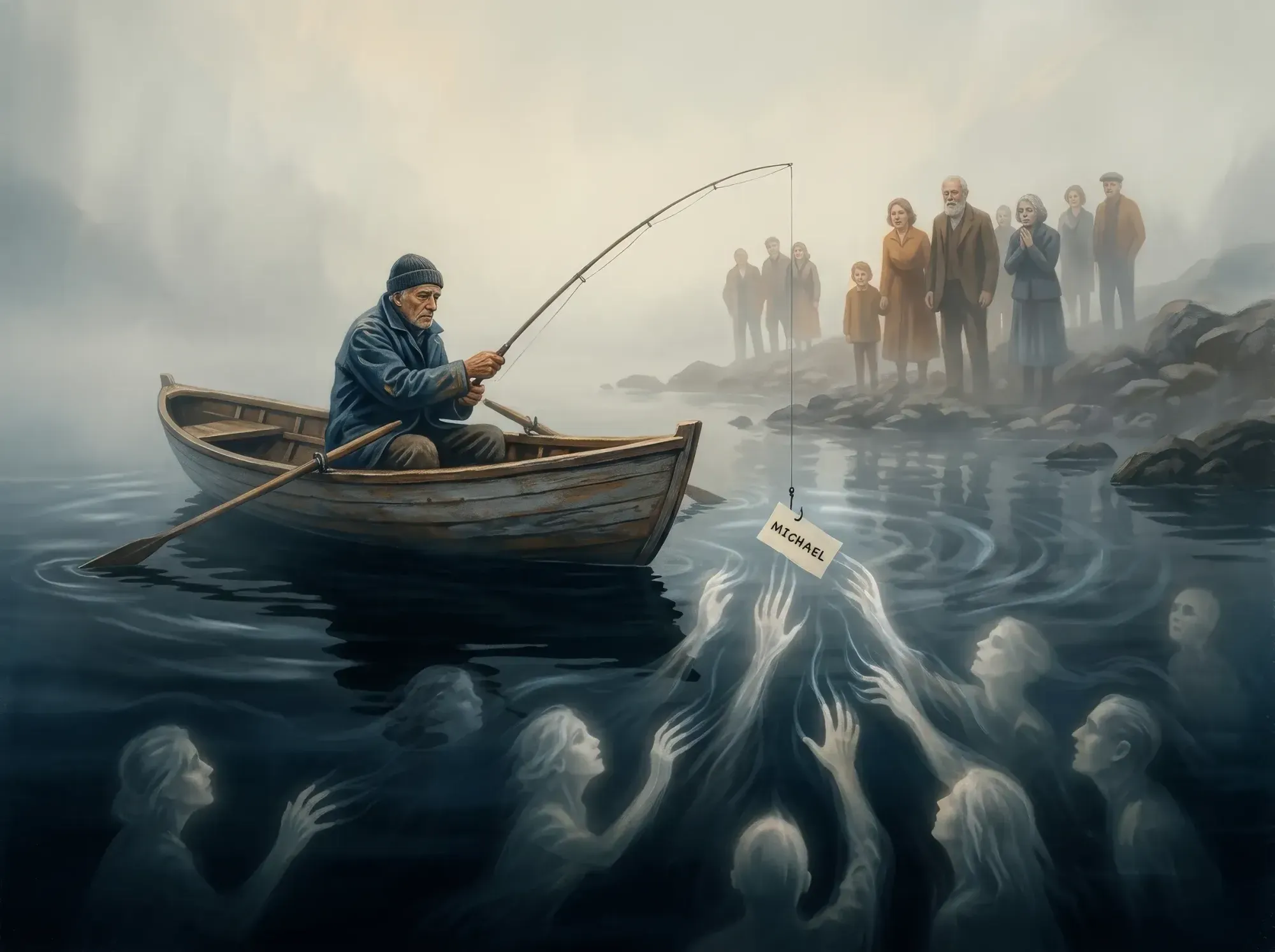
Though only fragments of the experiment were shown, for those who are familiar with the work of Van Praagh, Rowland appeared to be doing the same thing that he does, with the same results. He went fishing with names like “Michael” and “Karen,” and got hits on those because they’re so very common in America. He guessed about areas of pain or some detail or other. At times, he seemed to be playing the old game of Twenty Questions.
As I combat the fakers who so victimize the suckers, is that some of those taken in can be enlightened on this matter, and I have many communications from individuals who have crossed that bridge.
After the session, the volunteers were told that Rowland was using cold reading techniques. He revealed that when he throws out a name, such as “Michael” or “Karen,” he has not chosen these names willy-nilly. He has memorized the 18 most popular male and female names in North America over the past 45 years or so. He revealed that throwing out a name like “Michael” is a “Russian doll statement.” It has lots of layers. Someone in the audience will be named Michael, or have a deceased loved one by that name, or have a friend by that name, or know a friend of a deceased person with the name, etc. (“Karen,” for example, was the name of a volunteer’s cousin’s granddaughter. When Rowland asked about somebody moving, she identified her sister as moving.)
Rowland also revealed that when he says he is getting a message about a certain area of the body where an ailment is to be located, he is using his knowledge of the main areas (chest, stomach, head) where serious ailments usually occur. He noted that he does not worry too much if he doesn’t get any bites on his first pitch. He’ll just move on to another and eventually people will focus on the hits and ignore the misses. When he made the hit about the out-of-date calendar that evoked tears from one woman, he revealed that this was just one of a list of things he has memorized that are likely to resonate with many people. Other things on the list include boxes of photos and appliances that don’t work but haven’t been discarded. He explained that he asks lots of questions, gets into a meaningful dialogue, maintains control, sets the pace and the agenda. He gives the client “scope for interpretation” and lets her make the plausible connections. He just gives her material to deal with. And she connects the dots …