Lab-Grown Meat: Separating the Science From the “Yuck”
Before I dive in, a disclosure: I haven’t eaten meat since I was about 18 years old. That’s right, I’ve intentionally deprived myself of the joys of filet mignon and wagyu. And while most of my reasoning is centered around animal welfare (severe crowding and brutal killing processes among them), there are a number of other reasons why some are concerned about factory farmed meat. Among them are greenhouse gas emissions, deforestation, pollution from animal waste, and safety issues around antibiotic resistance, genetic manipulation, and disease transmission.
That’s why I find the idea of lab-grown meat particularly fascinating.
Yet there’s something unsettling for many people when I bring it up. There’s a resistance, or what you might unscientifically refer to as the “yuck” factor. It’s mostly an emotional response. Lab-grown meat, to many people, intuitively feels unnatural, like a bad science experiment. In a recent study with 1,587 participants, 35 percent of meat-eaters and 55 percent of vegetarians weren’t even willing to taste it.
Those who are willing report that it doesn’t quite taste like the “real thing,” even though in blind experiments subjects often have trouble telling the difference. There’s also legitimate skepticism about the unknown long-term effects of consuming lab-grown protein since this is a new technology. Some health experts consider it ultra-processed food and note that while it’s similar to real meat, it’s not identical. Conventional meat contains the nine essential amino acids that our bodies cannot produce on their own, as well as vitamin B, iron, zinc, and various minerals. Cultivated meat tries to mimic that but the ratios aren’t always exact. One study, for example, found lower contents of protein and essential amino acids, but higher levels of total fat and cholesterol. But this was based on testing of a particular company only.
And then there’s the matter of cost. Although it has come down significantly over the past few years to a level approaching competitiveness with organic meat, it’s still a more expensive option than many consumers are willing to engage with. For now, it seems to be a novelty.
For companies within the cultivated meat industry, there’s been a number of technical and regulatory barriers to overcome. While lab-grown meat is sold—in a limited capacity—in countries like the United States, Singapore, Israel, and Australia, it cannot yet be sold in much of the world, including countries like Canada where it is classified as a “novel food.” Health Canada states that it requires strict pre-market safety assessment of cell-cultivated foods on a case-by-case basis. No approvals have been given to date.
Still, several companies operate within this emerging industry. Mosa Meat, which produces cultivated beef, was among the first, creating one of the first cultivated burgers in 2013, and has been at the forefront of pursuing approvals in several jurisdictions as well as raising some solid funds. Upside Foods, along with GOOD Meat, were among the first to obtain U.S. approval for cultivated chicken.
Lab-grown meat, to many people, intuitively feels unnatural, like a bad science experiment.
Others have struggled and failed. Believer Meats, for example, despite receiving FDA and USDA clearances, ultimately could not make its finances work and ceased operations. Likewise, Meatable in Europe.
While many countries are exploring regulatory frameworks, the challenge to these companies comes from getting consumer buy-in and economics. Production costs remain high and scaling is difficult.
Recently, at Web Summit, I spoke to Dr. Uma Valeti, cardiologist, founder, and CEO of Upside Foods. His company was responsible for creating its first cultivated meatball in 2016, followed by cultivated chicken in 2017—both grown directly from animal cells.
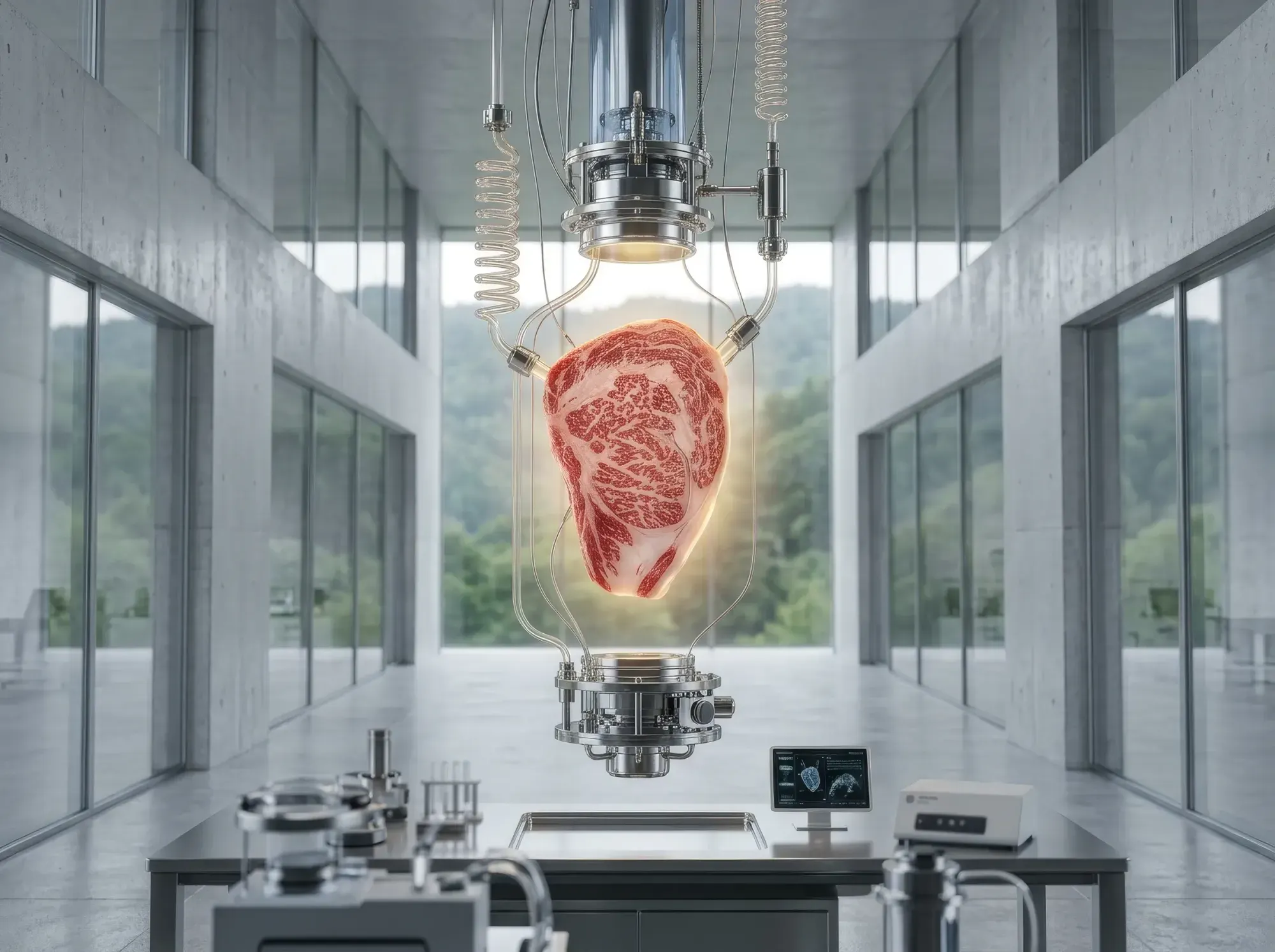
He says that there are a lot of misconceptions about cultivated meat production. Often people imagine it being made in a lab-like environment, but it is more akin to a food production facility. “This is the cleanest food production facility you can imagine,” he says, “You can go into a brewery, a winery, yogurt maker, and this is going to be cleaner than that. It is going to be a billion times cleaner than a slaughterhouse where meat is made.”
As more people discover his product through channels like a recent Mr. Beast video, Dr. Valeti says that he encounters a lot of curiosity from people.
So, how does one grow cultivated meat? The process involves taking a cell from an animal and providing it with nutrition so that it keeps doubling, just like it would in the body of an animal, Valeti explains. “And we do it in a much cleaner setting and we also do it in a much shorter period because the only job for these animal cells that we’re making for meat is to be delicious [and nutritious].”
The process takes two to four weeks, depending on the species. “After that, we just shape it into the product people are used to seeing.” Like a chicken tender, burger, or sausage—using the same equipment that’s currently being used for processing conventional meat.
Valeti believes that cultivated meat is tastier than traditional because it can be engineered to be superior in terms of its nutritional profile, offering health benefits of having lower cholesterol, lower saturated fat, better iron content, and so on. It can also be modified in terms of making more intense or milder flavor profiles, or gaminess. It’s just a matter of picking the types of cells in the feed, not unlike grass-fed or grain-fed, according to Valeti. Indeed, the technology allows the modification of things like amino acids, fat profile, as well as vitamins and minerals. The cell culture environment can also be adjusted to make the protein more or less fatty, or combined with more water or binders to lower protein contents as it is shaped.
It’s also possible to modify its protein contents, to be higher or lower, depending on personal needs. For example, an athlete or someone looking to build muscle will want more. But someone with chronic kidney disease or those who’ve had dialysis would need to decrease their intake.
There’s also legitimate skepticism about the unknown long-term effects of consuming lab-grown protein since this is a new technology.
Valeti argues that cultivated meat could also dramatically reduce risks associated with pathogens such as E. coli and Salmonella while eliminating the need for routine antibiotics. “You could have a meat production facility right next to your Starbucks,” he tells me. “You could walk around, it could be next to your community, your kids’ school, your church. It could be in the community. It doesn’t have to be segregated far away from the city or outside the state borders.”
He explains that Upside Foods’s production facility has been built with glass walls around it. It offers full transparency. The company hosts tours for middle school, high school, and undergrad students. “They’re totally blown away and they love seeing meat being made this way versus where they know it’s [currently] coming from.”
He understands the hesitation by many people. “Whenever you talk about a lab, it’s an experiment that’s being conducted, right?” And many cynics point to the lack of long-term data. But, he argues, the “biggest risk to humanity right now is the current experiment of confining billions of animals in tiny, tiny locations that set up the breeding environment for germs to spread at incredible rapidity and pace that can have uncontrollable and exponential risk of pandemics and zoonotic diseases.”
This is an experiment we conduct daily, he says. In fact, he argues, it is the largest lab-grown experiment in the world: “We add more billions of animals into the food system. And right now we have 80 to 100 billion animals.”
While we may not yet have long-term data on consumption of cultivated food, we do have a lot of data on the food that’s available in the current system. “We already know that the current supply chain causes enormous amounts of chronic diseases associated with cancers and cardiovascular issues,” he says.
Valeti no longer eats traditional meat, but he grew up eating it and loves the taste. But for the first time in history, you no longer need to raise and kill an animal to eat meat. “For the first time, we have a choice,” he says.
Meanwhile, global demand for meat has only grown, yet resources are scarce. Could this approach create an unlimited supply of meat? Valeti thinks so, but cost remains a factor. “When we started, we were a thousand times more expensive than organic meat prices,” he says. Today, it is closer to being on par.
For now, it seems to be a novelty.
Still, even if cost is brought down further, it will take some time to properly scale, establish supply chains, and then there’s also the matter of energy. These can be energy-intensive operations—energy is necessary in order to run the reactors that house the cells as they grow and power the facilities. It’s difficult to compare directly the difference between energy intake from cultivated meat and traditional chicken, or beef. Estimates put cultivated meat energy use at a range of anywhere from 25–250 MJ/kg depending on bioreactor design and production scale. Meanwhile estimates for conventional pork are at around 17–20 MJ/kg and chicken is at 15–30 MJ/kg, but that doesn’t take into account land and water use as well as methane, a significant additional environmental cost. For reference, a typical consumer HVAC system in your home uses around 20–50 kWh/day depending on how hot it is.
Another common concern I hear from those more hesitant to embrace this new technology is that it would cause certain animals to go extinct. But what kind of life is it anyway to be held in a tiny cage with restricted movement and poor conditions, only to be eventually slaughtered? The animals that have gone extinct in the last hundred years have gone extinct because of biodiversity loss, the intense amount of deforestation that has happened to feed the factory-farmed animals that live their entire lives in confinement and suffering.
Humans don’t have to give up eating meat; we can simply make the process better.
Valeti sees cultivated meat production as the cutting-edge future of farming. He notes that the current average age of a farmer in the U.S. is 60 years old, and younger people aren’t going into the traditional path. And, he says, it is a cleaner workplace with massively lower risk of occupational hazards and more transferable skills.
I bring up the visceral reactions of the people I’ve spoken to about eating lab-grown meat in preparation for our conversation. That “ick” factor I referenced earlier seems to dominate. Valeti thinks it can be overcome simply by tasting cultivated meat.
But the science and technology may be advancing faster than public trust. For all the debate over taste, ethics, sustainability, and cost, the question that keeps returning is simpler: will humans be willing to give it a try?
The choice is there.