The Liquefying “Blood” of St. Januarius

“The prejudice of credulity may, in some measure, be cured by learning to set a high value on truth.” —Isaac Watts, English theologian and author, 1674-1748.
In the year C.E. 305, an Italian chap now known to the Catholic church as Saint Januarius is said to have been martyred by decapitation. We are told that an enterprising bystander witnessing this festive event had the foresight to bottle some of the resulting blood and also to save the head of the unfortunate fellow.
Much time elapsed after the martyr passed. Then, in 1337, just about the time when relics-of-the-saints were becoming very popular among competing archbishops (the infamous Shroud of Turin popped up at that time as well), the Cathedral of Naples announced that the head of Januarius and the vial of his blood, recently re-discovered, were going on display. (Mind you, the head was not actually shown. A silver urn said to contain it was shown, as it is even to this day. It seems no one has ever troubled—or dared to look inside the urn. But then, faith is a wonderful thing.)
It was 52 years later that the archbishop of Naples disclosed another wonderful fact: under certain limited circumstances, he said, the red-brown congealed blood in its lavishly-mounted reliquary would miraculously liquefy if the congregationalist’s prayers were earnest enough. And, for the past six centuries, this popular wonder has been regularly exhibited at the cathedral to the never-failing astonishment of the public. So established is the event that a group of local women are specifically charged with leading the enthusiastic praying. In the ceremony, the reigning archbishop reverently inverts the bottle, the congregation prays fervently, the process is repeated many times, and eventually the “blood” becomes a bright red, freely flowing liquid.
What are those “limited circumstances?” Well, only the archbishop, they say, can cause the transformation; others are evidently not worthy. The miracle only occurs on special feast days. The liquefication, which never fails, can take anywhere from a few minutes to a few days to occur. Really?
The unfortunate fact is that the substance in that reliquary has often liquefied during the process of cleaning and polishing the device, while it is being handled by quite ordinary folks on any day of the year.
It is, admittedly, difficult to become emotionally involved with the process of dressing up a hamburger …
Three Italian chemists recently became curious about this wonder. Doctors Luigi Garlaschelli, Franco Ramaccini, and Sergio Della Sala looked into the remote possibility that perhaps a hoax was afoot. Unable to directly examine the substance due to its sanctified nature, the team had to content themselves with examining the very unsatisfactory evidence presented in various pamphlets on sale at the cathedral. They saw that the church had permitted selected scientists to view the relic by indirect means, resulting in an infuriatingly incomplete data set. Iron, an element present in hemoglobin, had been detected during the previous inadequate examination; the resulting conclusion jumped to was that the substance in the reliquary was indeed real blood, and any doubt that might have existed among the faithful was banished.
The team of chemists was unsatisfied with the conclusion. They reasoned that if they could replicate the observed effect, there might be some cause to doubt the validity of the miracle. Using materials that were available locally from the slopes of nearby Mount Vesuvius, and utilizing procedures that were well-known to medieval workers, the team eventually produced a liquid that in every way matched the liquid in the reliquary. It is the correct red-brown color, it coats the interior surface of the container in the same way, it gels solidly, liquefies, and becomes a translucent, bright blood red when jarred, shaken or repeatedly inverted. It re-solidifies after a few hours if undisturbed.
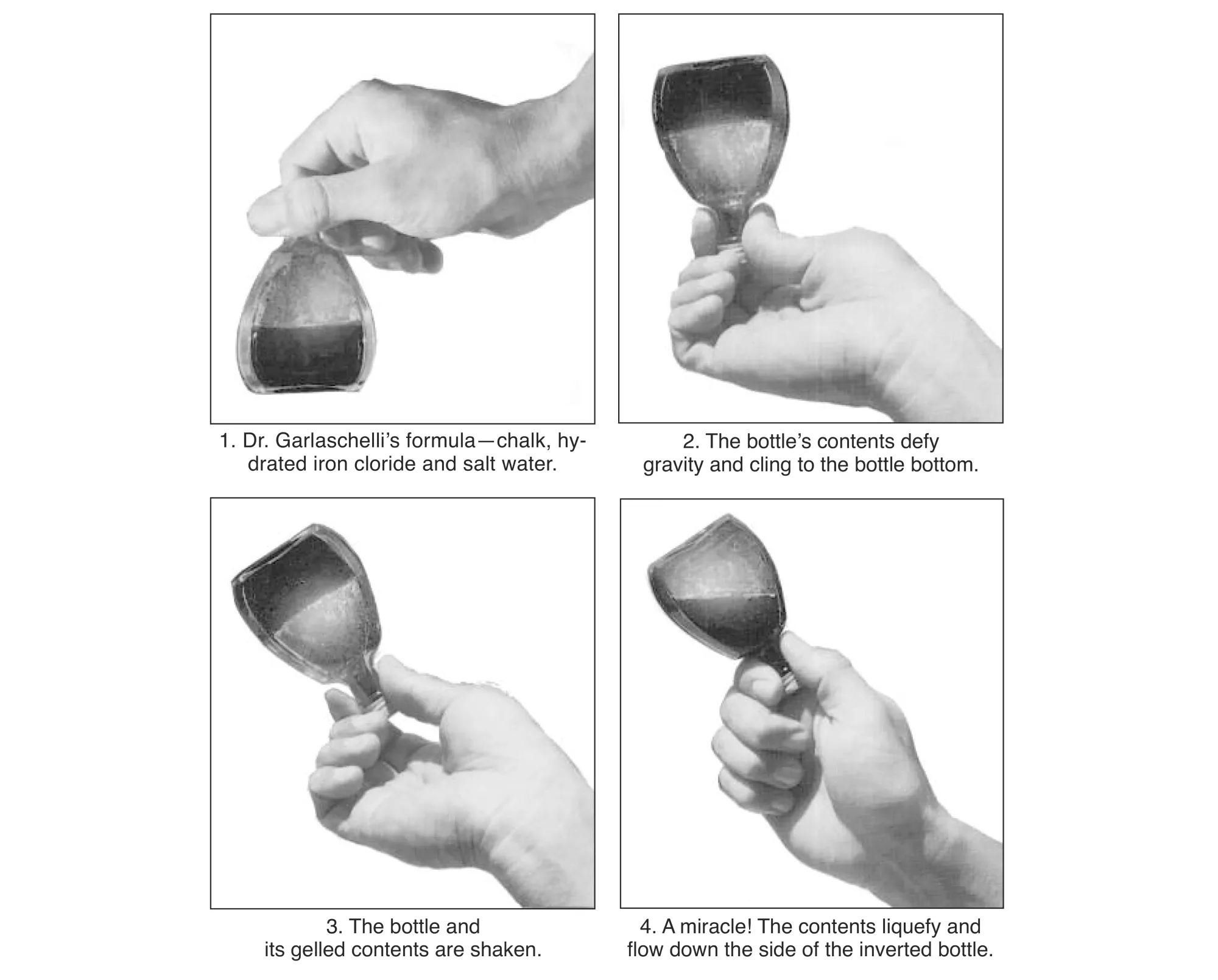
The substance is “thixotropic,” which means that it tends to become fairly firm when left alone in a bottle, then responds to shaking by becoming fluid and can then be poured from the container. Hold on. Please re-read that last sentence. Does that not sound like a familiar process? Think about it the next time you pour ketchup on your burger. Perhaps we have been experiencing a miracle quite similar to the one that is so well covered in the media when it is given this religious, foreign, and romanticized background. It is, admittedly, difficult to become emotionally involved with the process of dressing up a hamburger …
Dr. Garlaschelli, who is presently at the department of organic chemistry at the University of Pavia, has generously sent me samples of his product to examine. I now use it as part of my lecture demonstration, and I often get angry reactions from audience members who challenge me about whether the replication of a miracle by ordinary means disproves the miraculous nature of the original phenomenon. The answer is, of course, no. But all the doubt could be nicely resolved if the present archbishop of Naples would allow close examination of the “blood” of Saint Januarius. I’m not holding my breath waiting for such permission.
Remember that in 1978, when the Shroud of Turin was finally properly tested, the claims of the skeptics were firmly established to be true. Of course, the results were denied by the Shroud fans, who had suddenly discovered that carbon-dating does not apply to religious relics. Were the “blood” of Saint Januarius to be properly examined, no doubt similar new scientific discoveries would be announced.
The remarkable fact about all such matters is that the faithful persist in accepting them as miracles despite the absence of any supporting evidence, the questionable manner in which they are produced, the fact that far more parsimonious explanations are available, and/or the strong evidence that a hoax exists. One defender of the Shroud of Turin, the Reverend David Sox, for example, commented after the definitive investigation was completed that for him “‘Forgery’ and ‘authenticity’ are essentially meaningless terms.” Perhaps for you, sir; not for me.
A final observation on the Saint Januarius “miracle”: little advertised is the fact that in the Naples area there have also been, in the past, similar liquefying—blood miracles claimed for seven other saints! These have now been dropped by the church, and Saint Januarius is the only one being promoted. Umm …