Indigenous Knowledge, Public Money, and Bad Science
How a debunked Māori voyage to Antarctica, along with other indigenous folklore, became part of the New Zealand educational curriculum
New Zealand is known for its enthusiastic embrace of its indigenous cultural heritage. However, this has recently crossed into the uncritical promotion of pseudoscientific ideas. In Skeptic (April 30, 2025), I documented how the government sponsors websites that promote an array of unfounded ideas about the country’s original Māori inhabitants. Foremost is the influence of their lunar calendar.1
These sites continue to thrive in 2026 and include claims that the moon’s phases affect everything from energy levels and mental health to crop yields.2 None of this is supported by controlled studies or established principles of physics. These claims continue to flourish in part because politicians and mainstream media editors appear reluctant to challenge them for fear of being labeled as culturally insensitive or racist. The result has been a proliferation of unsupported claims presented as scientific fact.
Public funding has flowed freely for a series of questionable projects. Recently, the government spent NZ$1.2 million to study the possible effects of lunar phases on health,3 and NZ$400,000 on how the lunar calendar may influence birthing outcomes.4 These projects form part of a broader pattern of government agencies funding attempts to test or validate claims rooted in Māori knowledge that either lack plausible biological mechanisms or have yet to produce convincing empirical support. This marks a pattern where the scientific bar is quietly lowered when cultural sentiment is involved.
Playing Whale Songs to Trees
In recent years the government has funded other indigenous studies of questionable scientific value. In one project researchers set out to heal the country’s iconic kauri trees that have been ravaged by dieback disease. Their novel solution included playing audio recordings of whale songs to affected trees, along with karakias (ritual prayers) and indigenous music. The study cost NZ$521,000.5 The rationale? In Māori lore, the paraoa (or sperm whale) and the kauri tree were ancestral siblings, and whale products have traditionally been used for their healing properties.6
To justify this, researchers pointed to a study that showed that playing healthy coral reef sounds near degraded coral ecosystems attracted fish and sped up recovery.7 Applying this concept to land-dwelling plants is a false equivalence.8 The kauri tree researchers drew on the Māori notion of ihirangaranga: “ancestral energies” and sound vibrations that are believed to promote healing.9 However, land-bound kauri trees lack the physiological mechanisms to process and respond to sound waves in the same manner.
The Curious Chemistry of Whale Balm
Equally problematic was a parallel NZ$1.1 million study which used a topical balm that included pulverized whale bones and oil and a blend of secret ingredients. When the final report failed to show measurable success, researchers pivoted away from quantitative data to subjective, observational anecdotes. Reports of “bark regrowth” and “reduced trunk leakage” are common in tree-healing trials including those using inert (chemically inactive) treatments, as trees can naturally wall off an infection over time. A more scientifically robust assessment would have required setting up a control group consisting of untreated, diseased kauri trees that would be monitored under identical conditions to determine the rate of natural recovery. Their failure to list the ingredients in the balm, and in a spray that was applied to roots, meant that other researchers could not replicate the study—undercutting a foundation of modern science. Even if the treatment had proved effective, implementation on a meaningful scale was always going to be impractical as it relied on a steady stream of whale carcasses!
The result has been a proliferation of unsupported claims presented as scientific fact.
In defending the “whale potion” study, the CEO of the agency overseeing the experiment suggested that sperm whales historically used to bounce their sonar off coastal kauri trees to avoid stranding, and that whales might still communicate “through the sea floor to shoreline kauri roots.”10 This is a textbook example of motivated reasoning cloaked in scientific language.11 When viewed individually, each project could be dismissed as an isolated lapse in scientific judgment. But collectively they reveal a pattern: public funding is being increasingly directed toward testing propositions whose principal justification is cultural rather than empirical.
The Polynesian “Discovery” of Antarctica
New Zealand holds the distinction of being the first country to establish a national public holiday based on an Indigenous astronomical calendar. Matariki (“eyes of the chief or god”) celebrates the annual pre-dawn rising of the Pleiades star cluster as seen from New Zealand, which marks the start of the Māori New Year. In Western astronomy, it is known as the Pleiades. To commemorate this year’s holiday on July 10th, a government-funded documentary was released, which follows two Māori scholars on their journey to Antarctica. The documentary received NZ$400,000 in public funding.12
A promotional blurb put out by government-funded agency, Antarctica New Zealand, which hosted the pair on their trip, identifies them as “astronomers” (neither holds formal credentials in the field) and states that their genealogies “can be traced directly to Polynesian Antarctic explorers Tamarereti and Hui te Rangiora.”13 The public premiere of the film mentioned the belief that Māori ancestors once reached Antarctica.14
The appearance of this claim revived public discussion as to whether Polynesian ancestors reached the frozen continent in the 7th century, which has been the subject of public controversy in recent years. Despite detailed scholarly rebuttals that address the historical, archaeological, linguistic, and navigational evidence, the Ministry of Education continues to promote the claim as an open question.15
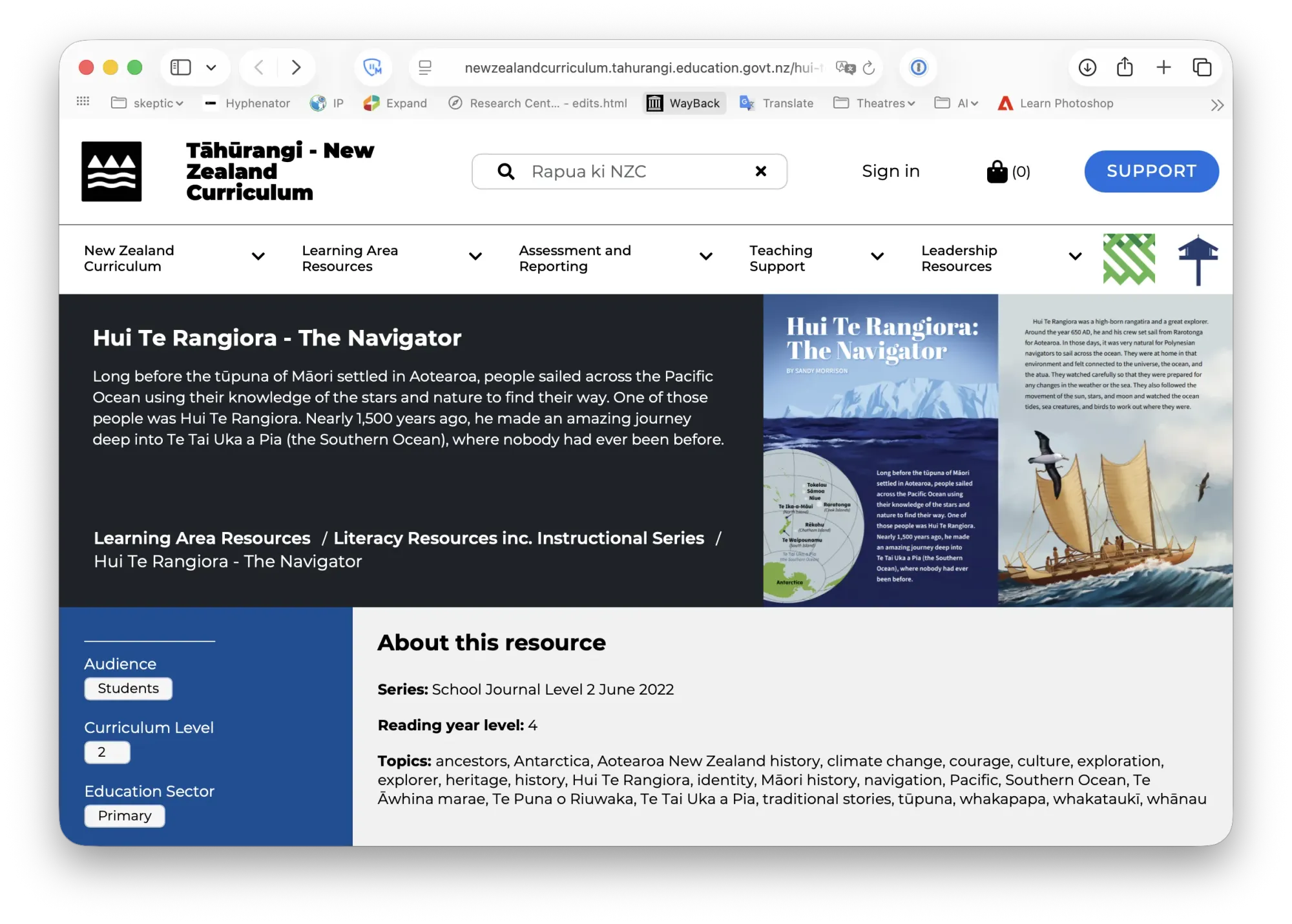
It has even published a story of the possible journey in its influential School Journal, which is used to support the curriculum.16 While principal objections have been addressed repeatedly in the scholarly literature, educational resources continue to portray the issue as though the evidence were evenly balanced.
On Thin Ice
On June 6, 2021, the Journal of the Royal Society of New Zealand published an article that made the dramatic claim that Polynesians likely visited Antarctica in the seventh century, over a thousand years before Europeans.17 It caused a global sensation and was quickly picked up by news outlets around the world, from The Guardian to The New York Times.18 The New Zealand Herald proclaimed: “Polynesians First to Discover Antarctica Not News to Māori,”19 while the headline in The Press of Christchurch read: “Antarctica: The Maori Connection.”20
In reporting on the story, a writer for Smithsonian magazine noted that the research drew “on oral histories and other traditional records often ignored by Western scholars.” It quotes lead author Priscilla Wehi, who said: “When you put it together, it’s really clear, there’s a very long history of connection to Antarctica.”21 She told Radio New Zealand that an exciting part of the research was that “it shows how oral tradition can really be considered as a reliable source of evidence.”22 The difficulty is that her claims were based on oral narratives that scholars, including Māori researchers, have warned should not be interpreted literally as historical voyage records.
The claims of Antarctic exploration draw on Rarotongan oral traditions, which hold cultural value but need to be interpreted carefully when used as historical evidence. Rarotonga is the largest and most populated island in the Cook Island chain in the South Pacific. The story was translated by ethnographer Stephenson Smith (1840–1922). In 1954, the manuscript was rebuked by revered Māori anthropologist Sir Peter Buck, who characterized Smith’s approach as naïve, and noted that the manuscript was so laden with colonial influences that its meaning had been distorted and could not be taken as a literal historical record.23
When viewed individually, each project could be dismissed as an isolated lapse in scientific judgment.
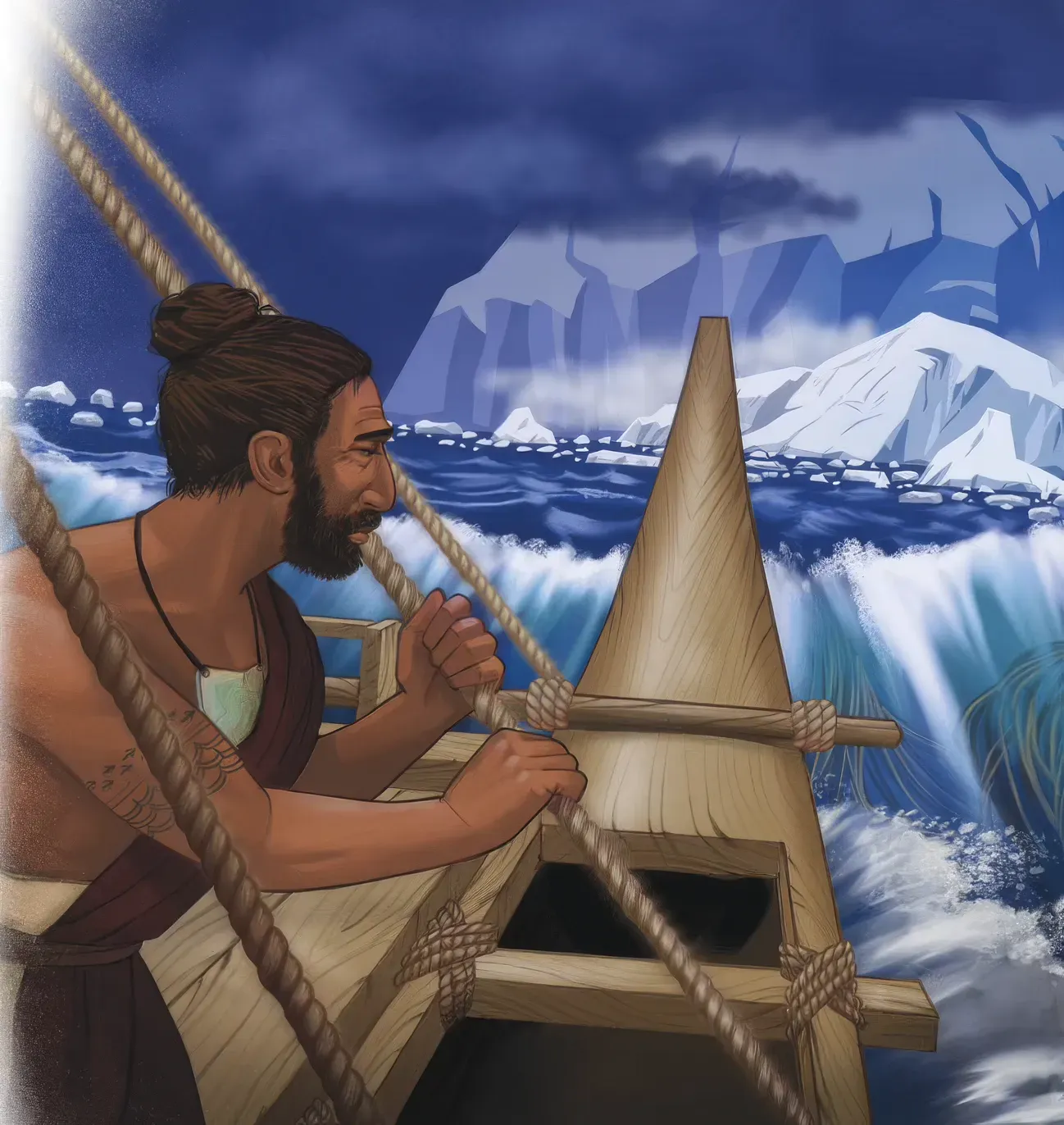
According to the story, the Polynesian voyager Hui Te Rangiora and his crew ventured into Antarctic waters during the seventh century and “were likely the first humans to set eyes on Antarctic waters and perhaps the continent.”24 Here is the passage in question:
… the rocks that grow out of the sea, in the space beyond Rapa; the monstrous seas; the female that dwells in those mountainous waves, whose tresses wave about in the water and on the surface of the sea; and the frozen sea of pia, with the deceitful animal of the sea who dives to great depths—a foggy, misty, and dark place not seen by the sun. Other things are like rocks, whose summits pierce the skies, they are completely bare and without vegetation on them.25
The key words from the text are “tai-uka-a-pia” with “tai-uka” meaning frozen sea and “pia”—a reference to the white flesh of the arrowroot. The literal translation then is “frozen sea of white.” Wehi and her team interpreted this as a reference to Antarctic ice.
An Old Claim Suddenly Grows Wings
Three months after Wehi’s publication, a team of researchers, including Māori scholars, challenged the claims of Antarctic contact in a rebuttal published in the same Royal Society journal. Led by distinguished archaeologist Atholl Anderson, they noted Buck’s longstanding rejection of this translation.26 They pointed out that frothy white caps are a common sight in the ocean south of New Zealand, but well north of Antarctica, and metaphorical descriptions of the white-capped ocean are common in Polynesian voyaging traditions and clearly do not refer to ice or snow.27
Anderson and his team give several reasons why such a voyage or voyages—5,000 km (3,100 miles) one-way just to reach the Antarctic Circle from Rarotonga—were beyond the Polynesian capabilities. The southernmost archaeological evidence of prehistoric Polynesian landfall is Enderby Island. At 51 degrees south latitude, it is 2,000 km (1,240 miles) from Antarctica. Any voyagers travelling below this boundary would have faced insurmountable challenges, including high winds, large waves, and freezing temperatures. The circumpolar westerly winds (the “Roaring Forties” and “Furious Fifties”) would have wreaked havoc as their sails were woven from pandanus leaves and “notoriously fragile.” They write that voyaging through the circumpolar westerlies would have been perilous and placed them at great risk a of a “breaking up, swamping or overturning.”28 There was also a lack of wood and plant fibre for the necessary boat repairs.29
Prior to the 1820s, Māori sailing vessels “had no windward capacity” and were “vulnerable to catastrophic failure in strong winds.”30 A 2025 study led by Dr. Thomas Leppard of the International Archaeological Research Institute reached the same conclusion, noting that any such trips would have been “foolhardy” and “suicidal.”31 The physical constraints alone make the claim untenable.
Treating the Legend Literally
Wehi and her team also engage in selective omission to give the myth more credence than it deserves. They left out fantastical elements of the story in their report, for according to the narrative, “the whole of the canoe [used by Hui Te Rangiora] was built of men’s bones.” This information was later downplayed by Smith and is absent from most subsequent retellings. Referring to a canoe made of bones suggests a mythic or legendary origin story rather than a historical voyage.32
Māori scholar Tipene O’Regan has expressed concern over the need to conduct serious research into indigenous history in New Zealand, which sometimes involves fantasy and mysticism, being funded by the government. He notes that the “Māori ancestors discovered Antarctica” saga involved “those who, without any real historical analysis or content, have managed to give new birth to the idea that Māori discovered Antarctica.”33
When Evidence and Politics Collide
Following the sensational headlines about Māori ancestors discovering the frozen continent, the rebuttal that appeared three months later received only a fraction of the media attention. Even today, the original article has received over 21,000 views online, while the rebuttal has had less than 7 percent of the viewership (1,364).34 Three of the rebuttal authors would later write that their attempt to challenge the claims of Wehi was initially met with resistance by the Royal Society itself, which struck them as being inconsistent with “the principle of open debate, and the society’s stated aim of advancing and promoting the pursuit of knowledge.” They wrote that “only our dogged determination … led to the eventual publication.”35
This marks a pattern where the scientific bar is quietly lowered when cultural sentiment is involved.
The original article by Wehi was essentially a rehashing of an old story and not a newly uncovered revelation, yet just two months after the rebuttal, the Royal Society rewarded Wehi and Otago University with a $660,000 grant to examine Antarctic narratives in relation to Māori knowledge titled: “Kaitiakitanga [Guardianship] and Antarctic narratives.”36 In response, Anderson and his colleagues asked: “What can we conclude from this? Above all else, that … the state continues to invest significant amounts of taxpayer money into Māori-themed scholarship of questionable quality.”37 This remains true today.
Claims of pre-European Antarctic discovery by Polynesians has also appeared in the journal Nature Ecology and Evolution, which included a timeline of the supposed Polynesian discovery of the frozen continent. “Circa 650 AD Hui Te Rangiora voyages south from Rarotonga in the waka Te Ivi o Ateaand encounters a vast ice landscape, naming it Te tai-ukaa-pia.”38 This led American biologist Jerry Coyne to ask: “Doesn’t this journal do fact-checking, or do they accept all dubious claims from a group if it’s ‘minoritized’? They at least should say ‘claimed timeline.’”39
Coyne’s criticism illustrates a broader concern: whether claims associated with indigenous knowledge are sometimes subjected to less critical scrutiny than comparable historical or scientific claims. His question captures the core issue: the danger of identity politics overriding basic evidential standards in peer review. It is a phenomenon skeptics know well: the suspension critical scrutiny in the face of cultural deference.
The debate over the Polynesian discovery of Antarctica raises a broader question: should cultural traditions be allowed to influence the standards by which historical and scientific claims are evaluated? When this occurs, it risks weakening public trust in both science, and the institutions charged with defending it. It is essential that evidence should be assessed using unwavering standards regardless of the cultural, political, or ideological origin.