The New Normal for Antisemitism
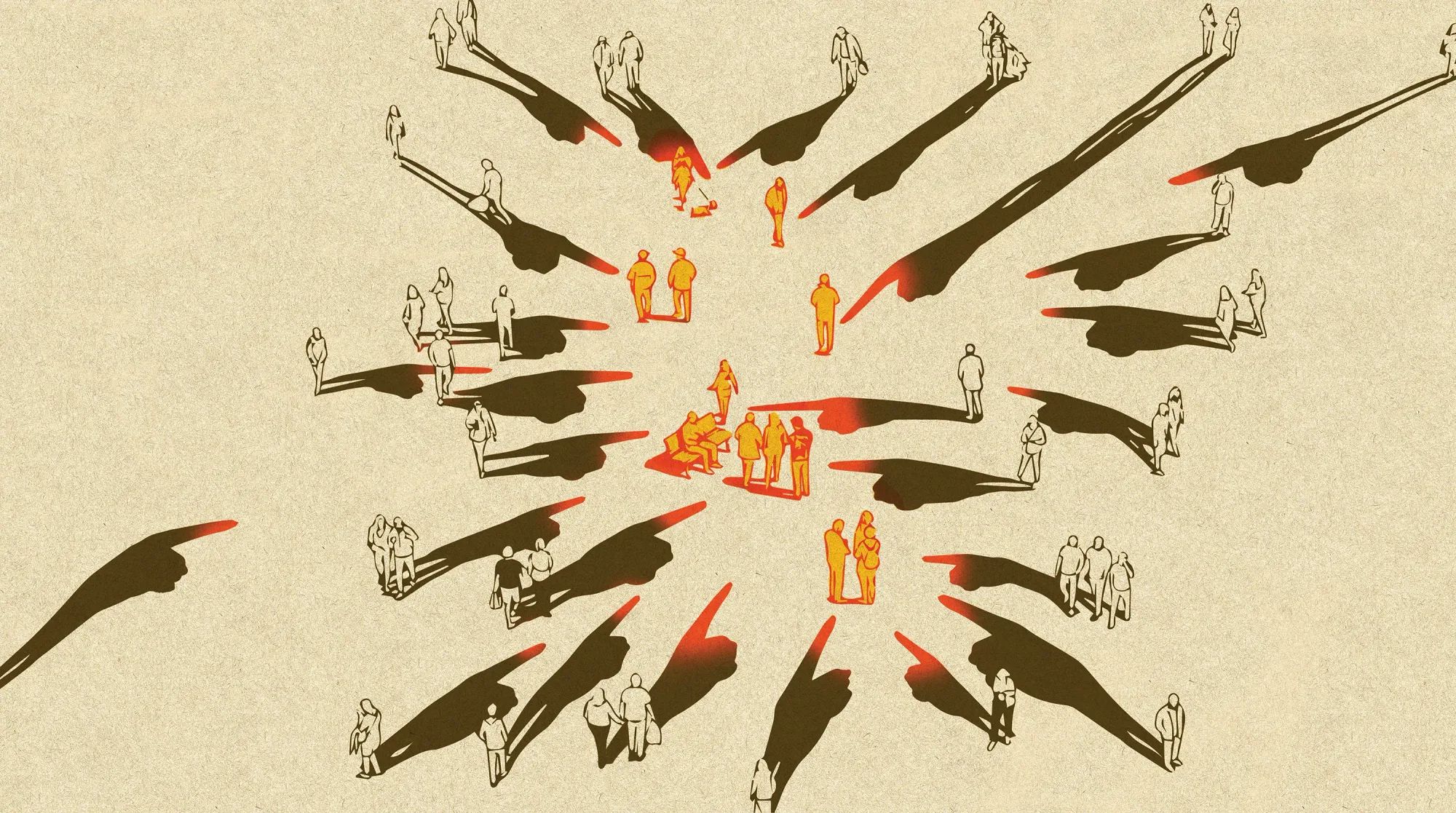
A year before October 7, 2023, reshaped the political landscape, we founded a nonprofit organization called Antisemitism Watch. The decision followed decades of reporting on the Holocaust and its aftermath, and years of chronicling daily antisemitic incidents. What became unmistakable over time was not simply persistence, but normalization—antisemitism embedding itself across wide swaths of society with diminishing resistance.
In a Newsweek op-ed in which we announced the launch, we wrote that “few contest that antisemitism—history’s oldest hatred of a religious and ethnic group—has had an unmatched post-Holocaust resurgence.”1 The data confirmed record numbers of anti-Jewish attacks across the United States, Canada, and Europe, while social media accelerated newer conspiracies blaming Jews for everything from the slave trade to COVID-19.2, 3
Even then, our concern was not only the scale of antisemitism, but the way it was being confronted. The most prominent institutions tasked with addressing it were doing so selectively, not consistently. The Anti-Defamation League had diluted its core mission by repositioning itself as a more generic anti-hate organization and, in practice, mostly focused on right-wing antisemitism while giving a free pass to anti-Jewish hostility from the political left.
In the months following the October 7 attack, antisemitism shed its inhibitions.
What distinguishes this moment is the collapse of stigma. Expressions that would have ended careers a decade ago now generate applause, clicks, and campaign donations. Language that would trigger immediate condemnation if directed at other minorities is routinely excused, contextualized, or ignored when directed at Jews. Hostility that once hid at the margins has migrated inward—into campuses, political platforms, cultural institutions, and digital ecosystems. The result is an old hatred on steroids—newly unmoored from consequence.
This normalization is not diffuse, but has taken shape through two distinct but mutually reinforcing channels. The progressive left frames Israel as fundamentally illegitimate, a country of inherent injustice. That creates an atmosphere in which hostility toward Israel is cast as an ethical obligation. And for many on the left—and their Muslim activist allies—the distinction between Jews and Israelis frequently collapses.
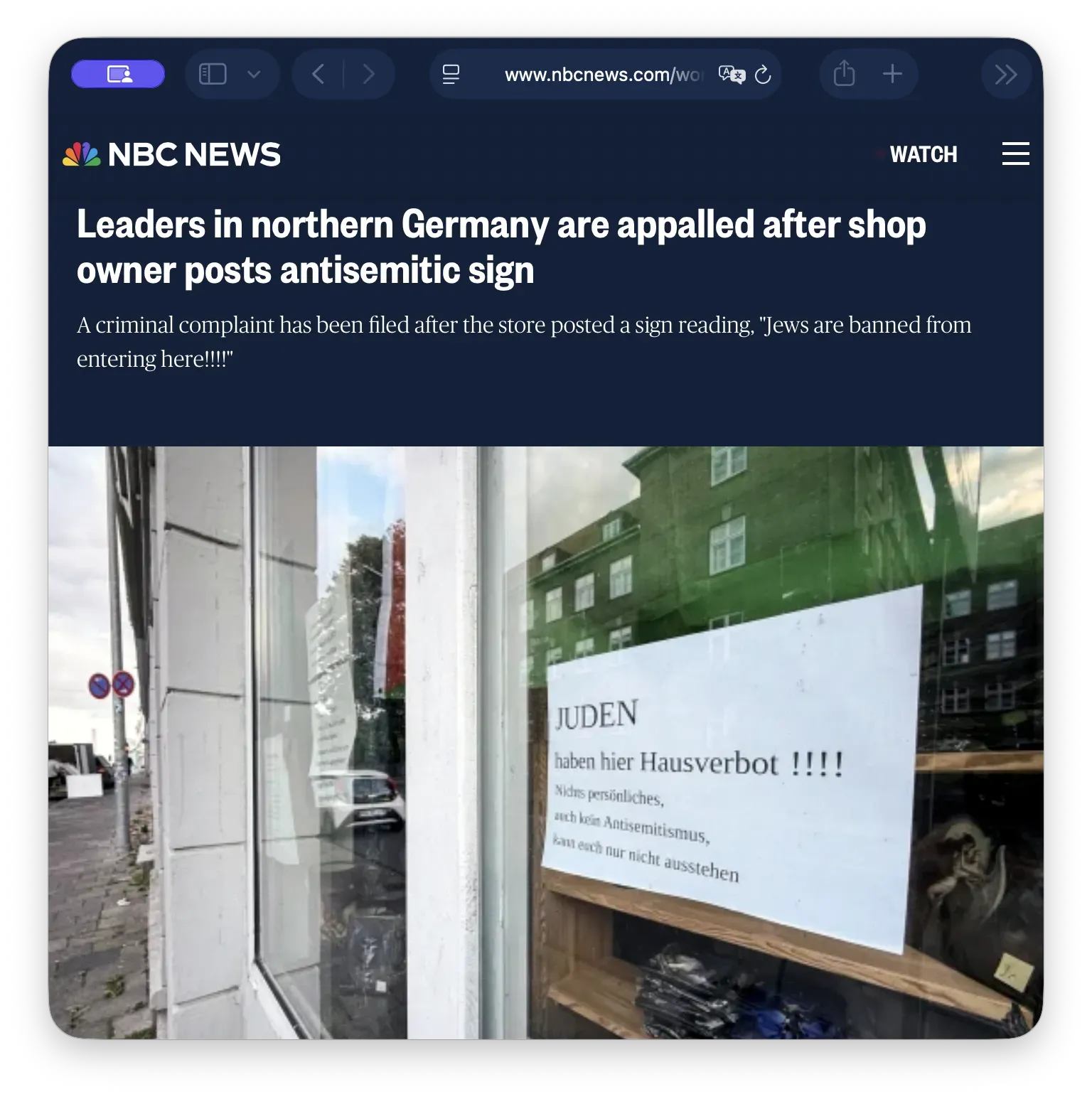
On parts of the populist right, antisemitism has reemerged through the architecture of conspiracy theory. Jews are cast not as oppressors, but as puppet masters—orchestrators of migration, finance, media narratives, and foreign entanglements. The vocabulary differs from that on the left, but the structural function is identical: Jews are assigned exceptional and malign agency.
Political Normalization on the Left: From Policy Critique to Moral Indictment
Criticism of Israeli government policy is legitimate. What has shifted in recent years—and accelerated sharply after October 7—is not the criticism, but its recasting into a moral indictment of all Jews, whether they have anything to do with the country or government of Israel or not.
Beginning in the mid-2010s, segments of the progressive movement increasingly described Israel as a uniquely flawed state: a settler-colonial project, an apartheid regime, and a profoundly racist enterprise.4, 5 Universities helped entrench this view, often through curricula and campus programming that treated those claims not as arguments but as axioms.6, 7 Qatar, for example, the same country that has been a financial lifeline to Hamas, has given $6.6 billion to American educational institutions.8, 9
More foreign money boosted the Boycott, Divestment, and Sanctions (BDS) anti-Israel movement, once largely confined to activist circles, into footholds in student governments, academic associations, and local political campaigns.10, 11, 12, 13 Local chapters of major U.S. unions, including units within the United Auto Workers, adopted resolutions describing Israel’s actions as “genocide” and calling for arms embargoes and boycott campaigns.14
The antisemitism of the left and the right converge within the broader framework of modern populism.
At several American universities, diversity, equity, and inclusion offices came under criticism for omitting antisemitism or Jewish identity from their anti-discrimination frameworks. At Stanford, a DEI official told Jewish students that their identity was tied to “whiteness” and “colonialism,”15, 16, 17 while at UCLA, campus officials told Jewish students that “Zionism” placed them outside the scope of DEI protections, even when they were targeted as Jews.18, 19, 20
These developments began to erode an important distinction: in many campus protests after October 7, chants and signage moved quickly from condemning Israeli military actions into rhetoric that not only censured Israeli policies but questioned Israel’s right to exist.21, 22, 23 As harassment, intimidation and social exclusion of Jewish college students surged, they began hiding visible signs of their identity.24, 25, 26 Jewish students report pressure not only to criticize Israeli policy, but to disavow Zionism entirely as a condition of social inclusion.27, 28, 29
Language played a central role. The term “Zionist”—historically denoting support for Jewish national self-determination—increasingly appeared as a pejorative rather than a description. Our colleague David Christopher Kaufman has written about the rapid mainstreaming of the slur “Zio,” a diminutive form of “Zionist” historically popularized by white supremacist David Duke and long embedded in extremist discourse.30 The term has migrated from fringe spaces into activist debates, entertainment culture, and political rhetoric.31 Graffiti reading “Kill your local Zio Nazi” has appeared on American campuses, while demonstrators in London chant, “Gaza, Gaza, make us proud, put the Zio in the ground.”32, 33, 34
When Zionism is defined as racism or genocide, those who identify as Zionists are implicitly placed beyond the moral community. Zionism is no longer treated as a political ideology open to debate, but rather as a moral stain. Empirical data confirm the broader climate.
A March 2026 survey of 1,000 students across 170 British universities found that one in five said they would be reluctant to have a Jewish roommate.35 Nearly half reported witnessing slogans justifying the October 7 attacks, while among those frequently exposed to campus protests the figure rose to 77 percent. One in ten said Holocaust denial or minimization was not antisemitic, and more than a quarter believed that calls to remove “Zionists” from campus were not discriminatory.
In these findings Israel is not described as acting disproportionately, imprudently, or even unlawfully; it is described as inherently genocidal. Holocaust inversion—labeling Israelis as Nazis or Gaza as Auschwitz—has appeared with increasing frequency at demonstrations and across digital platforms.36, 37, 38, 39, 40, 41, 42 By depicting Jews as the new Nazis, such rhetoric reverses historical roles in ways that are psychologically potent and politically combustible, allowing hostility to be reframed as anti-fascist virtue.
The same pattern has surfaced in cultural spaces. At the 2024 Berlin International Film Festival and related events, filmmakers and actors issued open letters accusing Israel of “genocide” and denouncing institutions that declined to take a maximalist anti-Israel stance as complicit in “anti-Palestinian racism.”43, 44 That same year at the Eurovision Song Contest in Malmö, Sweden, Israel’s representative, Eden Golan, performed under extraordinary security amid sustained protests and explicit death threats.45, 46 To protect her, Swedish authorities asked her to remain in her hotel room except for rehearsals and performances.
Political incentives reinforce these dynamics. In several Western democracies, including the United States and the United Kingdom, some elected officials face organized blocs for whom anti-Israel activism is a defining issue. In the United Kingdom’s last general election, for instance, five independent candidates were elected to Parliament on only a pro-Gaza and anti-Israel platform.47, 48 In the U.S., public condemnation of antisemitic excesses within those political movements risks primary challenges, social media backlash, and accusations of complicity in alleged war crimes. Silence, by contrast, carries fewer immediate costs. That silence, of course, allows the most strident voices to have outsized influence.
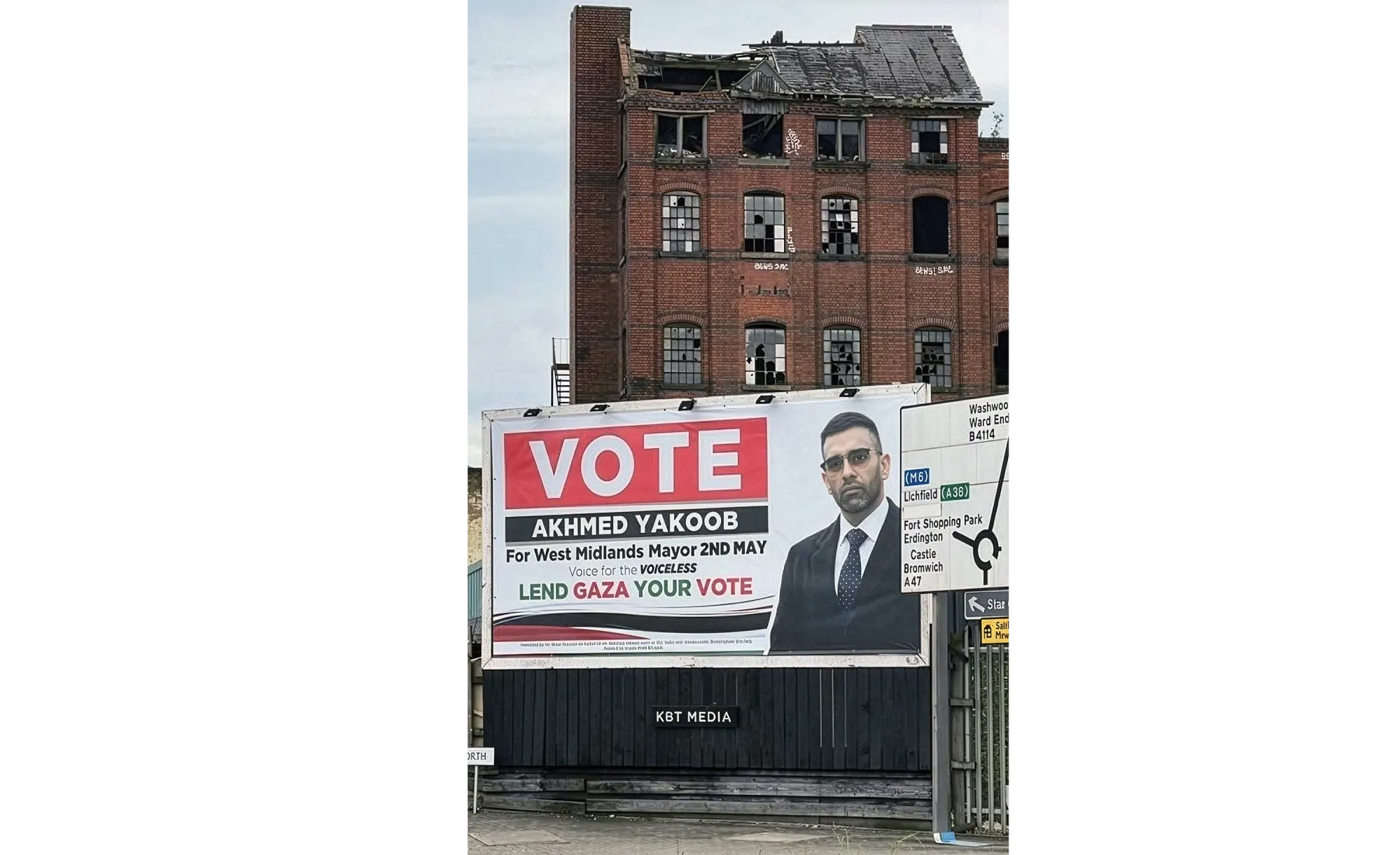
This asymmetry matters. Political leaders routinely condemn antisemitism when it emerges from the opposing party. Far fewer are willing to confront it when it surfaces within their own coalition. The reluctance to draw internal boundaries contributes to the perception that such rhetoric is acceptable, even righteous.
Political Normalization on the Right: The Return of Conspiratorial Antisemitism
If the progressive left has contributed to normalization through moral absolutism, the populist right has done so through conspiratorial absolutism.
Antisemitism on the right rarely presents itself as hatred, but rather as revelation. But its structure is familiar. Jews are not condemned as colonial oppressors but cast instead as hidden orchestrators—disproportionately powerful actors.49, 50 These tropes are recycled from earlier eras: insinuations of Jewish control over media and finance,51 suggestions of dual loyalty,52 and recycled speculation linking Jews to shadow networks of global power.53, 54, 55 These themes, once confined to fringe pamphleteers, now circulate widely through podcasts, livestreams, and social media feeds to audiences in the millions.56, 57
The accusation that Jews are omnipotent has long been one of antisemitism’s most durable adaptations. What distinguishes the present moment is scale—and monetization. Digital media ecosystems allow conspiratorial claims to travel instantly, stripped of context and insulated from institutional gatekeeping. Influencers with audiences in the millions can launder antisemitic tropes through the language of anti-elitism or investigative skepticism.
Antisemitic conspiracies are algorithm-optimized, fusing centuries-old libels with modern virality. Figures such as Tucker Carlson and Candace Owens have built massive audiences by not merely courting controversy—they have aired claims rooted in longstanding antisemitic conspiracy frameworks. Carlson has suggested, for instance, using genetic testing to determine Jewish legitimacy in Israel, “to find out who Abraham’s descendants are.”58 He has questioned whether Israel’s Prime Minister Benjamin Netanyahu has any connection to the land because his family is “from Poland.”59 The premise echoes the discredited Khazar theory, which casts Ashkenazi Jews as impostors.60
The danger is the quiet, cumulative expansion of what society is willing to excuse.
Carlson has also provided an uncritical platform to extremist figures, including Nick Fuentes,61 who has publicly denied aspects of the Holocaust, praised authoritarian regimes, and repeatedly argued that Jews wield disproportionate and harmful influence. Carlson did not substantively interrogate or rebut anything said.62 The significance lies less in any single statement than in the format: a two-hour content that allowed historically fringe antisemitic narratives to be presented to a mass audience without correction or context.
Candace Owens, meanwhile, has made the Khazar claim explicit, writing to Sen. Ted Cruz on February 21, 2026, that “The people currently occupying Israel are Khazarian Turks,”63 while also promoting narratives of “Jewish supremacy,”64 depicting Jews as a “cult,”65 and claimed on the February 2, 2026, episode of her podcast that modern Jews are not actually Jews but “pagan gypsies wearing the cloak of Judaism.”66 In extended broadcasts, she has also revived claims that Jews dominated the slave trade and promoted classical antisemitic texts rooted in blood libel, and alleged that a secret Jewish cult, Sabbatean Frankists, practices pedophilia and conspires to control non-Jews.67, 68, 69
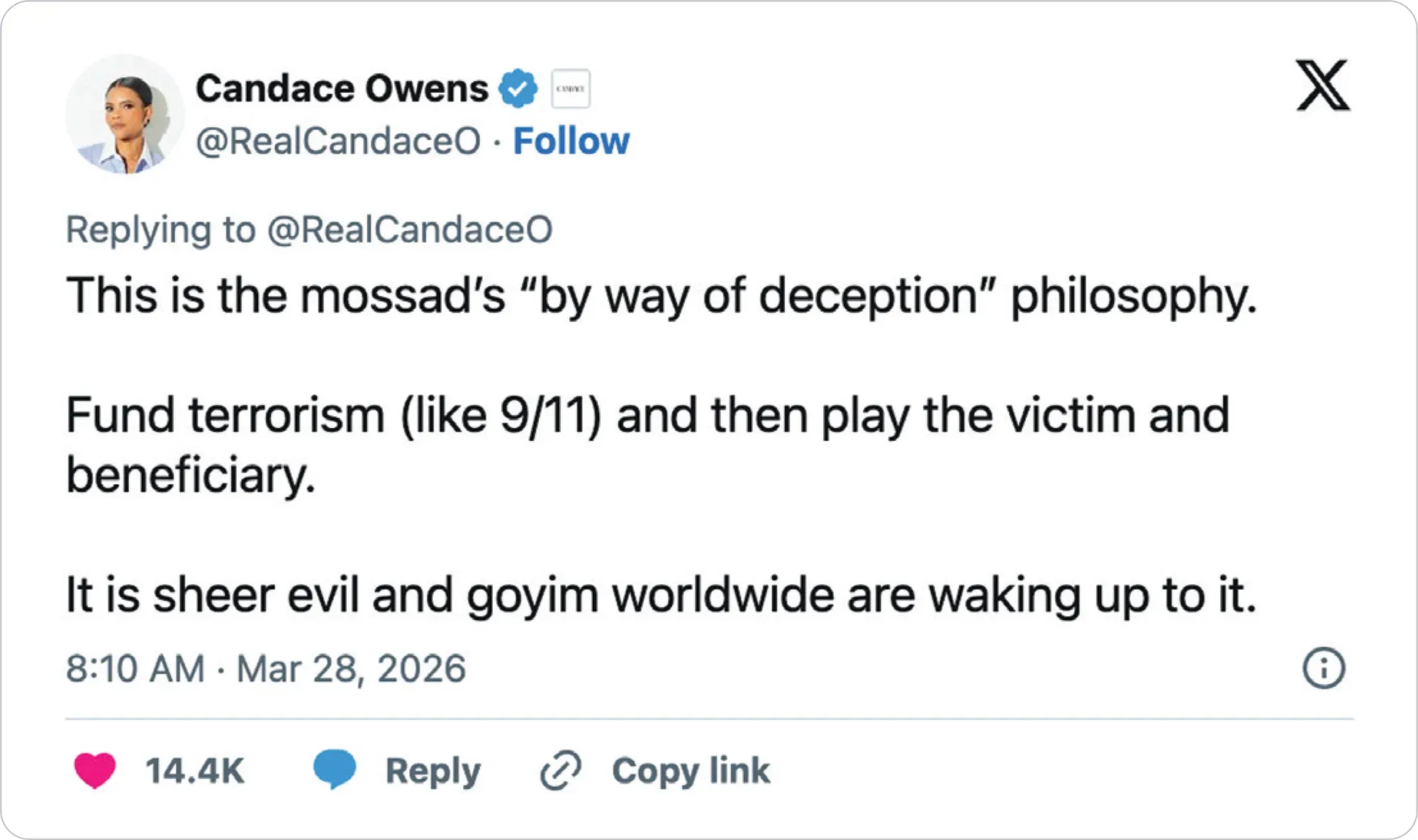
Monetization data reveal advertising rates of tens of thousands of dollars per episode and annual revenues reaching into the millions.70 Antisemitism has become lucrative content.
Figures such as Owens, Carlson, Dave Smith, and others use social media not just to monetize their posts, but to clip, amplify, and circulate appearances, arguments, and narratives across a much larger ecosystem. Content that may begin in a podcast, livestream, or interview is rapidly fragmented into short, emotionally charged segments optimized for sharing. The result is a feedback loop in which inflammatory claims travel farther than careful rebuttals, and antisemitic insinuation is normalized through familiarity, repetition, and algorithmic lift. In that environment, the distance between coded rhetoric and explicit anti-Jewish abuse has grown perilously short.
We saw that process directly in the responses to two of our recent posts on 𝕏,71, 72 one about a Miami Beach incident that led to an assault and hate crime arrest, and another about the persistent claim that Israel was behind the assassination of John F. Kennedy. In both cases, the replies quickly filled with material that was not merely critical of Israel or political in nature, but floridly antisemitic: recycled conspiracy tropes, insinuations about Jewish power, and language that would once have been confined to the extremist fringe. Social media, by design, rewards provocation, virality, and repetition, allowing anti-Jewish hatred to appear in waves and then recede, only to surge again around the next triggering event.
𝕏 is not alone as a visible accelerant of contemporary antisemitism. Other platforms have played a comparable role, especially since October 7. TikTok in particular helped drive a dramatic expansion of anti-Jewish hostility by turning complex events into emotionally saturated, highly shareable fragments that rewarded outrage over context. Younger audiences encountered not only intense anti-Israel content but also conspiracy narratives, moral inversion, and language that blurred any distinction between Israelis, Zionists, and Jews.
What is unfolding is not simply another cycle of prejudice but rather the normalization of it. It is a structural shift.
Taken together, these platforms have created an information environment in which antisemitism is not merely tolerated but made to feel ambient. What appears in any single comment thread is therefore not an isolated spasm of hatred, but part of a broader digital culture in which antisemitism has become newly confident, newly networked, and far more public. This mode of thinking repackages antisemitism as inquiry and presents hatred as courage.
The Convergence: How Opposite Narratives Produce the Same Result
The antisemitism of the left and the right converge within the broader framework of modern populism. In periods of institutional distrust and geopolitical uncertainty, populist movements seek simplified explanations for complex realities, often attributing responsibility to elites or symbolic adversaries.73, 74 Jews, historically visible yet diasporic, have long served as convenient stand-ins within such narratives.
The left assigns Jews excessive guilt while the right assigns them excessive power. Both frameworks transform Jews from individuals into symbols and reduce political disagreement to an artificial moral certainty. Jews cease to be a minority community with internal diversity and become symbolic actors—avatars of oppression or manipulation. That transformation flattens nuance, rewards ideological purity, and erodes the distinctions between critique and condemnation, skepticism and conspiracy. In doing so, it creates fertile ground for reemergence of antisemitism across ideological lines.
Digital algorithms reward outrage and insinuation. Normalization requires only the erosion of consequences. When one in five university students in a liberal democracy reports reluctance to share housing with a Jew, prejudice has moved beyond rhetoric into social calculus.
A corrosive development within this broader normalization has been the resurgence of Holocaust minimization and the emergence of October 7 denial narratives. On parts of the left, documented October 7 atrocities are questioned, minimized, or reframed as morally explicable resistance.75, 76, 77 When the mass murder of Jews becomes negotiable fact—contextualized beyond recognition or rhetorically inverted—antisemitism is normalized not through open hatred but through a gross and dangerous distortion.
Antisemitism has always adapted to prevailing ideologies. While today’s rhetoric differs on the left and right, it is Jews who are again cast as the hinge upon which broader grievances turn: too powerful to be trusted, too illegitimate to be equal.
Internal Validation and External Weaponization
A particularly uncomfortable dimension of this moment is the role sometimes played by Jews themselves—as participants in an environment that helps destigmatize antisemitism. In cultural, academic, and political spaces, some Jewish figures have concluded—implicitly or explicitly—that open identification with Israel, or even with mainstream Jewish communal positions, carries professional and social risk.78, 79
Initial expressions of solidarity after October 7 were, in many cases, followed by quiet retreat—statements deleted, positions softened, or replaced by language that avoided any association with Israel altogether.80, 81 In parts of the entertainment industry, publishing, and academia, the boundaries have become clear: certain forms of speech carry consequences, while others confer acceptance. The incentives are not abstract. They shape behavior.
In political life, the same pressures operate differently but with similar effect. Anti-Israel movements increasingly elevate progressive Jewish voices that validate their claims.82, 83 The argument is straightforward: if Jews themselves describe Israel as genocidal, or Zionism as inherently racist, then such claims cannot be antisemitic. The phrase “as a Jew” becomes a form of credentialing—used to shield arguments from scrutiny and to confer legitimacy.
That reasoning is logically flawed yet rhetorically powerful. It is a form of rhetorical laundering in which claims that would otherwise be recognized as antisemitic are reframed as internal critique, even courageous dissent.
Organizations such as Jewish Voice for Peace have played a central role in this dynamic. Their activism—highly visible in post-October 7 protests, including organized demonstrations at the U.S. Capitol and on university campuses—has framed Israel in the language of genocide and colonialism, while advocating for boycotts and the dismantling of existing political frameworks.84, 85 In some instances, that rhetoric has extended into Holocaust-adjacent spaces, including efforts to insert contemporary political claims into memorial contexts at concentration camps like Buchenwald,86, 87 in ways that many Jewish institutions and historians have strongly rejected.88
This dynamic operates alongside a second, parallel force: organized Muslim activist movements that have fused opposition to Israel with rhetoric and practices that increasingly blur, and at times erase, the distinction between Israelis and Jews more broadly.
In the months following October 7, protests across Western cities have frequently featured slogans such as “rape is resistance” or “globalize the intifada” that framed violence as justified resistance. Visual symbols, including the widespread adoption of keffiyehs as a form of political uniform, signal not only solidarity with Palestinians, but alignment with the rejection of Israel’s legitimacy. The widely used chant “from the river to the sea” is a call for Israel’s elimination, since a Palestinian state stretching from the Jordan River to the Mediterranean Sea would leave no room for a Jewish state.
Institutional actors have played a role in amplifying this environment. Advocacy organizations such as the Council on American–Islamic Relations (CAIR) have issued statements and hosted speakers whose rhetoric has fomented antisemitism and contextualized violence in ways that blur moral boundaries.89, 90 In parallel, documented incidents in countries including the United Kingdom and Australia have raised concerns about Jewish patients feeling unsafe in medical settings after Muslim healthcare workers expressed hostility over the Israel–Hamas conflict.91, 92
For example, two nurses at Bankstown Hospital in Sydney—Ahmad Rashad Nadir (male nurse) and Sarah Abu Lebdeh (female nurse)—recorded a viral social media video while in hospital scrubs, in which they made explicit antisemitic threats, including statements like “I won’t treat them, I will kill them,” “You have no idea how many Israeli dog[s] came to this hospital, and I sent them to Jahannam” (Jahannam means “hell” in Arabic), and a throat-slitting gesture and other dehumanizing comments.93 Separately, Dr. Omar Azzam, a nephrologist at Royal Perth Hospital, was suspended by AHPRA and referred to a professional standards tribunal for alleged professional misconduct involving harassing medical colleagues with antisemitic abuse (including “ZioNazi” slurs).
Antisemitism has become ideologically portable, socially permissible, and, in many quarters, professionally and financially rewarding.
These developments do not define entire communities. But they illustrate how, within certain activist ecosystems, the distinction between opposition to Israeli policy and animus toward Jews has become increasingly unstable.
The interaction between these forces—internal validation and external amplification—is what gives the current moment its intensity. When activist rhetoric expands the scope of acceptable hostility, and selected Jewish voices are used to legitimize it, the result is a feedback loop. Claims that would once have been rejected outright are normalized through repetition, credentialing, and the absence of consistent challenge.
Institutional Courage and Consistency
If antisemitism is now being normalized not only through ideology and institutions, but also through validation—external and internal alike—then the responsibility of institutions is no longer ambiguous. It is unavoidable.
Moments like this inevitably invite historical comparison. The rhetoric and the polarization are familiar. But history does not repeat itself on command. The 1930s were not just an era of words, but of institutional collapse and state-sponsored persecution. The warning today is different, but it is unmistakable: the stigma that once made antisemitism politically radioactive has been stripped away.
What has taken its place is something more insidious. Antisemitism has become ideologically portable, socially permissible, and, in many quarters, professionally and financially rewarding. When hostility toward Jews can be repackaged to fit almost any political narrative and still command applause, a line has been crossed. The danger is the quiet, cumulative expansion of what society is willing to excuse.
This is not a problem that can be solved with selective outrage or partisan finger-pointing. It is a failure of institutional will. Organizations that claim to fight antisemitism have too often treated it as a conditional priority—forcefully condemning it in adversaries while rationalizing, minimizing, or ignoring it among allies. The result is not balance but complicity: warnings dismissed, evidence reframed, action delayed until it is no longer necessary. Institutions do not lack information. They lack willingness to incur the cost of acting on it.
Antisemitism has always adapted to the dominant language of its time. What distinguishes this moment is not its evolution, but the degree to which that evolution is being tolerated—even legitimized—by those responsible for opposing it.
This is the test. And institutions, political parties, and civic leaders are failing it.
The consequences for such failure are no longer theoretical. What is unfolding is not simply another cycle of prejudice but rather the normalization of it. It is a structural shift. In the United States, Jews increasingly find themselves required to justify their identity and affiliations in public space,94, 95 while in Europe, Jews are reconsidering whether they can safely remain.96, 97
If this moment demands anything, it is not another task force or hashtag, but an unflinching commitment to a single standard of moral clarity. The oldest hatred has learned our newest languages; our institutions must relearn the courage to name it, wherever it speaks.