The Oregon No-Vortex

The famous “Oregon Vortex” is up for sale for $3.5 million. I’ve had a number of calls from the media asking how the mysterious gravitational and magnetic forces exhibited there can be explained. That’s a little like asking me to explain how witches fly on brooms—over the telephone.
Looking at the ridiculous promotional material offered by the site owners, you can see just how an interesting but hardly incredible phenomenon can be misrepresented. One blurb tells us, “No matter your education or profession you will find a challenge to all your accepted theories.” Really? And, under the heading “Scientific Information,” we read:
A vortex, essentially a whirlpool of force, is the basic form of our universe. From our galaxy, whose vortex form we see as the countless suns of the Milky Way, throughout the gravitational vortex of our solar system, down to the vortex of an atom, the vortex form recurs throughout our world structure. The Phenomena that gives [sic] The Oregon Vortex its name are evident throughout the entire area. Nowhere in the circle do you normally stand erect. Inevitably the visitor assumes a posture that inclines toward magnetic north. The corona of The Vortex, as well as the minor vortices, discovered during the continuous study of The Vortex, are among the unique phenomena to be observed here.
As another person, on a level platform, recedes from you towards magnetic south, they appear taller. When they approach you, coming towards magnetic north, they become shorter. This is contrary to the laws of perspective, as we know it, and must be seen to be believed.
What drivel! There is nothing at all “unexplainable” about the phenomena seen near the town of Gold Hill, Oregon. This particular combination of geographical singularities, applied hype, and invented crackpot notions—the same set of factors that have given birth to dozens of such sites all over the globe—was first unveiled to the public in 1930. The usual parade of scholars came by to expound on the “miracles” advertised; those who solved the puzzles were ignored and not heard from again, while the few who declared themselves mystified, were embraced and quoted.
There are three main claims: (1) visitors experience a loss of balance and undergo various degrees of disorientation while at the site; (2) ordinary basic phenomena such as rolling balls and pouring water appear to take place in contrary ways; (3) the visitor’s perception of size and ratio are seriously altered.
The proprietors of all these “magnetic/haunted/magic” sites install deliberate illusions to amplify that disorientation.
The Oregon Vortex site is wooded, and it appears that a land-shift has occurred where old-growth trees have been rather uniformly tilted from the vertical. Now, a strong part of our inherited perception of our surroundings tells us that trees grow straight up, drapes hang straight up-and-down, and a chain or flexible rope will come to rest at right-angles to the horizon. Any visual perception of our environment that does not allow us a view of the horizon or of a puddle of water from which we can obtain a strong signal that informs us of what’s “level,” will default to the balance organs in our ears—which are more effective when we’re in motion—and to this memory/expectation of what’s vertical, and thus, what’s horizontal. Any slight movement of our body produces a contrary signal from the balance organs, and if we’ve already made an assumption about what’s level, an immediate conflict is experienced, and a feeling of giddiness.
The proprietors of all these “magnetic/haunted/magic” sites install deliberate illusions to amplify that disorientation. Inside one of the “haunted” houses, we find that the entire structure—inside an exterior “shell” that is truly vertical and horizontal—is inclined a few degrees to one side. To defeat the natural tendency to use peripheral clues to judge what’s level, window drapes are stiffened and aligned with the slanted window-frames, chandeliers are supported from welded chains that are inclined off-vertical, and glasses of liquid are actually filled with solid transparent plastic that has a surface similarly sloped. A billiard ball placed on a table and released, immediately rolls—as if on its own—into the far corner pocket. A faucet delivers a stream of water into a sink at an angle. That limited world looks very contrary to expectation.
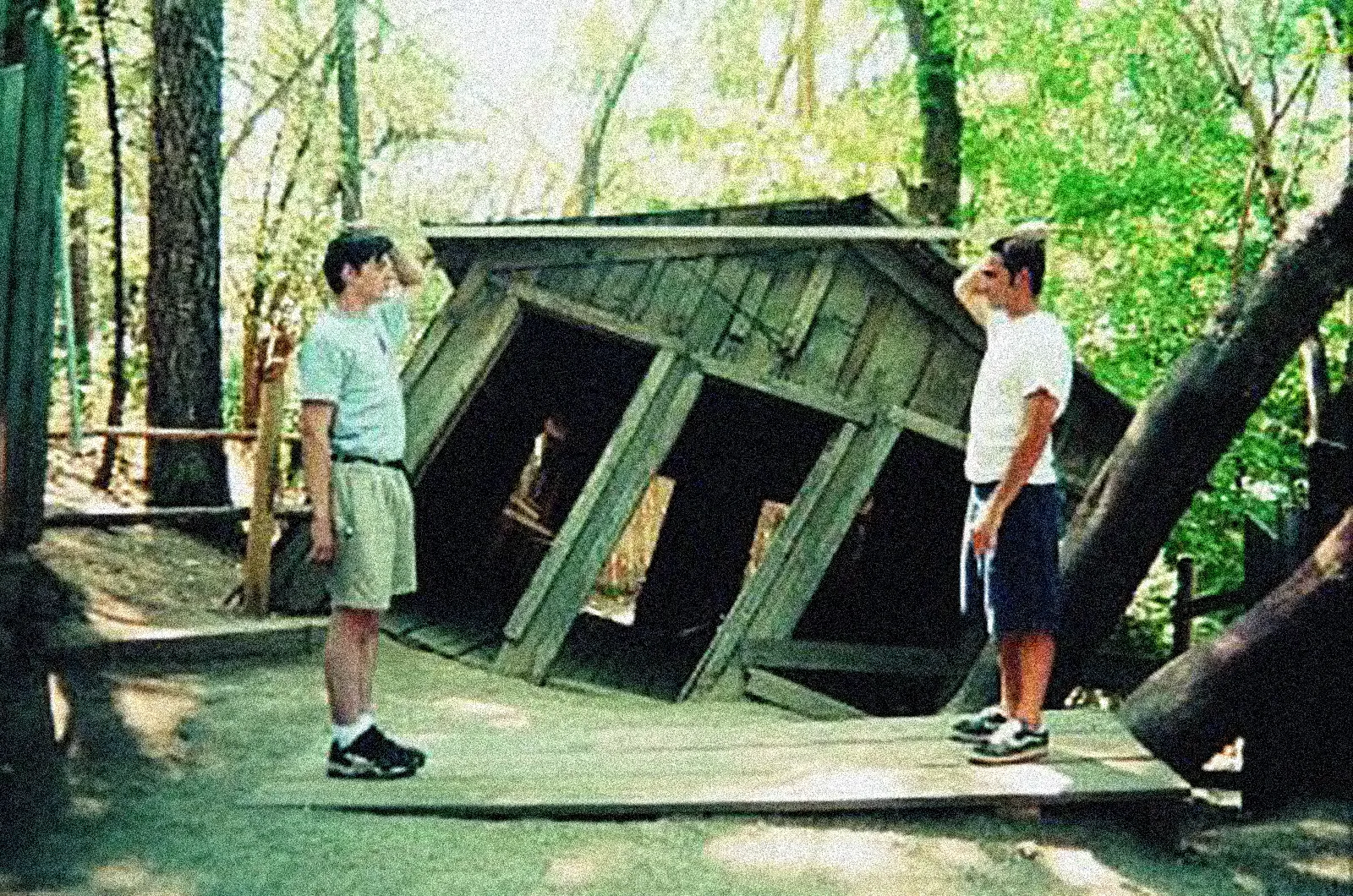
But the mysterious “growing person” phenomenon is the one everyone goes away talking about, because they can carry this one with them in the form of photographs. Would the camera lie? Yes. Referring to “Oregon Vortex” sites through Google.com, you’ll find a number of photos that show the remains of a wrecked shack in the background, and two persons standing facing one another from the opposite ends of a nine-foot platform, placed at right angles to the line-of-sight of the camera, which is on a fixed tripod. Lo! When these two persons change places, the one on the right of the photo has apparently gained a few inches in height, while the other chap has shrunk a bit! There are problems with obtaining a solution to this mystery, the vortex people tell us, for “whatever instrument you use to measure with while inside the affected area you will always measure to be the same height because the instrument of measurement will [itself] change.” Drat!
Not being accustomed to balking at obtaining a solution despite significant difficulties offered, I put my massive encephalon to this task. After a bit of experimentation, I was able to replicate the effect using two bottles of spice from my kitchen, a loose-leaf notebook, and a piece of cardboard. (Figures 1–4.)
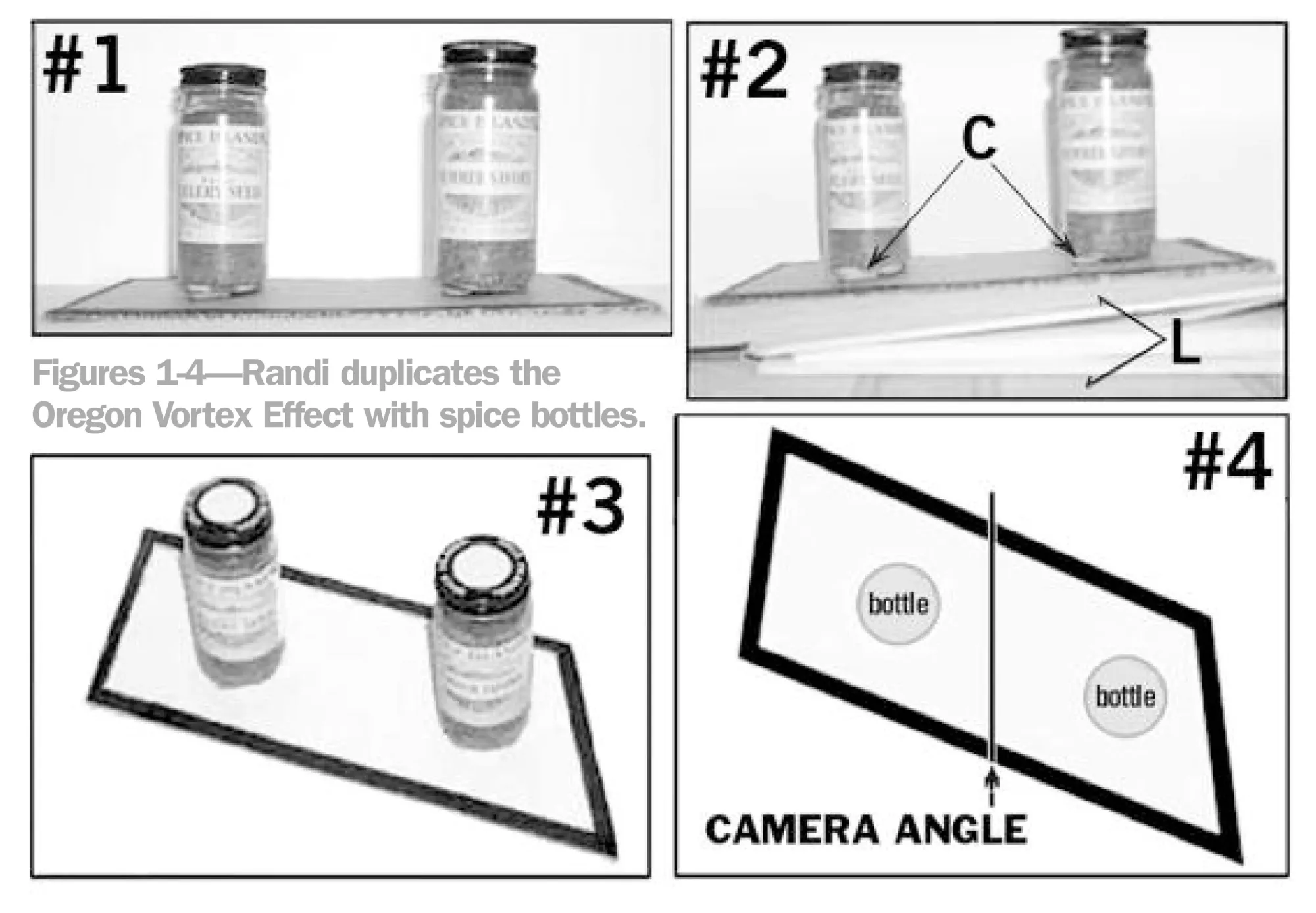
Figure 1 shows the finished product, in which two bottles, identical except for contents and labeling, are placed on a miniature platform. The one on the right appears to be substantially larger than the other. This uses the same simple means that the vortex folks use. Figure 2 reveals the ruse. While Figure 1 appears to represent the true horizontal, we see in Figure 2 that the whole setup has been sloped by being placed on a loose-leaf notebook “wedge” labeled “L.” Bits of modeling clay, marked “C,” were placed under the edges of the bottles to incline them slightly; in the full-size set-up using people, the subjects can stand at a slight angle to appear perpendicular to the platform, while spice bottles cannot. Locating the camera at just the right height, the leading edge and far edge of the platform are parallel to the false horizontal. The two ends of the platform are slanted, as can be seen in Figure 3, taken immediately in front of the miniature set-up, but from about 45° up and above. Figure 4 shows the line-up, although from this angle the fact that the platform is elevated on the right side does not show.
Since the right-hand bottle is closer to the camera, it registers a larger image. That’s all there is to it, folks!
I should mention one or two other facets of the “growing person” illusion. Note, in the published photos that you’ll find on Google.com, that though the two persons appear to be looking into one another’s eyes, they are actually staring right past each other, over the other person’s left shoulder. In the photo you can actually see a huge piece of lumber placed under the right end of the platform to bring it up from the level ground, and of course the photo is rotated slightly to the right so the platform seems to be truly horizontal! Also, the eccentric angles of the tumble-down shack in the background confuse the spectator’s orientation.
Not much in the Oregon Vortex is on the level, I think.