The Pigasus “Flying Pig” Awards for 2001 Plus: How to Talk to the Dead
The Pigasus “Flying Pig” Awards
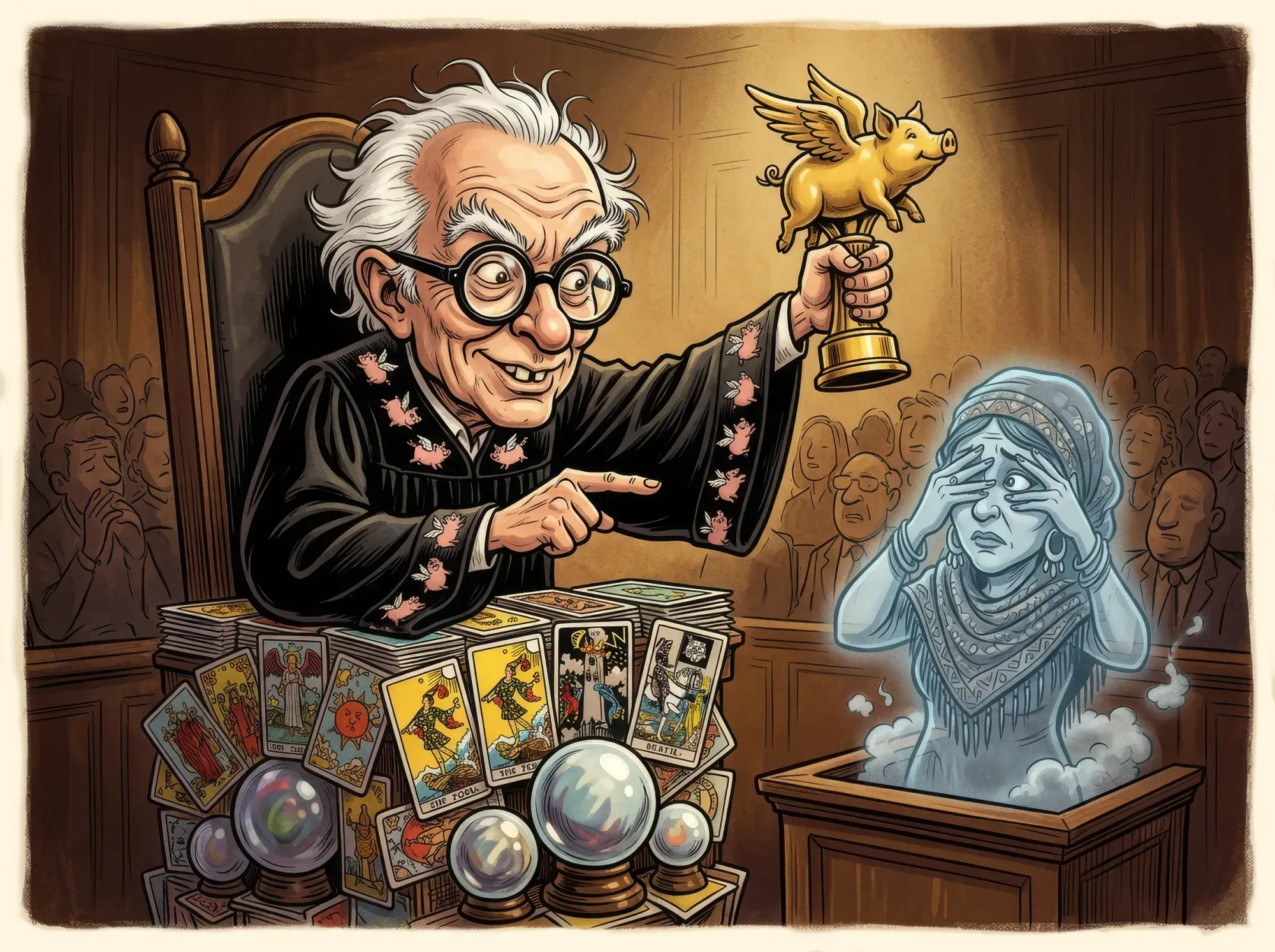
A On April 1st of each year, the James Randi Educational Foundation proclaims the yearned-for Pigasus “Flying Pig” awards in four categories, for accomplishments in the year previous. We allow the Academy Awards to occur before ours, so that we don’t distract from their festivities. Our awards are, of course, announced to the winners via telepathy, the winners are allowed to predict their triumph in advance, and the Flying Pig trophies are sent to the winners via psychokinesis. We send; if they don’t receive, that’s probably due to their lack of paranormal talent. The Pigasus prizes for achievements of the last year, 2001, go to:
CATEGORY #1, for the scientist who said or did the silliest thing related to the supernatural, paranormal or occult, goes unavoidably to Dr. Gary E. Schwartz of the University of Arizona, for his “testing” of psychic mediums that he reported to the media as “90% accurate.” Despite pleading by embarrassed friends and colleagues at the U of A, Dr. Schwartz has refused to back up these assertions by further examination of the subjects. His “findings” were widely reported by the international media, and Dr. Schwartz was careful in interviews to point out his credentials, as if that established the validity of his actual statements.
As a single example of his poor control of the “experiments” in “carefully isolating” a subject from a psychic during the tests—so that the psychic would have no information about the subject—he failed to notice the psychic clearly peeking into the adjoining area. When this was pointed out to him, he shrugged it off as an unimportant factor. So much for scientific rigor.
(The University of Arizona has turned down my offer to pay them the million-dollar prize if Dr. Schwartz would send us the confirming raw data on these tests—which he promised to do—but the University told us they were not interested. Incredible. Schwartz also sniffed that as an academic he would not try for any prize. That presumably includes the one offered by Alfred Nobel …)
CATEGORY #2, for the organization that supported the most useless study of a supernatural, paranormal or occult claim, goes overseas this year to the French university, Paris-la Sorbonne, the seat of the faculty of Arts & Letters at the University of Paris. This prestigious center of learning awarded a doctorate in Sociology to Élizabeth Teissier after she delivered to them a 900-page thesis, a plea for the validity of astrology. Needless to say, this sort of scandal had never happened before in the 742-year history of the university. It is said that former graduates of the world-famous Sorbonne are still heard noisily spinning in their graves, tout malades qu’ils sont.
CATEGORY #3, for the media outlet that reported as fact the most outrageous supernatural, paranormal or occult claim. We had to decide whether to split the honor among several media, but because of their determined emphasis on this particular item of nonsense, we decided it should go to the CNN TV Network, which devoted a whole day to promoting a news photo of the World Trade Towers collapsing on 9/11, a gruesome shot which was interpreted as a profile of Satan supernaturally created by the smoke. In this time of utter tragedy and sorrow, we were subjected to this infantile fancy, and made to look like juveniles to the rest of the world.
Edward, far more often wrong than right in his guesses, uses the grieving, the bereaved, and the vulnerable as his subjects and victims.
CATEGORY #4, for the “psychic” performer who fooled the greatest number of people with the least talent, of course goes to John Edward, the man who plays “Twenty Questions” for higher stakes than anyone ever has—millions of dollars a year—via the Crossing Over TV show, featured on major networks, here and abroad. Edward, far more often wrong than right in his guesses, uses the grieving, the bereaved, and the vulnerable as his subjects and victims—people who desperately look for evidence that their loved ones are still around somewhere. Though hardly the most talented performer of this variety of scam, Edward adopts an aggressive attitude and an unctuous smirk to lubricate his escape from his frequent blunders.
How to Talk to the Dead
On the subject of “cold reading,” as used by such “psychics/sensitives” as John Edward, Sylvia Browne, and James Van Praagh—the three currently popular “readers”—I recall very well the work of the late Doris Stokes, who was very big in the UK and particularly in Australia, where I saw several of her performances. Cold reading, the “sleight of tongue” procedure that these fast-talking artists use, has many methods whereby they can get out of simply wrong guesses so fast that few will notice, unless they listen very carefully, or get to study a transcript of what was actually said during the show.
Simon Hoggart, the well-known British writer, radio/TV commentator, and reporter who in 1995, with co-author Michael Hutchinson, produced the excellent book, “Bizarre Beliefs,” provides us with an excellent example of Stokes trying to salvage blatant errors.
The following is transcribed from a BBC television program, “40 Minutes,” of some years back, a performance done before a sizeable studio audience. Stokes, throwing out names, initials, suggestions, clues, and anything else that might evoke a response from her audience, tried “Little Daniel.” This is an almost guaranteed “carrot” to dangle for such an audience, and it got an immediate bite. I will break in on this exchange frequently to point out what has occurred, and to anticipate what the performer must do at that point:
Young Woman (YW): I’ve got a Daniel.
This response, in the present tense, would indicate to Stokes that (a) “Daniel” is alive, and (b) that Daniel “belongs” to this woman.
Doris Stokes (DS): Little Daniel?
YW: Very little.
The victim freely volunteers the information that Daniel is “very” little, and Stokes correctly takes it to mean that Daniel is an infant, something she did not know until the woman gave her that fact. Remember that the victims of this process are expected to provide help to the “reader,” and since they want the reading to be successful, they eagerly provide clues. Stokes re-issues that finding to her, quite safely:
DS: You know, a baby Daniel. Did he have to go back into hospital, love?
This last sentence is a question, not a revelation. Had the answer been “no,” Stokes could have had a partial win here because she had at least guessed that he’d been in a hospital previously. The probability that he was born in a hospital is high.
YW: Yes, he had to go back into hospital.
DS: But he’s all right now, love.
This is both a question and a statement. A question because it can be used to inquire about the status of the infant, a statement because if it’s true, it’s a “hit.” In this instance, it backfires on Stokes, though the woman quickly tries to save it for her. This victim has been to this sort of meeting before!
YW: No. Well, he might be all right on your [the spirit] side, but we’ve lost him.
Fast talking from Stokes is called for here, and it happens:
DS: Yes, that’s what they’re saying, he’ll be all right now, love.
The “they” quoted is the spirit population on “the other side.” “They” are often blamed for giving out wrong information, which “they” do sometimes, as a prank. Here Stokes has quickly repaired her gaffe, by dropping into the favorite view held by spiritualists, that we all go on living on The Other Side, and Daniel’s doing just fine “over there.” But the statement, “we’ve lost him,” is not “what they’re saying”! “They” gave Stokes the wrong information, or so it might appear to the skeptical mind.
DS: And they said, “We’ve brought little Daniel, and he went home and then he had to go back into the hospital.”
There it is, the favorite ploy of all those used by the “readers.” Stokes is repeating exactly what the victim has just helped her to develop, as if “they” have just told her this! I offer here an example of this very same technique in one of James Van Praagh’s readings, which often—far too often—contain this sort of sequence, in which he asks questions—because he doesn’t know the answers!—and then immediately reconstructs the answers as if they were just revealed to him by The Other Side. Here’s the sequence, in which Van Praagh has “contacted” a spirit for a victim:
VP: Is this your husband?
W: Yes.
VP: Because he just said, “Husband! I’m her husband, I’m her husband.” Okay? Was he in the hospital before he passed over, please?
W: Yes.
VP: Because he’s talking about being in the hospital before he passed over. Did he die in a hospital?
W: Yes.
VP: It’s like—I’m waiting for him to come through with this—”Yeah! I died there!” He says he died there!
You can see how this rather obvious gimmick can easily slip past the observer in the heat of an exchange. And notice that these were three questions from Van Praagh, who then reworked each one into a statement from the deceased! But back to the Stokes event:
DS: And he never went home again, but they said, “He’s all right now.” And he’s about three now, lovey?
YW: Yes, he is.
Of course he “never went home again! He died! And again, here’s that premise that no one ever dies. Daniel is living in Heaven, and is now three years old. A comforting thought to the bereaved.
DS: I can see him. He’s got auburn hair, love.
YW: Yes, he has.
We must wonder, what if this guess had been wrong? No problem! I’ve heard these artists simply insist that the deceased now has hair of the guessed color, or now plays this sport, or now is tall and thin, now that they’re in Heaven. The victims of the scam are supposed to accept anything, if the medium can invent any sort of an excuse for being simply wrong.
Cold reading … has many methods whereby they can get out of simply wrong guesses so fast that few will notice.
Let’s go back for a moment to 1925, and another séance, when Harry Houdini’s dead mother was contacted by a medium. The spirit of Mrs. Cecilia Weiss spoke English fluently, which was a big surprise to Harry, who informed the medium that his mother had spoken Yiddish all her life, but not a word of English. Undaunted, and in the true tradition of the breed, the medium snapped back, “Well, in Heaven, everyone speaks English!” Harry was not convinced by this assertion, especially since his mother appeared not to know anything about her former life, when she was on “this side.”
Back to Stokes:
DS: Yes, he’s here [the child], looking at the flowers. Yes, Daniel, you can, love. He says, “Can I have some flowers for my mum?” [Audience sighs.] So when you go tonight, lovey, will you take some flowers?
YW: (Awkwardly) He... he wasn’t my baby.
Drat! Wrong again! Stokes had assumed, likely enough, that this woman was Daniel’s mother. She had to put an instant repair on this boo-boo. And she did:
DS: No, but you know his Mum?
YW: Yes.
The “no” here is delivered as if Stokes already knew that, rather than being an “oh!” and an admission of the error. She was a pro—far better than John Edward, in my professional opinion, though using exactly the same methods. Maybe John should contact her, now that she’s in Summerland, and get some pointers …?
DS: No, I didn’t say to you... he said, “Can I have some flowers for my Mum, ‘cos she’ll never believe I’m here,” and he’s a beautiful child...
Stokes has here expanded Daniel’s statement to make it accommodate her gaffe, and has immediately tossed in the expected, and accepted, compliment on the beauty of the child. The alternate observation, that the kid was a brat, never seems to be offered …
DS: Just a minute, Daniel... He had a defect with his heart, darling, [Young Woman nods assent], and they tried to repair it, and it didn’t work, but he’s growing up and he’s nearly three, he said, and he’s talking away …
Just a tad defensive, Stokes here repeats something she’s already found to be true, that Daniel died three years ago, after trying for—and getting—a correct shot at the cause of death. Not an unlikely possibility, and it worked. What if there’d been no heart operation? I’ve heard Stokes—and other readers—insist that there was some procedure carried out of which the parent or relative was unaware. In one instance, a man who died of a stroke was said to have died of heart failure, but Stokes rationalized her gaffe by “explaining” that “it was his heart that carried him off, lovey.”
As Simon Hoggart pointed out in his discussion of this excerpt, Stokes was right about the child’s age, and hair color, though neither of these is particularly surprising. The young woman had told her that Daniel was very little, and the description “auburn”—reddish or golden brown—could apply to almost any hair color except blonde or jet black.
Yes, Stokes was a real “pro” when it came to her calling.