Psychics Prosecuted—Never Saw it Coming
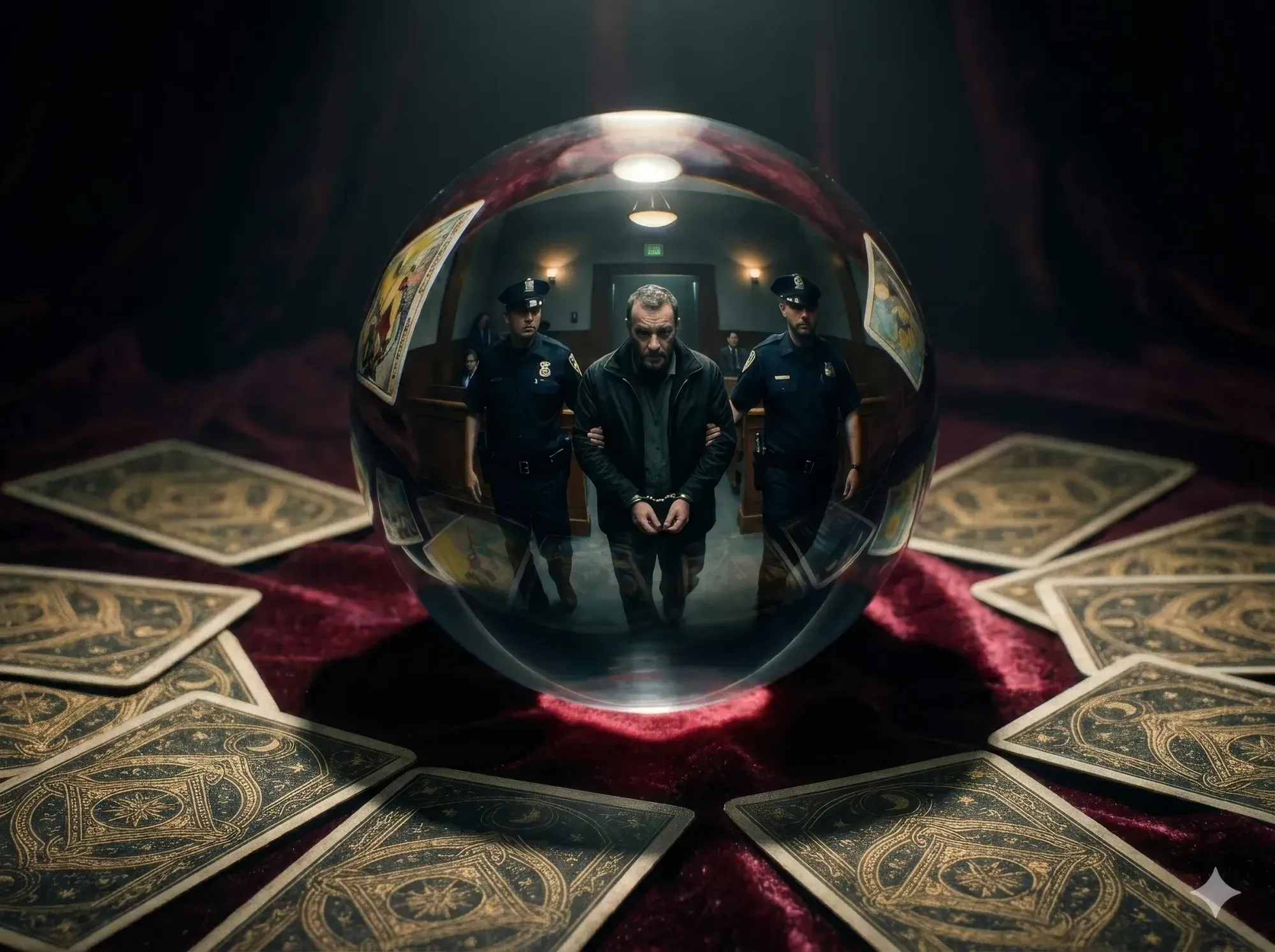
Three women in Queens, New York, who claimed to be psychics, were arraigned in July on fortune telling and other charges following a “sting” operation in which undercover police officers posed as clients. Queens District Attorney Richard A. Brown dryly commented: “As claimed psychics, the defendants themselves apparently suffered vision deficiencies, as they could not see themselves being prosecuted on fraud charges in their futures.”
Sabrina Martell, Dorothy Miller, and Rose Miller, all of Astoria, were arrested and charged with various infractions ranging from fourth-degree grand larceny, to first-degree scheme to defraud, petty larceny, and fortune telling. If convicted, they could be sentenced to one to four years in prison, but there are so many ways out of this charge—appeals to freedom of expression, freedom of religion, freedom of swindling—oops, not that last one. I looked up the pertinent statute. Under New York State law, S 165.35:
A person is guilty of fortune telling when, for a fee or compensation which he directly or indirectly solicits or receives, he claims or pretends to tell fortunes, or holds himself out as being able, by claimed or pretended use of occult powers, to answer questions or give advice on personal matters or to exorcise, influence or affect evil spirits or curses; except that this section does not apply to a person who engages in the aforedescribed conduct as part of a show or exhibition solely for the purpose of entertainment or amusement.
I see a gaping hole in this statute. I must ask, seriously, are exorcisms by Roman Catholic priests or other clerics similarly covered? I’ve never heard of a cleryman being charged under the statute. Nor have I ever known an ecclesiastical exorcist to declare, before, during, or following this potent ceremony: “This presentation was a show, and solely for entertainment or amusement purposes.”
But back to Sabrina, Dorothy, and Rose. Two undercover agents posing as customers met with the women and paid various sums to them. On one occasion, when a female agent said that she wanted to bring back her wandering boyfriend, $1,100 was asked for and received. Tarot card readings were given and evil spirits were banished, each for sums ranging from $275 to $375.
But hold on, folks! This sort of thing happens all over the state of New York, every hour of every day, and it has been happening for a century! The truth of the matter is that: (a) there are not presently enough agents in place to handle this problem; (b) it’s only a class B misdemeanor, maximum penalty 3 months, with the distinct possibility of only a scolding and no jail time; and (c) no one much cares if stupid people are taken in and relieved of their cash in this manner, certainly not police agents who usually have much more pressing matters to attend to. Also, electable officials who prosecute these scallywags may present a profile to their constituents that does not perform well at the ballot box.
When I lived in New York City in the 60s, I was invited to see the small “Black Museum” that the Safe & Loft Squad maintained somewhere downtown. There were ingenious gambling gimmicks and various scams displayed there, and I learned, during the tour, that the “Bunco Squad”—their more popular designation—regularly brought in fortune tellers and other such scam artists. In the museum were various devices used by gypsies—cloths for switching eggs, boxes for holding cash that was to be “purified,” and envelopes for substitution purposes. Alas, the gypsy/bunco profession is not now attracting its due attention from law enforcement.
Oh, I would dearly love to see a fully frocked ecclesiastic charged under New York State statute S 165.35 for casting out a demon, conducted by specialists designated by the Vatican. The applicable section of the statute can be more succinctly stated as:
A person is guilty of fortune telling when, for a fee or compensation that he directly or indirectly solicits or receives, he claims or pretends to … exorcise … evil spirits.
I’ll be damned—I’m sure.
The View of a Cold Reading
Recently, slogging computer-wise through folders of material I’d put aside—some for several years—I came upon a transcript of a reading done by “psychic” Char Margolis, on ABC-TV’s The View back in 2000. She’d picked out an audience member named Anita, and here it is, a succinct example of “cold reading,” 34 seconds of psychic marvels …
Char: Is there somebody who’s an “A,” or a “Willy”? Uh, a “William,” or an “A,” or, uh, an “M,” connected to you? Anyone deceased? Or living?
Subject: Living …
Char: What?
Subject: That could be a last name, no first name.
Char: What? That’s an “A”?
Subject: William.
Char: William? Is this someone living?
Subject: Yes.
Char: Who is this?
Subject: A co-worker friend.
Char: Okay. I was gonna ask, if you want to, are they making some changes at your work?
Subject: Umm, I’ve been offered to do something new at work, yes.
At that point, Anita was dismissed and Char turned to another victim.
In that same folder, I found another transcript of an excerpt from The View, this one with James Van Praagh doing the same scam with a woman named Susan, this segment mercifully only 17 seconds long:
Van Praagh: Who had eye trouble, please?
Subject: [holds up her hand] Ah, I have eye trouble.
Van Praagh: You had the eye trouble, did you?
Subject: Yes.
Van Praagh: The trouble with you. Mmm hmm. She’s talking about eye trouble. Was there something about maybe having a surgery or a procedure having to do with something?
Subject: Yes, I had eye surgery when I was two years old.
Van Praagh: Thank you. Because she’s telling me that!
“As claimed psychics, the defendants themselves apparently suffered vision deficiencies, as they could not see themselves being prosecuted on fraud charges in their futures.” —Queens District Attorney Richard A. Brown
Notice a few points here. First, the changing of the verb tense by Van Praagh; he’s asking about a previous condition, the woman identifies it as a current problem, and he switches it back to conform to his guess. The un-named female “talking about eye trouble” is introduced by Van Praagh to see if the subject will identify some ghost who might have provided that information. In a blatantly obvious probe for data that he doesn’t have, he asks—using the escape hatch “maybe”—whether there was surgery of any kind, of any person, at any time in the past or any “procedure” of any sort “having to do with something”! How wide can you throw that net, James?
It paid off—the victim gave him a very specific, important event, and a specific time—the eye operation—and Van Praagh is ready to use his tried-and-true gimmick: he takes what he’s just been told and puts it in the disembodied mouth of the ghost: “Thank you. Because she’s telling me that!” The victim will frequently later recall such a statement as coming from the spirit, not from herself!
Similarly, the first week of July, the television show Geraldo At Large featured a segment on a “cold reader,” one John Holland. The first example of his awesome abilities was just perfect. He “channeled” the ghosts of the 146 garment workers who died trapped in the 1911 Triangle Shirtwaist Factory fire in New York City. And what did he come up with? “It’s the part that they can’t get out, that’s getting to me.”
Duh. What else do you think might have been on their minds, John?
The interviewer, who was not at all sympathetic to the “reader,” still fell for the leading comments and outright questions, freely giving out information at every opportunity. He’d announced at the start that he wanted to contact the spirit of his aunt Marsha; that lady didn’t turn up, but Holland asked the interviewer if he had known his father’s father, and got a “not very well” answer. Then, as one of his many rambling comments, he said, “I want you to remember the name David,” and the interviewer immediately interrupted and told the reader, “David? That’s my father’s name!” It was not anything asked for, and it was a full generation away, but that became the “hit” the videotape editors chose as being significant!
The magician Jamy Ian Swiss, contacted by the show for his input, gave them a 20-minute-long interview on talking-to-the-dead operators. The entire statement by Jamy that they used lasted just 12 seconds. Said Jamy when I inquired:
Yes, and they used the weakest statement from me they could find. I’d talked about method, motive, and morality—nothing. And I pointed out that the guy started out—according to the reporter’s own account to me—by asking questions! I asked, “Wouldn’t your grandfather be able to come up with some more specific anecdote you two could share, beyond just his own name?”
Note: the “reader” didn’t identify the grandfather, at all, but the reporter later stated, “It kind of freaked me when he busted my dad’s name, David.” This is the typical, expected, and dependable reaction from the victim, to supply information and to then adapt it to fit the situation. With that kind of help, the “psychic” doesn’t need any more. The reporter wasn’t looking for his father’s name, at all, and as Jamy reminds us, Holland knew who was going to interview him, and probably has access to the Internet …
Holland also “tried on” references to motorcycles, a motor crash, and sky-diving, but none worked for him, drawing total blanks.
Such transcripts can benefit from a lot of study to determine the clever methods used by the “readers” to hook their naïve victims. Ian Rowland’s book, The Full Facts Book of Cold Reading, reveals all these secrets, and can be found on his website at www.ianrowland.com.
Me and Andrew Weil
Dr. Andrew Weil, M.D. is a major figure in the “alternative medicine” business. His pop-medicine, rosy-hued, attitude-is-everything brand of “wellness” has landed him on the cover of Time magazine, twice.
I first met Weil in the Spring of 1974, when he interviewed me for Psychology Today magazine. The result was an article that appeared in two parts, in the June and July issues. They were titled, “The Enchantment” and “The Letdown,” respectively. The first dealt with his complete conviction that the Israeli “psychic” Uri Geller was for real—a decision that resulted from a visit he made to the spoonbender, and the second part told of his subsequent disillusionment after I’d had an opportunity—at his invitation—to do a few demonstrations for him and asked him to seriously rethink his previous accounts of the “miracles” that Geller had shown him.
However, Weil’s ability to devalue facts led him to state, at the end of the Psychology Today article:
It might be possible to take more conscious control over the process by which reality is shaped and made to seem objective. “Wishful thinking,” though it has a negative connotation, is an appropriate term to describe this process. We all engage in it, often unconsciously, to bring things into reality according to our needs, and to make them leave reality according to our needs. That is why certain questions like, “Is Uri Geller a fraud?” or “Do psychic phenomena exist?” are unanswerable. The answer is always yes and no, depending on who is looking and from what point of view. Each of us has the power to make such phenomena real or unreal. The first step toward making them real is to believe that evidence exists. As for Uri Geller, I wish him good fortune and the wisdom to use his abilities well. From knowing him, I have learned an enormous amount about the way I see things and the need for great care in evaluating evidence—especially the kind of evidence which seems to prove things I want to believe.
I hardly need explain why I disagree so very strongly with what Dr. Weil expressed on this matter. The question, “Do psychic phenomena exist?” can obviously be answered by examining each claimed phenomenon, but it can’t be assumed that such phenomena exist just because every claim has not yet been examined; this appears to be Weil’s approach. Try the same treatment of the question, “Does Santa Claus deliver gifts to good kids at Xmas?” and you enter another endless pursuit that permits you to assume that since you can’t explain every gift ever received by a child, Santa is real … And, Weil’s naïve notion that the answers to these questions are always “yes and no,” is untenable.
And, “Is Uri Geller genuinely paranormal?” is a question that is answered, “No, until he provides proof that he is.” Catching Geller at trickery—which has been done often—does not prove he’s a fraud all the time.
When Weil visited me at my home in New Jersey, I not only duplicated everything that Geller had done for him—by sleight-of-hand and other such mundane artifices—I even outdid the Geller performance on several points. A taste of what Weil experienced at that session is best expressed by a partial quotation from his own account:
The key was bending. In a trice it was bent to about 30 degrees, looking for all the world like a Geller production. “No!” I protested. My faith in Uri Geller lay in pieces on the floor … I had never before had the experience of going from such total belief to such total disbelief in so short a time. Nor had I ever doubted my perceptions so thoroughly.
Perceptions may or may not represent reality; magic acts are the proof of that. Of course, if you assume that you can’t be fooled because you’re too smart, you might as well turn over your assets to the next person who shows you a card trick that fools you. I’m available …