The Terrorist in the Brain
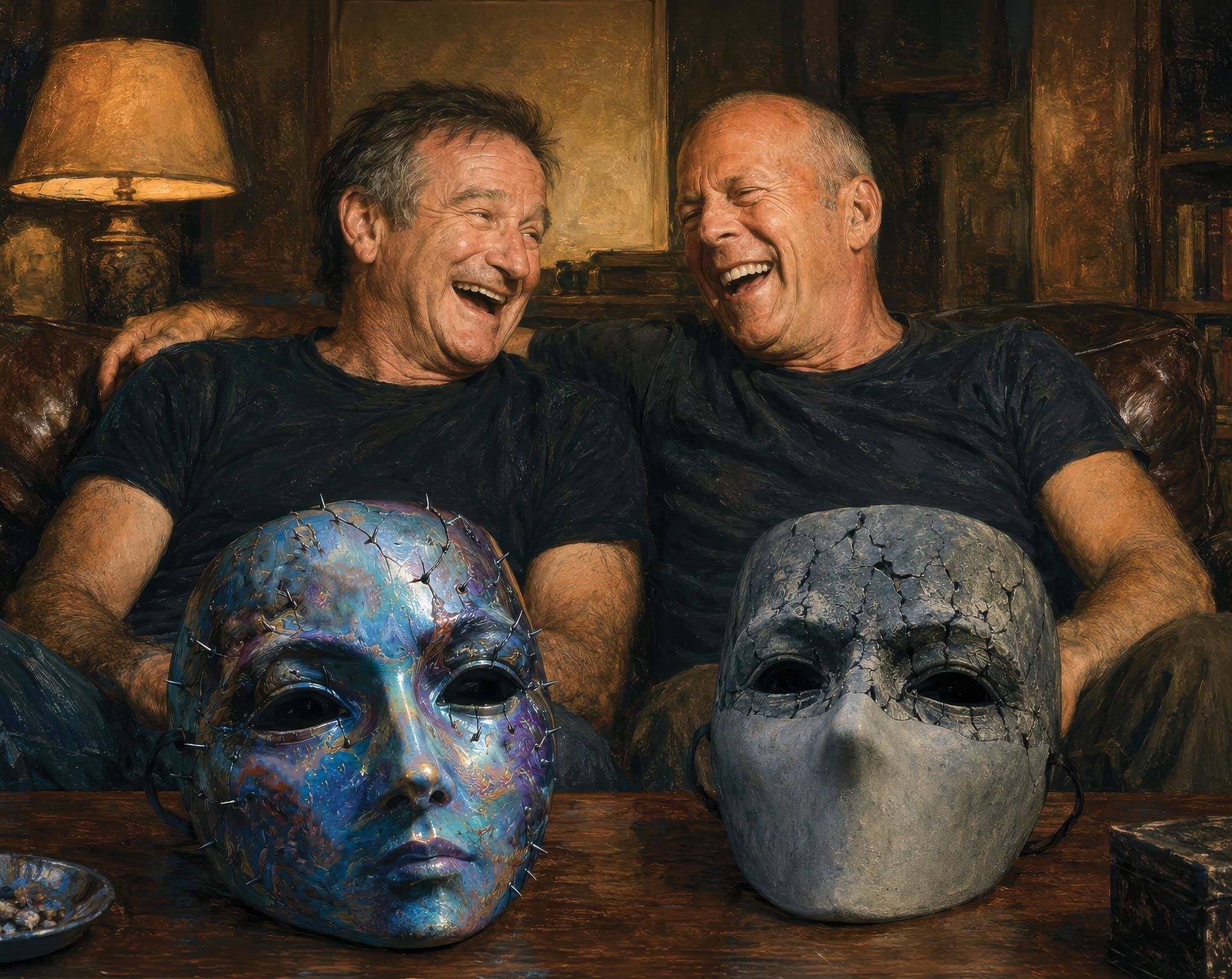
What Robin Williams and Bruce Willis can teach us about dementia—and about the industry that has grown up around our fear of it
In the last two years of his life, Robin Williams was being hunted by a stealthy predator. The early signs were easy to ignore: stubborn constipation, trouble sleeping, a sense of smell that had quietly faded, and the usual “senior moments.” Then symptoms came that were harder to dismiss. A tremor appeared in his left hand. His walk grew stiff and stooped. A man who had spent four decades as perhaps the fastest comic mind alive found himself, on a film set, unable to hold a single line in his head—an experience he reportedly described as feeling that he was losing his mind. Worst of all was the flood of anxiety, paranoia, and fear that no reassurance could assuage, and the people he saw who were not there.
His physicians—good physicians with the best diagnostic tests available—arrived at a reasonable conclusion. In May of 2014, he was diagnosed with Parkinson’s, with an accompanying dose of depression. It was a careful reading of the evidence before them. It was also wrong. In August, Williams took his own life.
The true culprit revealed itself only at autopsy. The pathologist who examined his brain found it riddled with microscopic deposits called Lewy bodies—a case so severe it was, in the examiner’s estimation, among the worst he had ever encountered. The real diagnosis shared some characteristics with Parkinson’s but is known as Lewy body dementia, and it had been there all along, mimicking other conditions, too small to see with any living test. His widow, Susan Schneider Williams, later wrote about the experience in the journal Neurology with unusual clarity and grief. She called the disease “the terrorist inside my husband’s brain.” It is a clinically apt phrase. The disease worked in the unseen dark, struck with a confusing pattern, and was identified only after it had finished bringing down one of the most creative verbal minds of our generation.
Robin Williams’s story illustrates clearly something that is often hard to see. Even with the best of care, we cannot always diagnose the true cause of dementia while the patient is alive. And a second case, that of Bruce Willis, is a fitting contrast, illustrating the variety of conditions lumped in the general media under the term dementia. We will also take a look at the new tests that promise early answers, new drugs that promise to slow the decline, and the very old curse of remedies that promise everything and deliver nothing.
In the spring of 2022, Bruce Willis’s family announced that he was retiring from acting because of aphasia—a loss of the capacity for language. What a blow for the dashing actor who made his name with the rapid repartee of “Moonlighting.” A year later, they clarified the diagnosis: frontotemporal dementia. Much of the press covered this as a grim turn for the worse, a disease that had advanced from a speech problem into something larger. That reading misunderstood the biology. Progressive aphasia is not a separate illness that later becomes dementia; it is most often the presenting symptom of frontotemporal degeneration itself. The 2023 announcement was not news of deterioration so much as a sharper name for what had been true from the start. The Willis family deserves real credit for speaking publicly and plainly about a disease most people had never heard of. The news coverage, in treating a more precise diagnosis as a sudden decline, illustrated a smaller failure—one that dogs this whole subject: a confident misreading of a broad spectrum of symptoms.
Different Diseases Wearing the Same Mask
The first thing to understand is that “dementia” is not a disease. It is a syndrome—a description of a problem rather than its cause. The word means only that someone’s thinking has declined enough to interfere with daily life. Saying a person “has dementia” is like saying they “have a fever”: it tells you something is wrong, not what.
Beneath this umbrella sit several distinct diseases that the media tends to merge into one. “Alzheimer’s” has become a generic label for memory loss, the way “Kleenex” stands in for tissue. The clumping obscures real differences, because these illnesses behave differently, are diagnosed differently, respond to treatment differently, and—as we will see—are exploited differently.
Saying a person “has dementia” is like saying they “have a fever”: it tells you something is wrong, not what.
Alzheimer’s Disease is the most common, responsible for perhaps 60 to 70 percent of cases. Its signature is the loss of recent memory: the person who asks the same question three times in an hour, mislays objects in strange places, loses the thread of a familiar route home. It is largely a disease of later life, growing more frequent with each decade past sixty-five. Under the microscope, the Alzheimer’s brain shows two abnormalities—plaques made of a protein called amyloid, and tangles made of a protein called tau. For thirty years, amyloid has been cast as the villain of the story. Hold that thought, because this casting is now in serious doubt.
Frontotemporal Dementia, the disease Bruce Willis has, often leaves memory intact in its early stages. It attacks the very things that make a person recognizable: judgment, empathy, social conduct, language. It strikes middle-aged people, typically between forty-five and sixty-five, and is the most common dementia in people under sixty. It comes in two broad forms. The behavioral variant turns considerate people into impulsive strangers who say outrageous things and feel no embarrassment about it. The other form, primary progressive aphasia, dismantles language—the form Willis appears to have—a particular cruelty in a person who made his living with his distinctive voice.
Lewy Body Dementia—Williams’s disease—is the second most common neurodegenerative dementia, accounting for somewhere between 5 and 15 percent of cases, though it is often mistaken for something else. By some accounts, only about one in three cases is correctly identified during life. It can be the most insidious of the three, because it combines features of all the others. It is caused by deposits of the same protein that causes Parkinson’s—alpha-synuclein—and brings the memory trouble of Alzheimer’s, the movement trouble of Parkinson’s, and a set of signatures of its own: vivid visual hallucinations, alertness that swings dramatically from one hour to the next, and a tendency to act out dreams—shouting, thrashing, sometimes leaping from bed.
Another common cause is Vascular Dementia, resulting from strokes and damaged small blood vessels. This tends to show deterioration in small steps rather than a smooth slope. Sorting through this list with overlapping symptoms is a major challenge for clinicians and families.
The $1.6 Billion Question
Let’s take a deeper look at amyloid, because the story of that protein is one of the more unsettling episodes in modern medicine.
For three decades, the dominant theory of Alzheimer’s has been the “amyloid hypothesis”: the buildup of amyloid protein in the brain is thought to be the primary driver of the disease. The proponents of this hypothesis dominated the scientific approach to what was studied and what was funded. By one accounting, the National Institutes of Health spent roughly $1.6 billion on amyloid research in 2022 alone, close to half of its entire Alzheimer’s budget for the year. The newly approved drugs are their direct descendants.
At the heart of the amyloid theory was a widely cited paper published in 2006 in Nature showing the buildup of amyloid deposits in the brains of patients with dementia. But 16 years later, in 2022, a neuroscientist at Vanderbilt named Matthew Schrag raised detailed concerns that this paper contained doctored images. After a two-year investigation, the original paper was retracted. This is how good science works. The investigative journalist Charles Piller traced this affair and several related ones in his 2025 book Doctored, documenting manipulation that touched multiple laboratories, patents, and drug programs.
A careful skeptic must resist the easy conclusion here. The fraudulent paper concerned one type of amyloid, and the broader hypothesis rests on other, independent evidence. The retraction does not mean amyloid is irrelevant. The honest conclusion is subtler and more disquieting: a celebrated pillar of the field’s leading theory appears to have been fabricated; a vast research enterprise was built around it for two decades; competing ideas were starved of attention and money. Skepticism, properly understood, is not cynicism. It is the insistence that even the reigning paradigm be made to show its work.
The Testing Boom and the Trap of Knowing
Until very recently, the type of dementia could be confirmed only at autopsy, too late to help the patient. This is changing, and the change is genuinely impressive. In 2024, researchers showed that a blood test measuring a form of tau protein called p-tau217 could predict Alzheimer’s pathology with roughly 90 percent accuracy, rivaling expensive PET scans or an invasive spinal tap. In May 2025, the FDA cleared the first such blood test for clinical use. Imaging can now map the disease in a living brain. After decades of diagnostic darkness, we suddenly hold something like a searchlight.
We have handed someone a frightening result, threatening them with a disease they may never develop and for which we have little to offer. We have manufactured dread and called it “early detection.”
This is real progress. But, other than for research, a searchlight is only useful if there is something worth doing once you see what it reveals—and here the new diagnostics run headlong into an old problem. Accuracy is not the same as usefulness, because the value of knowing depends entirely on what the knowledge lets you do.
Consider a healthy, worried sixty-year-old with a family history of dementia and no symptoms, who reads about a “simple blood test for Alzheimer’s” now sold online by companies happy to oblige. Suppose the result comes back positive for amyloid. What, precisely, has been accomplished? Medical guidelines do not endorse this kind of testing in people without symptoms. Worse, under the eligibility rules for the new drugs, an asymptomatic person would not even qualify for treatment. We have handed someone a frightening result, threatening them with a disease they may never develop and for which we have little to offer. We have manufactured dread and called it “early detection.”
This harm is not hypothetical. There is extensive literature that shows giving patients this kind of test result can cause anxiety, depression, stigma, strained families, and fresh worries about insurance and employment. There is a recognized “right not to know,” and surveys find that many people, given the choice, would rather not learn they might be bound for a disease they cannot prevent. There is a valid argument that early detection might encourage patients to enroll in clinical trials, but how many of those are available?
On the other hand, there are reassuring studies showing that disclosure causes little lasting distress. But read them closely and a pattern emerges: many recruited carefully chosen volunteers, deliberately excluding people who showed signs of depression or anxiety. The evidence that “telling people is fine” was generated by first removing the people most likely not to be fine. That is not reassurance. It is selection bias or “cherry picking.”
Even for patients who do have symptoms, the tests are messier in practice than the marketing headlines suggest. Roughly one in five who take the blood test have results in an indeterminate gray zone—not an answer but a shrug, requiring still more testing, more cost, more waiting, more worry. The searchlight, it turns out, flickers.
None of this makes the tests worthless. For someone already symptomatic and already in a diagnostic workup, an accurate test is a genuine gift: it can shorten the diagnostic odyssey, steer the patient away from the wrong treatment, and let a family plan while the patient can still take part. There is an old principle in medicine called stewardship: never order a test that cannot change the course of the patient’s care. The principle does not forbid these tests. It forbids selling them to the worried well.
The New Drugs: Marginal Benefit, Real Risk
This brings us to treatment, and to the question hanging over all this testing: what can we actually do for someone with Alzheimer’s disease?
The honest answer, as of 2026, is a little, perhaps, for some people, at some risk. After twenty years of failure, two anti-amyloid antibody drugs have won FDA approval: Lecanemab (sold as Leqembi) in 2023 and Donanemab (Kisunla) in 2024. They do something no earlier drug could: they clear amyloid plaque from the brain. In large trials, they slowed the rate of cognitive decline compared with placebo. But read that sentence carefully. Slowing the rate of decline does not mean improving. It means it got worse more slowly. And the difference between the treated group and the placebo was so small that many of the scientists and doctors on the FDA panel did not want to approve the drugs at all.
Even with the best of care, we cannot always diagnose the true cause of dementia while the patient is alive.
The fact that these drugs so effectively clear amyloid plaque, but only slow the progression of the dementia at a rate that many specialists argue a patient or family would never actually notice, raises a very important question. Either amyloid is not the whole story, or it is not the right story. The drugs, in a sense, are an experiment testing the very hypothesis that produced them, and the results so far are not a ringing endorsement.
Against that modest benefit sits an immodest risk. The drugs, Amyloid-Related Imaging Abnormalities, can cause brain swelling and bleeding, and are politely abbreviated ARIA. In the lecanemab trial, swelling or hemorrhage appeared in about 17 percent of treated patients, against 9 percent on placebo. Most cases were mild, but not all were. Deaths have occurred. The danger runs highest in people carrying a particular genetic variant, which means responsible use requires genetic testing, repeated MRI surveillance, confirmed amyloid in the brain, and infusions in a setting prepared for complications. The drugs are also expensive, and the European Medicines Agency, reviewing the same data the FDA saw, initially declined to approve donanemab at all.
If the tone of this feels familiar, it should. The immediate predecessor to these drugs, aducanumab (Aduhelm), was approved by the FDA in 2021 over the explicit objection of its own scientific advisory committee, priced at a staggering level, denied routine coverage by Medicare pending better evidence, and quietly withdrawn from the market in 2024. It stands as a near-perfect case study in approving a drug on hope and marketing rather than on convincing proof of benefit. The episode should make us cautious about the next promised miracle and about a regulatory process that can be pushed by desperation and dollars.
The Oldest Remedy in the Book
If the prescription drugs offer modest benefit at real cost, the supplement industry offers no benefit at enormous profit.
The global market for “brain health” supplements runs to roughly eleven billion dollars and is climbing toward twice that. Fear is a superb business model, and little frightens an aging population like the prospect of losing its mind. Into that fear pours a steady stream of pills.
The category’s bestseller is Prevagen, whose active ingredient is a protein originally isolated from a species of glowing jellyfish. The premise asks us to believe that a protein swallowed by mouth survives digestion intact, crosses into the brain, and improves memory. This sequence collides with the basic biology of the gut, which dismantles proteins into their component amino acids, and the blood-brain barrier, which effectively prevents any but the smallest molecules from entering the brain. The Federal Trade Commission and the State of New York sued the manufacturer for deceptive advertising. Tellingly, its marketing has since drifted from confident promises to “improve memory” toward the vaguer “supports brain health,” a phrase that commits to nothing and therefore can never be wrong.
Ginkgo biloba at least has the dignity of having been tested. In a large trial, it failed to prevent or slow dementia. Other regulars off the brain health shelf include coconut oil, vitamin E, and an ever-shifting roster of proprietary blends, resting on evidence ranging from thin to absent. As a final insult, independent testing has repeatedly found that supplements do not reliably contain the substances that their labels claim; in one government analysis, most ginkgo products held little actual ginkgo. You are, at best, not being harmed by a substance that is not there. Caffeine, a known brain stimulant, was the most common unlabeled ingredient.
There is more of this coming. In December 2025, the FDA signaled that it intends to relax how often supplement labels must carry disclaimers, the fine print admitting that the product has not been evaluated to treat any disease. Under this MAHA proposal, the warning would appear once per package rather than beside each health claim. Experts warned the change would make the disclaimer easier to overlook. Now it is the single mandatory note of honesty on these bottles, and the plan is to require it less often.
What can we do?
It would be a dreary column that offered only debunking, so let me end with what the evidence does support. How can we tell ordinary aging from something that warrants attention? And what can we do?
Forgetting where you left your keys is normal. Forgetting what keys are for is not. Occasionally losing a name is normal; getting lost driving home from a store you have visited for twenty years is not. A few specific changes deserve to be taken seriously rather than waved away. A shift in personality or social conduct, a reserved person turning crude or impulsive, a warm person turning indifferent, is a genuine warning sign, too often dismissed as someone merely getting cranky with age. Well-formed visual hallucinations of people or animals point toward Lewy body disease and call for evaluation. And acting out dreams in sleep, shouting, punching, leaping from bed, might be REM sleep behavior disorder, and can precede Lewy body disease or Parkinson’s by years. If your bed partner is reenacting their dreams, that is not a quirk. It is information.
The reason to seek a proper evaluation is not that a cure awaits, but that an accurate diagnosis prevents harm, ends the exhausting cycle of wrong guesses, and allows planning while the patient can still take part. An example of the kind of harm that can be prevented occurs with Lewy body dementia. These patients are often catastrophically sensitive to antipsychotic drugs, the kind a clinician might reach for to quiet hallucinations and agitation. In a substantial share of these patients, such drugs can trigger severe, occasionally fatal reactions. Getting the diagnosis right is not an academic nicety. The wrong label can lead directly to a dangerous treatment.
The deepest lesson of the Williams and Willis stories may be the simplest. Money and access do not buy a way around the limits of current science.
As for prevention, there is as yet no pill, supplement, or food that prevents dementia. What exists is a set of risk factors we can influence, with the understanding that lowering risk is not the same as buying immunity. The evidence is reasonably good that what is good for the heart is good for the brain: controlling blood pressure and blood sugar, not smoking, staying physically active, and keeping weight in check. Staying socially and mentally engaged appears to help, though here, cause and effect are genuinely hard to separate. And one of the more striking findings of recent years is that treating hearing loss, an unglamorous intervention if ever there was one, ranks among the more promising things a person can do for the aging brain, presumably because a brain starved of input declines faster.
None of this will sell eleven billion dollars of jellyfish protein, because it is unpatentable, unprofitable, and demands actual effort. It is also, unlike most of what is marketed to the frightened, true.

The deepest lesson of the Williams and Willis stories may be the simplest. Money and access do not buy a way around the limits of current science. Robin Williams had the finest medical care in the world and died misdiagnosed, hunted by a disease no test of his time could catch. Bruce Willis’s fame turned his diagnosis into headlines that mostly got the science wrong. If two of the most resourced patients imaginable could not escape the genuine limits of what medicine can do, the rest of us will not find our way out through a blood test we do not need, a drug priced like a small car, or a bottle of glowing jellyfish.
What medicine can honestly offer right now is neither a crystal ball nor a cure. It is an accurate diagnosis when a diagnosis will help, competent and humane care, the prevention of foreseeable harm, and a steady refusal to sell false hope to the frightened. That is less than we want. It is a great deal more than the people selling certainty are offering.
Notes and sources available on request. Key references include the family statements and reporting on Bruce Willis (Association for Frontotemporal Degeneration; 2022–2023); Susan Schneider Williams, “The terrorist inside my husband’s brain,” Neurology (2016), and her subsequent interviews; the Clarity AD (lecanemab) and TRAILBLAZER-ALZ 2 (donanemab) trial reports; Palmqvist et al. on p-tau217 blood testing (2024); the FDA’s 2025 clearance of the Lumipulse blood test; the 2024 retraction of Lesné et al., Nature (2006), and Charles Piller’s Doctored (2025); the Ginkgo Evaluation of Memory (GEM) study; the FTC and New York litigation against the makers of Prevagen; and the FDA’s December 2025 letter to industry on DSHEA disclaimer placement.