A Satanic Panic Panic
Revisiting the 1980s Mass Hysteria Over Alleged Satanic Cults, by Someone Who Was There
Rivers, railroads, and RVs is how I described my hometown of Elkhart, Indiana, a blue-collar boomtown recovering from recession in the mid-1980s. I lived in a trailer park bordered by cornfields and factories but had landed a job in a mall record store, largely because of my passion for music, particularly heavy metal. The Pierre Moran Mall was second-rate, located south of the tracks, more known for bizarre 1960s-era animatronic Christmas displays than its stores, but that gave World Records a little more freedom to create a heavy metal wall as well as play early rap music. Yeah, heaven for a high school student. But it would soon be the gateway to hell. An unassuming mother would walk into the store, pull me into a satanic saga, and become an overnight martyr of the Satanic Panic.
I was an aspiring teenage rock journalist, bred on CREEM’s Lester Bangs, living for the latest import issue of Kerrang! Neither magazine would publish a teenager from Elkhart, so I started submitting reviews to Suck City out of Indianapolis, a mimeographed underground heavy-metal fanzine with an obsession with the phrase “8 cents,” Uriah Heep, and umlauts. I also started writing for the local paper, The Elkhart Truth, which had a bigger circulation but was decidedly uncool. The record store became my connection with the local music scene, including Pete Kernan, a well-connected concert promoter who would go on to work Rolling Stones tours.1
Pete gave me concert tickets as long as the write up appeared in The Elkhart Truth, quid pro quo. Tim Bushong of Rox Sedan heard of the Suck City connection and came into World Records and asked that I write up his metal band. They were local legends, and I went to see them play at a dive in Goshen, Indiana; I had to sit on the stage because minors were not allowed in the bar. A few years later Bushong protested devil music outside heavy metal concerts. It was a confusing time.
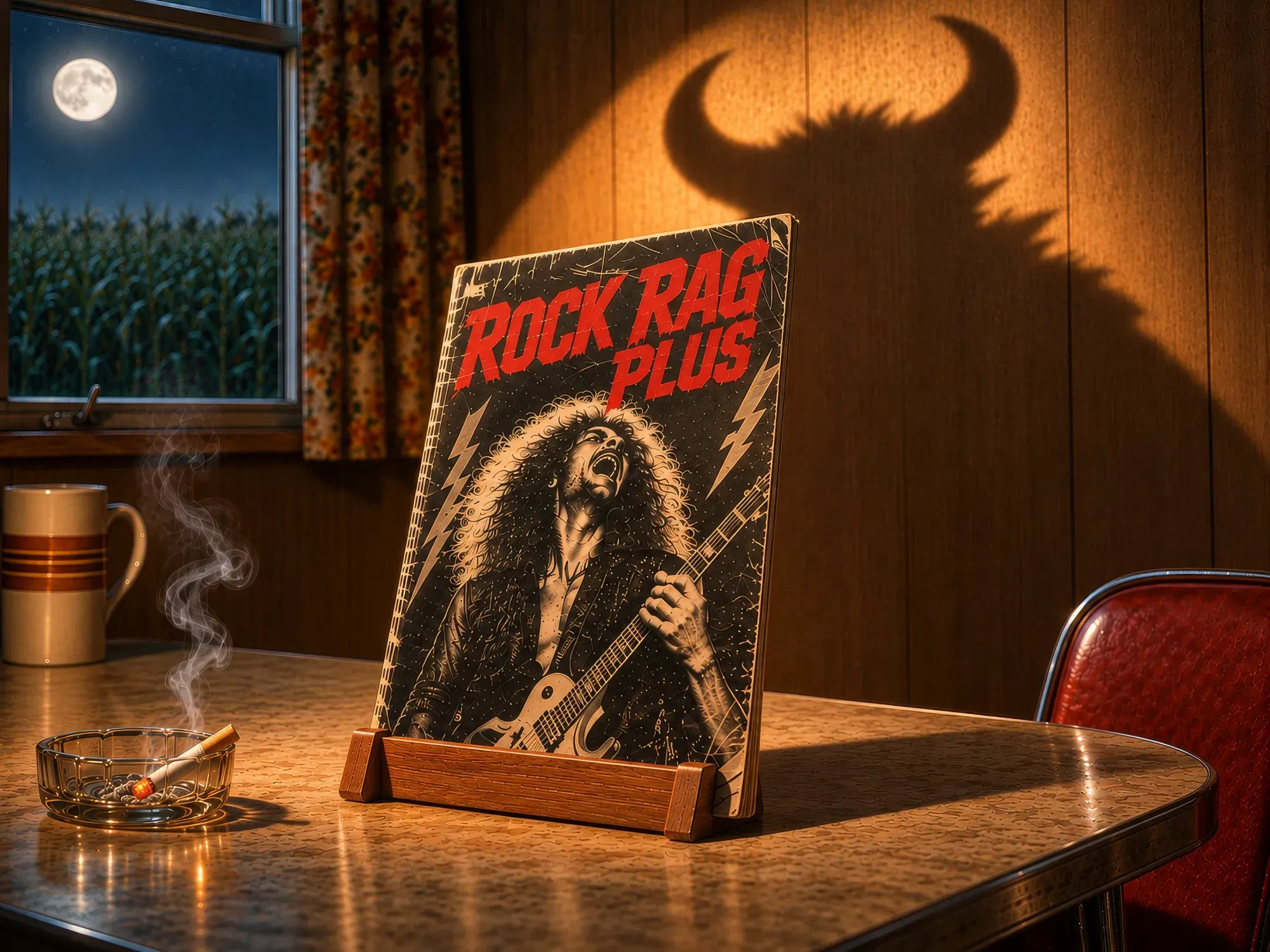
Marianne Hatfield heard about the Rox Sedan story and came to the record store. She looked more like a mousy librarian than a rock and roll publisher, so I was taken aback when she asked that I write for her new magazine, Rock Rag Plus. Marianne was nice, but Rock Rag Plus did not seem as cool a gig as an idiosyncratic fanzine, nor did it offer the circulation of the newspaper. Unlike those, however, she did offer to pay for the articles, which would make me a legitimate freelancer. I decided to highball her and asked for a bottle of Jack Daniel’s per article. To my surprise, she agreed.
A few weeks later I drove to Hatfield’s trailer, located in a park east of Goshen, surrounded by cornfields and long, straight county roads. Elkhart was conservative, a Republican stronghold, but Goshen—a sundown town into the 1960s2—made Elkhart look liberal. Goshen was home to Goshen College, a Mennonite institution, with more than 10,000 Amish living in the surrounding countryside.3 The owner of World Records, where I worked, had started the store in his hometown of Goshen but, after he made the mistake of telling a customer he “planned to light one up” after work, the Goshen police raided the record store, handcuffed everyone and proudly displayed a drug bust of two joints. He moved the store to Elkhart.
Beyond the sheer lunacy behind the charges, the idea that rock stars would want to kill off their record-buying fans was nonsensical.
A junior high friend moved to Goshen with his mom, and their trailer was about a 30-minute drive from Elkhart, so I often hung out with him and his Goshen friends. Far out in the cornfields east of Goshen, down the dark county roads, an abandoned farmhouse became the local hangout, decorated with a massive, spray-painted pentagram on the front, in homage to Mötley Crüe’s latest album, Shout at the Devil. We called it “Crüe Manor,” and it was the place to meet and get high and drink beer and argue the merits of punk versus metal.
Every so often, strange kids would turn up, polite and pale, hitting the drugs and the most explicit records harder than any of us, and then vanish. Years later I realized they were Amish teenagers on rumspringa, the run-around years before baptism, which few outsiders knew about in the mid-1980s. One night, Crüe Manor caught fire, and a reporter from the local paper snapped a photo of it burning, the large red pentagram surrounded by flames. The paper reported it as a site of satanic cult activity. That photo caption was my introduction to the Satanic Panic, though I did not know it at the time.
The Satanic Panic was a cultural wave fueled by allegations of recovered memories of ritual preschool abuse, the fantasy role-playing game Dungeons & Dragons, and devil worship.4
It started with allegations that secret networks of devil worshipers were sexually abusing children and conducting human sacrifices. The 1980 book Michelle Remembers, which purported to recount childhood abuse uncovered through psychotherapy, helped popularize the idea that memories of satanic rituals could be repressed for decades. One of the more notorious cases involved the McMartin Preschool in Manhattan Beach, California, where employees were accused of abusing children during elaborate satanic rituals. The investigation and trials lasted seven years, attracted national attention and ended without any convictions. But that did not stem the prosecutorial tide as accusations spread, sometimes resulting in lengthy prison sentences, such as the West Memphis Three.5 In 1994, three Arkansas teenagers known were convicted of murdering three young boys in a prosecution that used their interest in heavy metal music and paraphernalia as evidence of involvement in satanic rituals. They spent nearly 18 years in prison.
Television talk shows, evangelical preachers and sensationalist news coverage amplified the allegations, which turned toward heavy metal music and fantasy games. In November 1987, journalist Geraldo Rivera claimed that more than one million Satanists operated in the United States, who he claimed belonged to a secret network involved in ritual child abuse and murder. His October 25, 1988 NBC special, Devil Worship: Exposing Satan’s Underground, added further allegations of satanic cults, infant sacrifice, and ritual abuse.6,7
The Parents Music Resource Center (PMRC) overlapped a great deal with the Satanic Panic. The PMRC was a bipartisan group led by the wives of prominent Washington politicians (Senator Al Gore’s wife Tipper, Treasury Secretary James Baker’s wife Susan, etc.) that sought warning labels on offensive music, particularly those they felt promoted sex, drugs, and satanism; their “Filthy Fifteen” included W.A.S.P.’s “Animal (F**k Like a Beast),” Prince’s “Darling Nikki” (on sex and masturbation), Judas Priest’s “Eat Me Alive,” Mötley Crüe’s “Bastard,” AC/DC’s “Let Me Put My Love Into You,” Twisted Sister’s “We’re Not Gonna Take It,” Madonna’s “Dress You Up,” Black Sabbath’s “Trashed,” etc.
People got hurt by the Satanic Panic; innocent people were accused, persecuted and even imprisoned over allegations of devil worship and ritual abuse.
Indeed, W.A.S.P. was the inspiration for Rock Rag Plus, of sorts. Marianne felt the Goshen rock and roll landscape lacking, especially when her son heard rumor of a W.A.S.P. concert nearby but could not find out where. W.A.S.P. opened for Kiss in 1985 at the University of Notre Dame’s Athletic and Convocation Center in South Bend, Indiana, about 30 minutes north of Goshen. It was a good show, with Blackie Lawless prophetically declaring, “we are your parents’ worst nightmare.” Behind the scenes, Notre Dame officials were not thrilled with the performance, particularly his backless pants. Before it all ended, however, Lawless became a friend of Rock Rag Plus, talking with Marianne often, and meeting with her in Los Angeles.
Rock Rag Plus was not a professional operation, mixing poorly written sycophantic press releases with non sequitur stories such as “killer trucks on the road.” I did get a bottle of Jack Daniel’s for my first article, but I was rarely paid after that. Still, Marianne set up an interview with my favorite band, a budding group called Metallica, and she seemed quite chummy with many music industry people, certainly more a reflection of her nice, sincere personality than the magazine’s clout. She once touted its circulation as 12,000,8 but those were Geraldo Rivera numbers. I wrote a few more articles and in the fall of 1986 I headed down to Bloomington, Indiana, to enroll in the journalism program at Indiana University.
I did a couple of phone interviews for Rock Rag from my dorm room, including a delightful conversation with Rhett Forrester, former vocalist for Riot, who was shot and killed during a carjacking. Otherwise, I had little interaction with Marianne and the magazine. And then the whole thing exploded. I turned on MTV one day in late January 1987, hoping to catch the occasional heavy metal video, when MTV News blasted out that Vinnie Vincent and his bassist, Dana Strum, were in Goshen to defend Marianne Hatfield and her magazine. It was surreal. Marianne. Vinnie Vincent. Goshen.
Vinnie Vincent had replaced Ace Frehley in Kiss in 1982, trading Frehley’s Spaceman for his own Ankh Warrior persona. Kiss fired him in 1984 amid personal and contractual disputes that dragged through the courts for decades, and Vincent subsequently formed his own band, the Vinnie Vincent Invasion. The band needed attention, and it got it by championing a nice mother of three besieged by religious zealots. Vincent was represented by the Howard Bloom Organization, a powerful publicity firm. Bloom was heavily involved in fighting the PMRC, helping to establish Music in Action with Spin publisher Bob Guccione Jr. and music manager David Krebs.9 His firm represented AC/DC during a controversy surrounding serial killer Richard Ramirez, the Night Stalker.10 Ramirez left an AC/DC cap at a murder scene, and the press subsequently linked the band to violence and satanism.11,12 In January 1987, Vincent and Strum visited Goshen to support Hatfield at a meeting with Mayor Max Chiddister. The Howard Bloom Organization notified local and national media about the appearance in advance.13
Marianne said that she and her family were targets of intimidation because her magazine promoted heavy metal music. She reported receiving threatening telephone calls accusing her of encouraging satanism and homosexuality, being followed and watched outside her home and encountering hostile individuals in public.14,15 She also claimed that her daughter was bullied at school, a contributor’s automobile brakes had been tampered with, and her printer feared retaliation. The only related incident on police record was a July report that a juvenile was bothering her daughter on the telephone. Police told that child’s family to stop and referred Hatfield to the phone company.16 Neither the contributor nor the printer was ever named; Marianne said the printer feared reprisal.17 Marianne attributed much of the hostility to the First Assembly of God Church, whose pastor, Paul McGechie, unapologetically preached against the evils of heavy metal.18 And, just before Vincent’s visit, The Goshen News published a five-part series on devil worship, including McGechie’s warnings about the dangerous influence of rock music.19
Marianne said that local law enforcement had dismissed her complaints, but the police chief said no formal complaint had been filed, and a retired sheriff’s detective said he had directed her to the city police.20,21 Chiddister noted that harassment is difficult to prove and compared the case to harassment allegations against Larry Flynt or Hugh Hefner; by printing a magazine, he said, a publisher opened herself to public scrutiny.22 McGechie called her claims a lie and said that when Hatfield came to him months earlier, he offered to confront whoever was responsible, but she would not give him any names.23,24 The police agreed to place extra patrols around Marianne’s trailer after she filed a formal complaint. The resulting police report stated that Hatfield could not identify anyone or provide evidence connecting the incidents to the church or any of its members.25
For all the national attention, Rock Rag remained an amateur magazine unlikely to survive on its own; the controversy that supposedly threatened its existence was what kept it alive.
In the end, the Mayor’s meeting was more about autographs and photos with the band than law enforcement.26 Rock Rag Plus went national regardless. Within two weeks, Marianne had been announced as a participant in the Music Business Symposium in Los Angeles, at which she participated alongside nationally prominent musicians, publicists and recording executives.27 At the April symposium, she participated in a panel titled “Rock Music’s Influence on Our Society,” sharing the stage with Frank Zappa, Jello Biafra, Howard Bloom, PMRC executive director Jennifer Norwood, national PTA President Ann Kahn, Recording Industry Association of America representative Trish Heimers and Al Menconi of Menconi Ministries.
Biafra, former singer of the Dead Kennedys, said that he and Hatfield were victims of “cultural vigilantes” who used PTA and PMRC criticism of rock music to justify more extreme attacks.28,29 Biafra was facing pornography charges over artwork included with the Dead Kennedys’ Frankenchrist album. The mousy mother from Goshen was now jetting across the country to California to join a panel of prominent political and music-industry figures and Rock Rag Plus was getting national attention from the music press and mainstream newspapers including MTV News, Musician, Cash Box, and the Los Angeles Times.30,31,32
I returned to Elkhart in spring 1987 to make tuition money loading trucks at a factory. At that point, Marianne had disconnected her phone, supposedly to avoid harassing calls, but I suspected financial difficulties.33 I drove to her trailer to ask about all of the national attention. My friends in the local Indiana music scene said it was all smoke, but they thought it impressive that she got Vinnie Vincent to visit. I had spent a year in journalism school, so I had some understanding about attribution and causation, and I asked about the incidents. I could not pin her down on a single concrete example; the closest was that a man tapped on a phone booth with a screwdriver while she was making a call. I asked if he was just frustrated waiting to use it. She did not answer me, but told the Los Angeles Times that the man was a telephone repairman who confronted her about her lifestyle.34
My interest in Rock Rag was wavering, and I essentially quit when she asked me to interview Megadeth by fax. I decided to go back to The Elkhart Truth, which offered more leverage with publicists, and I contacted Atlantic Records to set up an interview with Ace Frehley at his June 30, 1987 concert at the La Porte Civic Auditorium, a small historic hall that seats about 2,500 people. When I got there, my press credentials cleared smoothly, a rare feat, but a roadie flagged me down after I got to my seat, saying there were problems with my access. I met the tour manager, who was standing with a man who said I had his Rock Rag ticket and backstage pass. Incredulous, I asked the tour manager to check his sheet, as my credentials were from The Elkhart Truth, not Rock Rag. That infuriated the other guy, especially when the tour manager waved me back to my seat and had him escorted out. Marianne had promised him a ticket and backstage pass, but the tour manager’s list had no Rock Rag credentials at all.
I met Ace near the tour bus, which was parked in a cornfield turn-off, the corn about chest high on a warm summer eve with June bugs swarming the streetlight. The crew set up a card table next to the bus with Ace and his wife (ostensibly to prevent me from passing illicit substances to the newly clean and sober rock star). It had to be the low point of his career: a cornfield, a chaperon and an 18-year-old with a notebook of questions and tape recorder. The interview started horribly with me nervously stuttering out pat yes-or-no questions and Ace answering with a bored “yes” or “no” in a thick New York accent. I was young but had enough sense to recognize that I was drowning. I decided to take a chance: “I saw that they are going to release Kiss Meets the Phantom of the Park on VHS. What do you think about that movie being available again?” The 1978 made-for-TV movie is notoriously bad.
Ace lifted his hand and mimicked Radar from the popular M*A*S*H series, “Ah, Bach!” He put his hand on my knee and let out the famous Ace Frehley cackle. I tossed the notebook of questions into the cornfield, and the interview turned conversational.
As for Rock Rag, it faded into oblivion as quickly as it rose into national prominence. I had no further contact with Marianne, whose brief celebrity left few traces beyond a 1999 newspaper announcement that she had won a cruise and her obituary in 2024. W.A.S.P. and Vinnie Vincent also faded from the national spotlight. Vincent became embroiled in decades of litigation with Kiss, whereas Blackie Lawless, a parents’ worst nightmare, found Christianity, as did Megadeth’s Dave Mustaine.
The Satanic Panic too would fade. It did not end with a bang but gradually unraveled during the early 1990s as its extraordinary claims failed to withstand scrutiny. The McMartin Preschool prosecution ended in 1990 without a conviction, despite seven years of investigation and millions of dollars in public expenditures.35 Other convictions were overturned as courts and researchers raised questions about coercive interviews with children and the reliability of supposedly recovered memories. In 1992, FBI investigator Kenneth Lanning published a report questioning allegations of organized satanic ritual abuse, noting that investigations had uncovered little corroborating evidence despite claims involving thousands of perpetrators and victims. As prosecutions collapsed, research exposed the problems with suggestive questioning and recovered memories, and media attention waned, the panic lost much of its credibility.
Like most of us, she may have embellished her story, but her allegations became a convenient symbol for larger forces whose agendas mattered more than the evidence.
The panic left its mark on the music industry, where allegations of secret messages in rock recordings also reached the courts. Ozzy Osbourne and Judas Priest faced lawsuits that backwards messages in their songs induced teens to commit suicide.36,37 Beyond the sheer lunacy behind the charges, the idea that rock stars would want to kill off their record-buying fans was nonsensical. The Satanic Panic faded, but its consequences were felt for those falsely accused, prosecuted or imprisoned. The PMRC faded as well, although it left a lasting mark of the culture wars: a standardized black-and-white “Parental Advisory” label adopted by the recording industry in 1990.38
At the height of the Satanic Panic, the owner of World Records called his competitor at Elkhart’s first-rate mall posing as an outraged clergyman. He threatened to picket the store unless it removed its offensive heavy metal records. The competitor hid them under the counter, leaving World Records as the only store in town selling the demonic imports and independent-label metal albums. People got hurt by the Satanic Panic; innocent people were accused, persecuted and even imprisoned over allegations of devil worship and ritual abuse.39,40
But the panic also served many its targets. Lawless admitted he thought that the PMRC would sell more albums for them and make the band a household name.41 Marianne was a friendly, earnest mother from a trailer park in a small Indiana city. She found herself at odds with a local church and then at the center of a national controversy, a pawn of rock stars, publicists and activists with their own agendas. Like most of us, she may have embellished her story, but her allegations became a convenient symbol for larger forces whose agendas mattered more than the evidence. For all the national attention, Rock Rag remained an amateur magazine unlikely to survive on its own; the controversy that supposedly threatened its existence was what kept it alive.