Sciencing With a Primate Brain: Reflections on the Nature of Scientific Thought
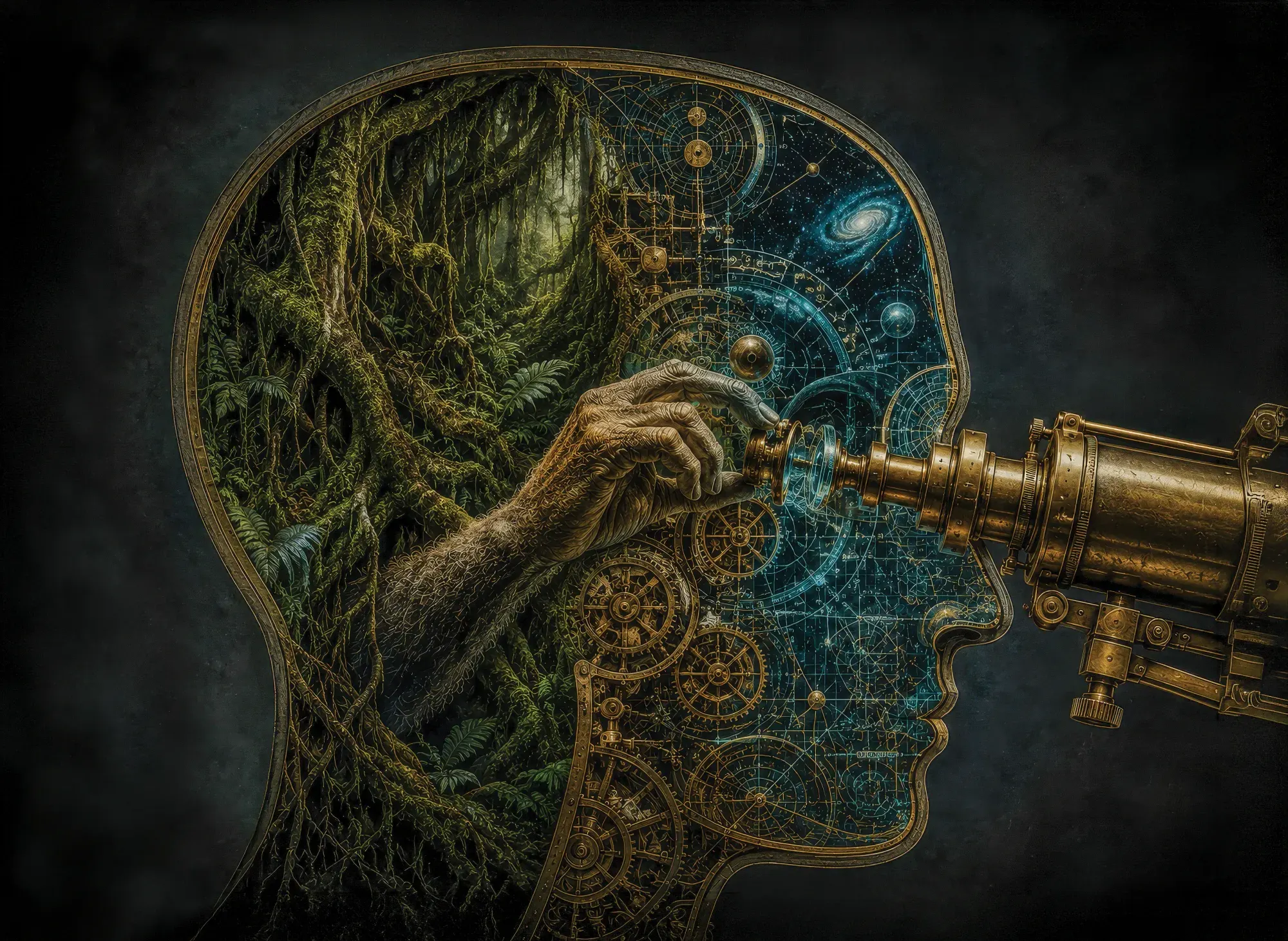
I was once a flat-earther. But probably you were too, so … Please. Allow me to elaborate.
Let us begin with the assumption that there is such a thing as objective truth. “Objective knowledge” means knowledge that is increasingly constrained by reality rather than by our preferences, intuitions, or inherited myths; put more simply, knowledge of a thing as it is, in-and-of itself, independent of us. For example, the heliocentric model of the solar system (sun-centered) is more objectively true than the geocentric model (earth-centered), even though it may not seem that way to us instinctively (and even if, in older calculations, the geocentric model can make as accurate predictions about planetary orbits as the heliocentric model).
Second, the human mind is no tabula rasa, or blank slate. It comes equipped straight off the assembly line, prewired with a variety of cognitive biases and other evolved, instinctive patterns of thought and belief. The brain is a collector of hacks that have helped us survive and reproduce successfully.
So, here’s the problem: our species’ brain (and mind) is not so much a truth detector as an interpretive device. It did not evolve to get at objective reality immediately or instinctively in order to see and know the world as it really is. Our brain evolved to aid us in survival and reproduction, which differs from acquiring objective knowledge. The two are related, of course, but not necessarily the same. In addition, evolution is an opportunistic, jerry-rigging process, and not always neat and tidy. Natural selection often involves haphazard workarounds or less-than-ideal solutions.
Objective knowledge, the ultimate goal of scientific inquiry, is therefore often counterintuitive (such as quantum physics, Schrödinger’s cat, or Einstein’s theory of relativity) and difficult for us to grasp. Science is our historically recent quest to know the world in this more objective manner. But we must overcome the aforementioned evolutionary prewiring to know, in a more objectively accurate and scientific manner, the actual nature of reality.
For example, the brain of the animal Homo sapiens did not develop to immediately, instinctively experience time or space in their objective sense, independent of us entirely. We evolved to think in terms of the time frame in which primate lives are lived: the time it takes to hunt, gather food, woo a mate, build a fire, or comfort a crying infant; the passing of day into night into day and the flow of the seasons; the cycles of the moon and menstruation; and the duration of a pregnancy, a child’s brief life, or an elder’s lengthy one. We instinctively think in terms of single and double digits: years, days, and months; how many family or tribe members we have; how many pieces of fruit and how many fingers and toes we have; and how many predators and prey there are.
Evolutionary fitness did not rely upon us understanding continental drift, evolutionary theory, numbers in the billions and trillions, or the visible spectrum of electromagnetic radiation (light) outside of the limited range between 380 and 700 nanometers. It is as a result of this instinctive immediacy that science is counterintuitive. It is cognitively challenging in a manner that many religious narratives, by contrast, are not.
This is the brain we inherited from our ancestors—the mind through which we know ourselves, our family and tribe, our world, and the cosmos. We never had much reason to evolve an instinctive capacity to immediately grasp micro- or nanoseconds, the speed of light, the age of a species or mountain range, or plate tectonics. For hundreds of generations of evolution, single and double digits were far more applicable to everyday life. So our brains evolved to think accordingly.
Science is not unnatural, but it is often counterintuitive. It requires us to correct the very cognitive instincts that helped our ancestors survive.
Genesis exemplifies this intuitively accessible origin story: a human-centered cosmos unfolding in a small, localized bubble in space and time, far more immediate than the objective story offered by the ever-growing body of scientific knowledge. We quite instinctively peopled the cosmos with spirits, animated forces, and the supernatural in our efforts to make sense of it all. Religion is ultimately rooted in instinctive cognitive predispositions such as agency attribution, the herd effect, and teleo (goal oriented) functional thinking, to name a few examples of what comes quite naturally to the human mind. Science is not unnatural, but it is often counterintuitive. It requires us to correct the very cognitive instincts that helped our ancestors survive: agency detection, pattern completion, teleological explanation, tribal conformity, and confidence in immediate perception.
It is clear that animism, paganism, and theism all come far more effortlessly to the human mind than does science. This helps explain why religion, including intuitively accessible origin stories like Genesis, is so easily taught to the very young, whereas scientific knowledge requires years of cognitive development and education.
Our mind must work hard to comprehend the incomprehensibly large, but also the similarly minute and tiny. Like deep time, which concerns the millions and billions of years required to comprehend such geologic phenomena as seafloor spreading, mountain uplift, and continental drift, our thinking is equally challenged when striving to understand the realm of the extremely minute, the microscopic organisms that truly dominate life on our planet are far beyond our day-to-day experience and instinctive comprehension. It was the invention of the microscope and telescope that really opened up these elemental and titanic new vistas, which had been previously inaccessible to us.
Science is a fairly recent human invention: a set of methods for disciplining intuition, imagination, social trust, and trained pattern recognition so that they can be tested against reality. Counterintuitive knowledge of objective reality can be made more accessible through the use of analogy, metaphor, and other forms of thought experiment. Such techniques translate objective reality into a form more accessible to our evolutionary instincts—for example, teaching that tectonic plates move at approximately the same rate as your fingernails grow. Or learning about Newtonian physics through the analogy of an apple falling from a tree, or billiard balls bouncing off of one another; these are familiar examples of the use of analogy to aid in comprehension. One very familiar thought experiment breaks deep time and the history of life into the more intuitively accessible single year or 24-hour day.
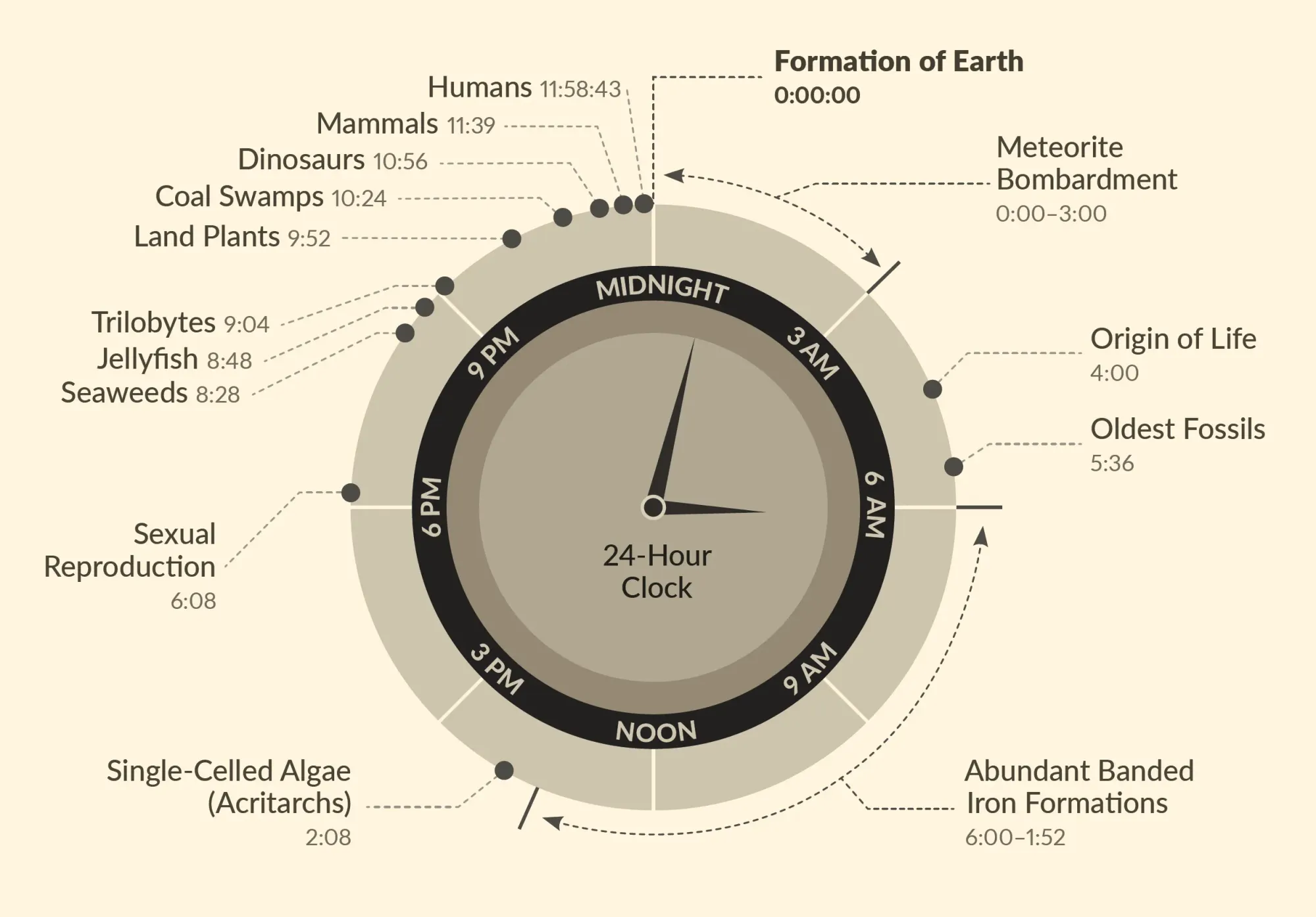
Evolutionary science illustrates the problem clearly. Many of us struggle to comprehend evolutionary theory because, in addition to its inherent threat to our long-standing and dominant mythological stories, it requires challenging, cognitively unfamiliar elements like deep time and imperceptibly slow incremental change.
Instinctive thinking is obviously natural. We are born with it. But so is rational, applied thought! Human brains appear to come equipped with both intuitive capacities and the potential for reflective, rule-governed reasoning. (The cognitive psychologist Daniel Kahneman called this Type I and Type II thinking.) The key difference is that rational thought is available to all merely as a potentiality. This potential is not fully realized automatically. It depends on two things: maturation and cultivation.
Maturation: Our natural process of cognitive maturation proceeds sufficiently, and reaches certain points of growth and natural development. A child of two or four years will struggle to comprehend evolution or deep time, no matter how smart or educated she is. But as she ages, she can understand better and deeper.
Cultivation: Education and training must accompany this process of natural development, and must reach certain degrees or levels of cultivation for the rational mind to begin coming online.
Evolution is an opportunistic, jerry-rigging process, and not always neat and tidy.
The brain of Homo sapiens is uniquely capable of complex cumulative and cooperative knowledge. We are a learning animal, perhaps more than any other. Human knowledge builds over time, transforming itself and transforming our species. Knowledge builds upon knowledge, ideally progressing toward greater accuracy and objective validity. But also constructing a better faculty for reasoning and rational thought. We get better at sciencing.
Maturation and cultivation are each necessary conditions in this process, but only in combination are they sufficient to produce a notably rational mind, one capable of thinking intelligently about scientific, objective truths. Increasing knowledge is intrinsically valuable, as most people who learn will readily attest. But it is also instrumentally valuable. The better our understanding, the more we progress and improve, individually and collectively.
This cumulative process can be thwarted by belief systems—religious or secular—that answer open questions with unfalsifiable certainties. When a question is answered with the magical or unfalsifiable, we simply plug supernatural stopgaps into the blank spots in our knowledge, leaving us with no more reason to seek. Curiosity and inquiry are slowed, warped, even halted. Human intelligence ceases to do what it does best—learn, grow, accumulate, and progress.
Our brains are magnificent survival machines, but science is the cultural technology we invented to keep those brains honest. As Carl Sagan noted in The Demon Haunted World:
For me, it is far better to grasp the universe as it really is than to persist in delusion, however satisfying and reassuring.