Should We Trust the Experts? Lessons From American Interventionism and the COVID-19 Pandemic
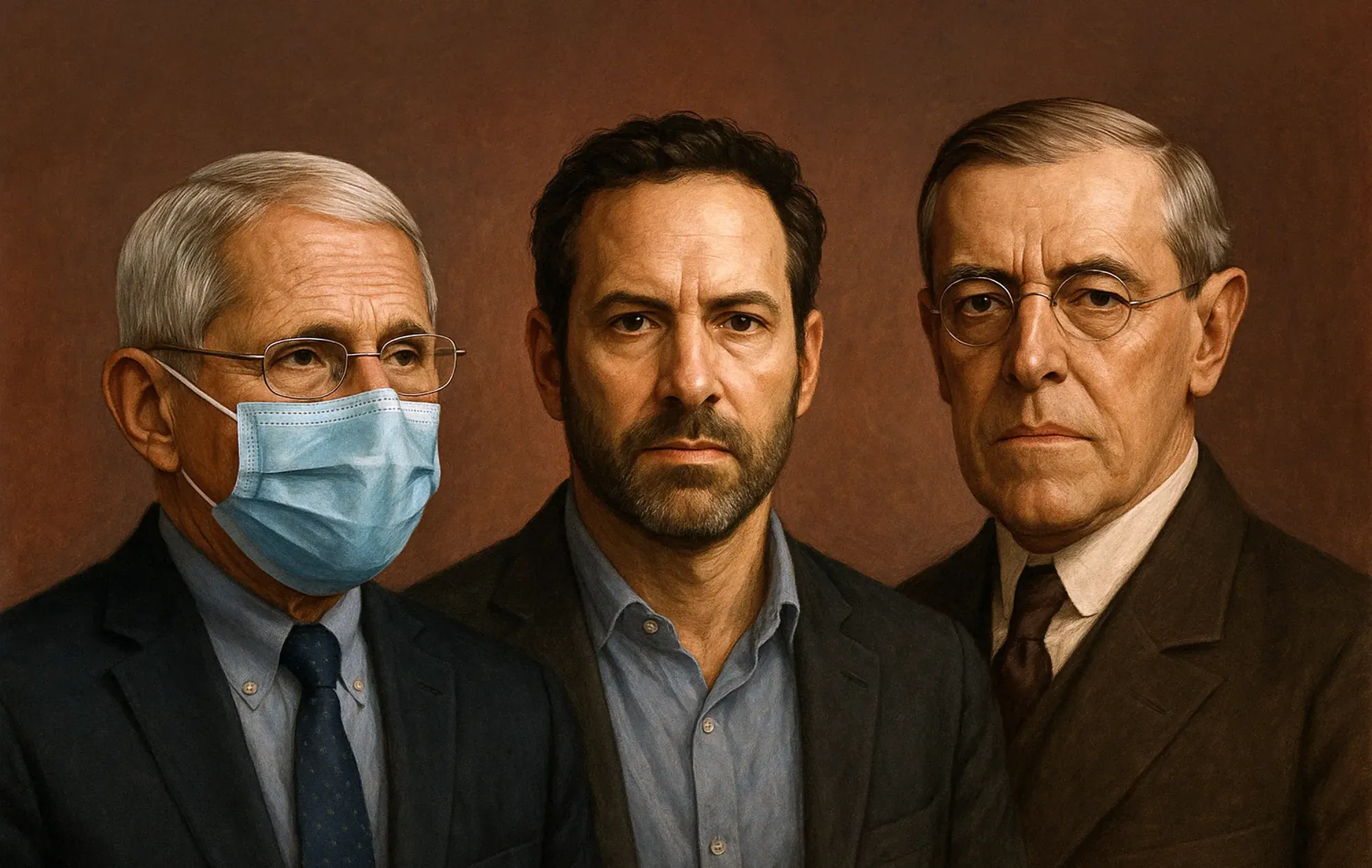
“The uncomfortable fact is that many [Harvard] reforms followed Mr. Trump’s inauguration and overlap with his demands. But if you’re standing in a downpour and Mr. Trump tells you to put up an umbrella, you shouldn’t refuse just to spite him. And doing things for good reasons is, I believe, the way for universities to right themselves and regain public trust.”—Steven Pinker in The New York Times
Woodrow Wilson’s Revenge
Some say democracies end in autocracy, but I say in bureaucracy. Seeing more danger in the latter, I see this as a time to praise Princeton man James Madison and condemn Princeton man Woodrow Wilson because the former helped create U.S. democracy while the latter helped destroy it with bureaucracy, stoking today’s populist responses, including Trump and DOGE.1 The national response to COVID-19 was fundamentally a Wilsonian response, a policy coup against democracy. It failed spectacularly. It was hardly the first.
In The Federalist Papers—essays in support of ratifying the U.S. Constitution—James Madison (with help from Alexander Hamilton and John Jay) developed a grand theory of government, with his guiding question being how government can control the people to assure order, defense, and freedoms, while controlling itself from unduly limiting those freedoms (Federalist Paper No. 51):
But what is government itself, but the greatest of all reflections on human nature? If men were angels, no government would be necessary. If angels were to govern men, neither external nor internal controls on government would be necessary. In framing a government which is to be administered by men over men, the great difficulty lies in this: you must first enable the government to control the governed; and in the next place oblige it to control itself.
Madison is rightly called the Father of the Constitution. George Washington depended on his interpretations. Like many of the Founders, Madison was an intellectual, but also had practical experience managing the Revolutionary War, electoral politics, and Congress. He understood better than most that men are not angels, and as he wrote in Federalist No. 10 “enlightened statesmen will not always be at the helm.” To limit the damage from both enlightened and unenlightened statesmen, Madison set up a complex government with three branches, including a bicameral legislature. Madisonian complexity frustrates action, but also defends truth and freedom, requiring pluralistic negotiation rather than autocratic coercion. As Jonathan Rauch argues at length in The Constitution of Knowledge,2 both U.S. government and academia depend on people being free to disagree without fear of reprisal. It is this pluralism, with its diverse views contending, that enables the processes of democratic government, along with effective science (Rauch’s “constitution of knowledge”). Regarding the former, Madison played a key role in passing the Bill of Rights, including the First Amendment, just a few years after the Constitution, largely as a political compromise with Jeffersonians who feared the Constitution unduly strengthened the national government. (Naturally, Jefferson rethought this once he led that government.)
The national response to COVID-19 was fundamentally a Wilsonian response, a policy coup against democracy.
All of this horrified Woodrow Wilson. I do not generally support toppling statues and renaming buildings, preferring retaining and explaining history to erasing it. Yet I approved when Princeton took former Princeton (and U.S.) President Woodrow Wilson’s name off its public policy school. Even for “a man of his time,” Wilson disdained women, Blacks, and pretty much anyone who was not an Anglo-Saxon or Germanic male. His longtime friend and comrade, Thomas Dixon, wrote The Klansman, the novel forming the basis for Birth of a Nation. As Wilson biographer (and former member of Congress) Christopher Cox put it, Wilson networked his way into a PhD by evading requirements, did mediocre scholarship (including some plagiarism), and preferred German theoriesof government to American practices of government.3 Wilson wrote an influential book, Congressional Government, while studying at Johns Hopkins University, but as Cox writes:
Even though he was living an hour from Washington by train, Wilson only stopped by the Capitol once during his years at Johns Hopkins. But Congressional Government was such an audacious attack on the Constitution’s system of checks and balances that it garnered instant media attention.4
The son of a slave-owning minister and Confederate army chaplain, Wilson saw society as hierarchical. He viewed Madisonian politics, in which relative equals negotiate agreements while representing dynamic constituencies, as fundamentally corrupt, even degrading. Naturally he liked Hegelian theories of government empowering elite experts to dominate the state. I see this as part of Wilson’s broader love of bureaucratic compliance over democracy.5 Broadly, Wilsonian approaches were a forerunner of cancel culture fetishes: Elites control the speech of nonelites in a sort of liberal authoritarianism, as empirical psychologist Luke Conway details.6
As a political theorist and later as president, in establishing professional bureaucracies supported by professional organizations7 as forces to be reckoned within government rather than as tools of elected politicians, the progressive Wilson pioneered many of the problems we face today, in which progressive bureaucratic “professionals” show more loyalty to their networks than to public service, or even truth. Even in recent memory, it was not always so.
The old elites were better.
I’m old enough to remember General William Westmoreland’s late 1960s statements about the U.S. military’s steady progress against the Communists in Vietnam. Then came the Tet Offensive, which, though very costly to the Viet Cong (VC), shattered expectations that an American and South Vietnamese victory was imminent. The 1975 fall of Saigon led to years of soul searching within the U.S. military. Relatively conventional thinkers like Army Colonel Harry G. Summers8 proposed that the U.S. avoid guerrilla wars to focus on what it does best—conventional high ordnance conflicts. Summers suffered critiques from renegades, often Marines, proposing that the defense establishment learn to fight whatever wars our politicians and adversaries choose.9
To be clear, the Vietnam War was horrible for Americans and far worse for Southeast Asians. Yet it had a bright spot. After defeat, the U.S. military acknowledged that it did not know what it was doing in Vietnam and could not simply expect even more men, more money, and more time for the same strategy and tactics the next time around.10 Significant segments of the defense establishment realized their standard operating procedures and compliance-oriented cultures tended to attract the worst and repel the best. A new breed of officers, including Colin Powell,11 spent years rebuilding the military, resulting in success in 1990s conflicts.
I posit that today’s elites are far worse, less insightful, more arrogant, more insulated, less honest, and more selfish than 1970’s military men. As Musa al-Gharbi details in We Have Never Been Woke: The Cultural Contradictions of a New Elite,12 colleges and other institutions produce more wannabe elites than high status corporate, professional, bureaucratic, and foundation jobs can employ, leading to ever more intense inter-elite competition. Second, the very long process of joining the elite, particularly by way of prestigious college admissions, assures that only the most compliant image managers make it, those mocked by former Yale Professor William Deresiewicz as “excellent sheep.”13 As importantly, 21st century elites do not seek to save souls or create new industries so much as become influencers, burnishing their brands, sometimes by canceling others. This leads to a cynical style of political activism that dramatizes (often imaginary) problems and then makes them worse. As Wilfred Reilly and I pointed out in a previous issue of Skeptic, Black Lives Matter activists created powerful symbols and won large grants, even as their policies killed hundreds and perhaps thousands of Black people annually. Not that academics or activists cared.14
Likewise, twenty years of failed U.S. and NATO military, social, and political intervention planned by the best minds of the West failed to stop the medieval and woefully underfunded Taliban. As Richard Hanania playfully writes in “Tetlock and the Taliban: How a humiliating military loss proves that so much of our so-called ‘expertise’ is fake,” failure in Afghanistan was “as if Wernher von Braun had been given all the resources in the world to run a space program and had been beaten to the moon by an African witch doctor.”15 Hanania cites Phil Tetlock, the psychologist who demonstrated that predictions by experts are no more accurate than those by informed nonexperts, perhaps since the latter need not worry about budget maximizing, institutional fealty, team loyalty, or demanding bosses. Likewise, as academic anthropologist Noah Coburn wrote five years before the fall in Losing Afghanistan: An Obituary for the Intervention,16 western military and aid bureaucrats could not disrupt their personnel cycles and career trajectories to spend sufficient time in the country to build personal relationships, in a society where personal relationships matter a great deal.
Though far fewer Americans died, in at least four respects our Afghan debacle was worse than Vietnam. First, it involved the entire Western world, not just the U.S. Second, the Taliban themselves are not exactly the VC and North Vietnamese Army.17 Third, and more importantly, unlike post-Vietnam military officers, today’s military bureaucrats do not seem to be trying to do better next time. Finally, the Abu Ghraib horrors in which poorly trained military police tortured prisoners gave the American Anthropological Association an excuse to do what it wanted to all along: publicly denounce the U.S. military and privately tell members that anyone who worked with the U.S. military would have trouble finding work in U.S. higher education. This left our forces ignorant of the very exotic country they were trying to help.18
In my main area of research, education (as detailed in the “Education Matters” issue of Skeptic, Vol. 28 No. 3), the schools of education that train teachers and leaders have always been academically mediocre, and indeed dismissive of the academic (as opposed to social) missions of schools.19 That was bad, but in the 21st century Ed schools got even worse, reinforcing mediocrity with wokeness. As David Marshall and I found, the 2024 American Educational Research Association (AERA) conference program had more mentions of race (531) than reading and math combined (507), more safe spaces (102) and queer theory (81) than COVID learning loss (68), and more on “resistance” (321) than anything but race. We found fewer than 20 mentions of student absenteeism, despite it being a top concern of educators. Phonics had just 15 mentions, some portraying it as a manifestation of White supremacy rather than a logical and effective way to teach English or any alphabetic language. Indeed, the schools of education that train teachers are skeptical of phonics, leaving millions of American teachers ill-equipped to teach reading.
I must note that, as its name implies, AERA is the preeminent educational research association. Not surprisingly, the most important and accurate empirical research on schooling has come from government contract researchers, many with little connection to Ed schools or AERA.20 It is also not surprising that AERA recently hired as its executive director the administrator who had spent hundreds of millions of dollars imposing Diversity, Equity, and Inclusion (DEI) on the University of Michigan, an effort that according to The New York Times made intergroup relations worse.21 Yet like other turf-defending Wilsonian bureaucracies and professional organizations, schools of education demand that the rest of us bow to their supposed expertise.
The COVID Coup de Grace to Public Trust in Experts
David Zweig’s exhaustive overview of the COVID school shutdown policy, An Abundance of Caution: American Schools, the Virus, and a Story of Bad Decisions, is the kind of bold exposé of large, nontransparent government bureaucracies that reporters often produced in the Vietnam era, but not so much since, and almost never of liberal bureaucracies. Yet, more than General Westmoreland, the architects of COVID school closings had it coming. As Zweig writes, “[Trusted] professionals in the public health establishment failed to accurately interpret the evidence, and they neglected to convey the uncertainty and enormously consequential trade-offs around a range of actions and outcomes.”22 Much like Black Lives Matter activists, they also failed to publicize the most important statistics, so that nonexperts free from institutional groupthink could scoop the experts (just as Phil Tetlock predicted).
As my coauthors and I first wrote in spring 2020, the first 15,596 COVID deaths in California included just three school-aged children, fewer than for many flu seasons. Just 1.5 percent of California fatalities were under age 35 while 64 percent were 70 or older, proportions that changed little during the pandemic. To be clear, the public health community was not dealing with shadowy enemies hiding in tropical jungles. They received daily reports from hospitals and morgues. Surely they knew that young people were safe. Yet “authorities” never told the public in any clear way, nor did legacy media.
The Vietnam war was horrible. Yet it had a bright spot. After defeat, the U.S. military acknowledged that it did not know what it was doing.
This was disinformation far worse than anything attributed to General Westmoreland. Naturally, the public—and particularly young people—perceived their risks of dying as orders of magnitude higher than they were.23 The influential laptop class was alarmed beyond logic. I know people who pretend to care about equity but spent a year having hired hands bring their meals and groceries. Authorities assured the proles that COVID-19 was the Black Plague. Yet by mid-2020 few knew anyone in good health and under 65 who died of the virus. Such cases were rare, except in the media and social media. Figures such as California Governor Gavin Newsom and White House public health expert Deborah Birx flouted the lockdown rules they themselves imposed.
Several aspects of Zweig’s telling were particularly depressing to anyone who wants people to trust the authorities, who, after all, did create safe vaccines in record time. First, our elites fixated on Chinese bureaucracies, with their ability to surveil people, control their movements, and decide what is and is not misinformation.24 What could go wrong? U.S. authorities chose to believe obvious propaganda that the Chinese Communist Party slowed the spread of the virus, which of course came from a wet market, not (as now seems likely) a lab leak. To be clear, though it has a free market, China is a politically totalitarian state that has not published youth unemployment statistics in years because the news is bad. That our so-called expert class trusts and seeks to emulate the CCP should be disturbing beyond belief. Maybe MAGA populists are not always wrong?
Second, authorities chose to believe their own abstract, nontransparent models over real world evidence from Europe, from U.S. states that reopened schools early, from private schools that never closed, and even from states such as New York where government-provided day care with essentially no COVID precautions for 50,000 children of essential workers! In Zweig’s telling, none of these suggested that opening schools would notably increase COVID transmission or fatalities. The utility of six-foot social distancing between students was based on a questionable interpretation of an 1897German study of bacteria, not viruses. Anthony Fauci, who repeatedly promoted the six-foot social distancing that would render school openings difficult, admitted in later congressional testimony that it had no empirical basis. So did NIH leader Francis Collins. Yet their critics were accused of ignoring the (in fact nonexistent) science!25 Six-foot social distancing became the de facto law of the land for reopening schools. Authorities ignored, belittled, or suppressed evidence. Dissenting researchers such as Jay Bhattacharya (then a professor at Stanford, now the Director of the NIH) barely escaped with their careers. While writing Abundance of Caution and related articles, Zweig received numerous off-the-record communications (he quotes many) from researchers supporting his interpretations and regretting they could not go public for fear of termination. As a broad literature on U.S. academia shows, their fears were rational.26
Third, as Zweig documents, just when sanity was reappearing, impassioned political opposition to Donald Trump derailed it. Despite the public health community’s liberal authoritarianism, in summer 2020 a quiet consensus was emerging that schools should reopen in the fall. This was in fact what authorities had promised at the start of lockdowns—that school closures were short-term expedients to flatten the curve so that hospitals would not be overwhelmed, one of many promises made in the early days of COVID that was later forgotten. The American Academy of Pediatrics (AAP) issued a statement at the end of June that argued forcefully for opening schools.
But then, on July 6th, after months of tweeting thousands of times on everything but COVID, President Trump tweeted “SCHOOLS MUST OPEN IN THE FALL!!!” The reaction was immediate. AAP walked back their statement, soon joined by teacher unions (which never wanted to reopen schools but always demanded more money), school administrators, Democratic politicians, and news media. Most argued (disingenuously) that they wanted to reopen schools, but without massive retrofits (strangely unneeded in Europe and red states) reopening would endanger the children, who in fact faced statistically greater threat from flu. Swedish schools, which remained open through the spring, suffered no deaths among a million-plus students and little transmission to others—but what is mere evidence compared to “the science,” or rather orders from authorities?27 Nearly all our elites were lying, if only to themselves.
Should we forgive some of these missteps? We should not, as the immeasurably costly mistakes were not made in good faith. First, the “authorities” put their hatred of Trump above the well-being of children and their respect for public service. Second, those children paid a high price in lost learning and damaged mental health, with the least fortunate harmed the most. Third, science cannot work if powerful people forcefully silence critics rather than answering their concerns, even sometimes admitting that we do not have all the answers. During the COVID-19 pandemic, the public health community, school leaders, and elite media acted like Trofim Lysenko, though thankfully with less lethal tools at their disposal. Twice, physicians complained to Zweig not that he was wrong, but that by “calling attention to the lack of evidence or conflicting evidence for a particular policy I was causing harm by allowing Trumpers to question the CDC. I wasn’t wrong, but I was helping the wrong people.”28 No wonder Trump, a candidate whose virtues hardly plead like angels, nearly won in 2020 and did beat the bureaucratic29 establishment in 2024.
To return to Tetlock, Zweig notes that three of the four most accurate models of COVID spread came from outside the public health community, created by the director of a software forecasting company, a physicist, and a management consultant, respectively.30 So why do we even have a public health community? With the notable exception of vaccine researchers, during COVID we would have done better without one. After all, despite having a far larger proportion of senior citizens, Florida, which did little to stop COVID, had relatively fewer fatalities than California, the state that did everything the public health community wanted (while letting important people like the governor do whatever they wanted).31 Likewise, Georgia faced media denunciation for its “experiment in human sacrifice.”32 Reporters never apologized when Georgia’s COVID cases then fell. Voters remembered, rewarding Governor Kemp with a landslide reelection. Throughout Abundance of Caution, Zweig offers examples of voters having more accurate perceptions than the various well-credentialed, Wilsonian establishments. So far as I know only one member of that establishment has apologized—former NIH Director Francis Collins.33
I would fault Zweig for one thing in his readable, but magnificently detailed book. Though a man of the left, Zweig lets President Trump off the hook. Federal bureaucrats answer to presidents. Trump, as president for the first months of the pandemic, had a responsibility to question officials about their recommendations and terminate those who could not explain their rationale for school closures and other costly, questionable COVID policies. Trump could have bypassed the media to explain why to the public. The whole point of having an outsider president is to shake up the bureaucracy—so why didn’t Trump do so? By May 2020, I knew that COVID chiefly affected old people and that European schools reopened with great benefits and few costs. If I knew all that, why didn’t the President?
Safeguarding Democracy From Bureaucracy
Our massive mishandling of COVID represents the ultimate triumph of Woodrow Wilson’s vision: insulated, arrogant elites expecting unquestioning obedience from the masses. It also represents the ultimate triumph of Progressive education, teaching elite solidarity and mass obedience to authority, rather than the knowledge enabling everyone to (politely) question authority, as I and other pluralist political scientists have long critiqued.34 In the short term, the establishment paid a huge price. Trump is back. The administration is forcing elite universities such as Harvard to reform, as Steven Pinker noted in the epigram of this essay. DOGE is cutting jobs sought by those who prefer administrative or symbolic positions over essential frontline work, such as teaching or law enforcement. Perhaps, like the U.S. military in the 1970s, the public health establishment, academia, and legacy media will learn. After all, outside of Democratic nominees for New York City mayor, almost no one talks about defunding police anymore.
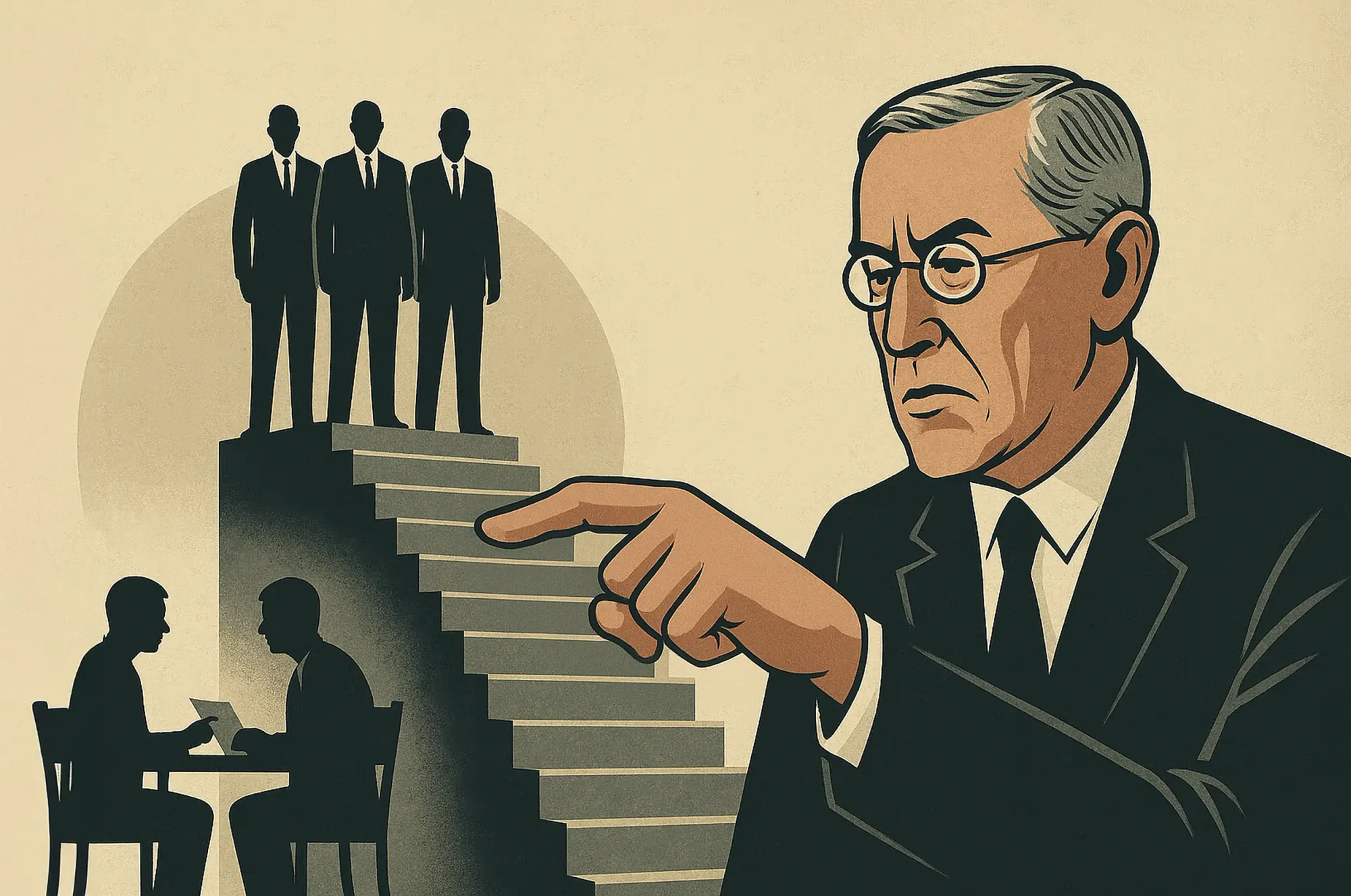
Yet authoritarians remain in the shadows, ready to maximize their power at the next crisis, or when Democrats retake the White House. Some have failed upward. Anthony Fauci is a bestselling author, liberal icon, and, unlike Zweig, lauded by PBS. As the latter notes, sketchy COVID pundit Megan Ranney who denounced reopening schools as racist is now dean of the Yale School of Public Health, shaping the education of future public health “experts.”35
Over the long term, possibly, education could enable the public to question elites, and elites to embrace Madisonian pluralism rather than Wilsonian despotism and self-interest masquerading as scientific authority. For direct action, I urge anyone who knows a member of the medical, media, educational, or public health establishments to (politely) ask them what went wrong during COVID. Why did Florida suffer fewer per capita COVID deaths than California? Have they learned anything from that experience? Ask respectfully but firmly why we should trust them after so many of their recommendations proved misguided at best, and plain wrong at worst. Next time—and with globalization there will be a next time—will they let us ask questions? Will they base major policies on science rather than irrelevant papers from 1897? Will they transparently consider the costs and benefits of different options? Or just demand obedience to authority? Will they intimidate critics into silence by threatening their jobs, grants, or social media reputations?
Let’s hope such questions are answered in an open, rational manner before the next pandemic hits, which it surely will in our lifetime.