Simon Winchester (1944–2026): Our Final Interview
Simon Winchester was the acclaimed author of many books, including The Professor and the Madman, which was adapted into a film starring Mel Gibson and Sean Penn, as well as The Men Who United the United States, The Map That Changed the World, and Krakatoa. His books have been New York Times bestsellers and have appeared on numerous best-of-the-year lists. In 2006 he was appointed an Officer of the Order of the British Empire (OBE) by Her Majesty the Queen. His final book is The Breath of the Gods: The History and Future of the Wind.
Wind helped scatter the Spanish Armada and, centuries later, carried radioactive fallout onto a Japanese fishing boat far from a nuclear test site. It also made possible the voyages that brought people to islands separated by thousands of miles of Pacific Ocean. In his final book, The Breath of the Gods, Simon Winchester (1944–2026) follows these connections through history, asking how people learned to harness the wind and what happened when they misunderstood it.
For the author of The Professor and the Madman and Krakatoa, the book began with a more immediate puzzle. He had read about research suggesting that average wind speeds across mainland Europe were declining. That finding surprised him: the storms making headlines seemed to suggest an increasingly violent atmosphere. He wanted to understand what wind was doing, how it was measured, and whether the patterns on which people depended were changing.
In this conversation with Michael Shermer, recorded in November 2025, Winchester discussed the science behind these stories, and much more about what ended up being his final book.
Michael Shermer: How did you end up writing a book about wind?
Simon Winchester: Someone asked me the other day, “How on earth did you manage to persuade your publishers to allow you to write a book about wind?” It took a little bit of doing. They weren’t initially terribly keen, but I think they’re reasonably happy now.
I read a piece in The Guardian about research suggesting that, totally counterintuitively, the average wind speed in mainland Europe in the first ten years of this century had fallen by something like 15 percent. This seemed just not possible. Everything seemed to be getting worse and more dramatic and more fierce, and yet we were told the average wind speed was going down. We were in the grip of something called the Great Terrestrial Stilling.
There are a lot of books about climate and weather, but not so many about wind, because it’s invisible and difficult to pin down, as it were.
I thought, that seems interesting. Why don’t we look a bit more closely into the whole idea of wind: what it is, what is happening with it, and why? There are a lot of books about climate and weather, but not so many about wind, because it’s invisible and difficult to pin down, as it were.
Doesn’t a warming planet mean more energy in the system, and therefore stronger winds?
You’d think so. But there are two arguments in favor of stilling, if it is happening, because that’s another matter. One is that the Earth’s surface is getting more rough. There are more things to interrupt the passage of wind, notably big buildings and big cities. That argument doesn’t really seem to hold water.
The other is to do with climate change. It’s not so much that the Earth is getting warmer; it’s the differential between the really hot equatorial regions and the polar regions, which aren’t as cold as they used to be. Because that differential has decreased, it seems to be causing a lowering of wind speeds overall.
However, the latest statistics suggest that the stilling may not be occurring as much, and may be diminishing. There’s a new term of art being used: the Great Terrestrial Reacceleration. So this may have all been a figment of every meteorologist’s imagination.
What does it take to measure wind in a place like Mount Washington?
I had my big birthday, my 80th birthday, on the summit of Mount Washington in New Hampshire. They take a whole host of measurements every hour, on the hour, night and day. These poor volunteers, when you see them in the middle of winter going up this sort of periscope tube, out onto where the wind may be blowing. They have rubber mallets to bash away the accumulated ice from their instruments.
It’s a brutal place, but they give us the data. Here they’ll say, “On the summit of Mount Washington this morning, visibility may be 500 yards,” or something, “but wind speed, 120 miles an hour.” And you think of those poor people having to do that. By the time they get down again, it’s time to suit up for another reading.
Most of the weather in the United States is going from west to east. Storm tracks generated in the Pacific Northwest, or down in the Southwest, funnel over the Great Lakes and approach this great wall of mountains in New England. The terrain squeezes the wind, and it accelerates. Then, once it gets past the mountains, it expands again, slows down, and flows out to sea. There’s a very specific reason why they chose Mount Washington as a premier weather station. And this is not just a matter of wind speed. Imagine having to go outside in those conditions when the temperature is twenty degrees below.
In your book, you describe B-29 bombers having trouble making progress toward Japan. What were they encountering?
The jet stream. A Japanese researcher called Oishi sent up balloons and found that, once they got above about 25,000 feet where he was, they were suddenly swept eastward by a ferociously strong wind he hadn’t known existed.
He observed it in great detail and published a paper, and no one responded. He thought this was peculiar, because he was a seasoned meteorologist and knew the meteorological community was vibrant and intellectually alive and keen to read and write about research. So he wrote another paper. And he kept publishing more papers saying, in one way or another, “I have discovered this new phenomenon.”
He wasn’t writing his papers in English, or in Japanese, but in Esperanto. This was the unusual global language that a lot of early twentieth-century people thought would unite the world in peace. He was an idealist, and president of the Japanese Esperanto Society.
One of the early bombing raids was to send a force up from Saipan, I think, to attack a radio factory north of Tokyo. The agreement was that they’d meet somewhere near Mount Fuji, make sure everyone was there, and then head east to the factory.
What they didn’t know was that the altitude they were at, as they assembled over Mount Fuji, took them into the jet stream. They found themselves going uncontrollably fast over the radio factory. The pilots and the bomb aimers were caught unawares by a wind Oishi had already told us was there. But we didn’t know.
You can notice this yourself when flying from Los Angeles to New York. It takes almost an hour longer to get back.
I have to go relatively soon from New York to Auckland, New Zealand, nonstop. Going westbound, or southwestbound, it’s 18 hours and 15 minutes. Coming back, 15 hours. A three-hour difference!
Wind also carried the fallout from nuclear tests to people who were nowhere near the explosions. You tell the story of a Japanese fishing boat, Lucky Dragon No. 5.
The big bomb was called Castle Bravo. It was a miscalculation, much larger than they thought it would be. To the east of the test site was this Japanese fishing vessel. They were putting their nets in the water, or retrieving them after overnight fishing, when they saw an enormous light far away to the west.
Then what appeared to be snow fell on their little boat: large flakes of a white, leafy substance. They had no idea what it was. They held out their hands and caught it, and it didn’t melt as snow might have done.
They became very, very sick and sailed slowly back to Japan. It was a couple of weeks’ sailing, and they were getting sicker and sicker, losing their hair, vomiting, all sorts of things going wrong with them. They went to the little hospital in the town where their fishing boat was based. The doctors there had no idea what this was about. They were sent to Tokyo, where doctors realized it was radiation poisoning.
I don’t want to get on a pedestal and turn this into a polemical book, but everything about nuclear weapons is so ghastly.
There is also this postwar belief in Japan, wrong of course, that people who suffer from radiation sickness are contagious. They’re not, but they were shunned. People didn’t want anyone to know they’d been contaminated with radiation. This applied to survivors of Hiroshima and Nagasaki, and now to these poor fishermen from the Lucky Dragon.
The whole thing is a sad reminder. I don’t want to get on a pedestal and turn this into a polemical book, but everything about nuclear weapons is so ghastly.
One of the book’s stranger stories concerns wind on the Moon, where there isn’t supposed to be any.
For there to be wind, there has to be an atmosphere, and there has to be a source of heat to get that atmosphere moving. The Moon has no atmosphere and consequently no wind.
When Neil Armstrong and Buzz Aldrin visited, they needed to mark the moment. What better way for Americans to mark it than to erect a flag? But they realized Old Glory wouldn’t fly. It wouldn’t flutter, because there was nothing to blow it. So they produced a vertical aluminum pole to stick into the lunar surface and a horizontal pole from which the flag would be suspended.
The photographs were duly taken, the salutes were made, everyone was happy. Then the lunar lander took off, producing exhaust gases, and the wind did what winds invariably do: blew things over, including the flag. The flag that had been so proudly hoisted fluttered to the ground.
How did people first learn to make the wind take them where they wanted to go, even against a river’s current?
I’m fascinated by the whole creation of the sail and its development. I think it was Thor Heyerdahl who remarked that man hoisted a sail long before he invented a wheel.
If you wanted to travel somewhere, you could get to a river, the Tigris or the Euphrates, put a log in it, and sit astride the log. The river takes you somewhere, not necessarily where you want to go, but it moves you. Then someone has the right idea of sticking a vertical mast, as we would now call it, into that log, and suspending the skin of an animal from it.
You find that by moving the skin you can direct where your craft is going: maybe to the other side of the river, or along it, or in certain cases against the current, if the wind is strong enough to propel you.
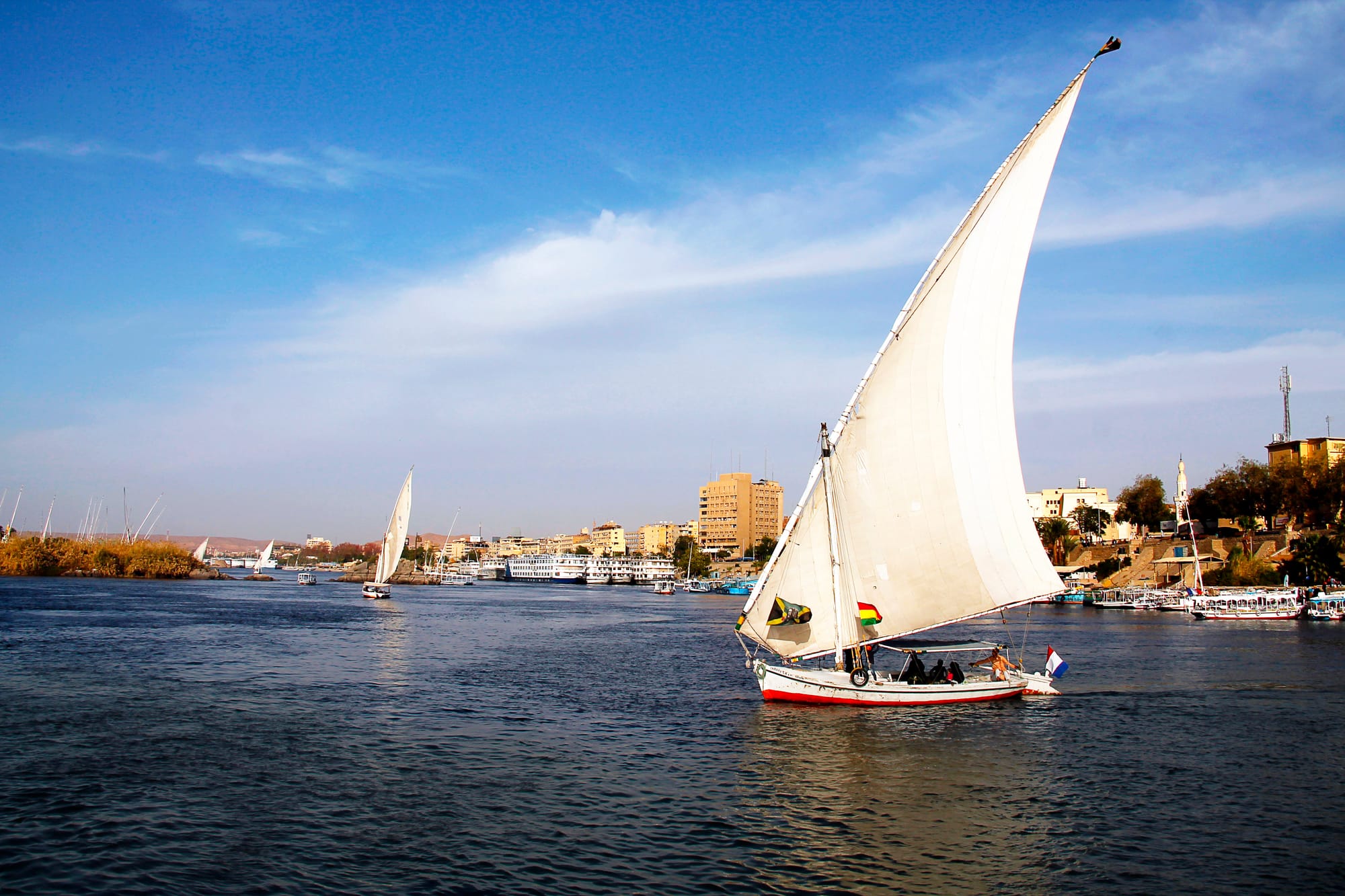
The sail developed in Mesopotamia, and really well in Egypt. The felucca, the single-masted boat with a triangular sail that you find on the upper Nile, in places like Luxor, is still very much a mode of transport on that river. It gives you the ability to control your passage downstream with the current toward Alexandria and the Mediterranean, but also upstream, against the current, using the wind to help propel you. A great revelation.
It developed in different ways in Europe and on the other side of the planet. When the wind is blowing and you’re in a single-masted or double-masted vessel, you lean over. It can get very dangerous if the wind is strong.
The Polynesians, who must rank as the greatest navigators on the planet, had the outrigger: an extra hull attached to the main hull by horizontal struts. It makes capsizing very difficult. They could sail very fast, very close to the wind. Not directly against it, but close to it, which is where we get the phrase.
People were distributed by sails, by canoes, and by the wind.
Using outriggers, they went thousands of miles. If you’ve been to the Pacific, there are very few islands and huge distances to cover between them. Yet they did it. Their journeys spread across this huge triangle from Hawaii in the north to Easter Island in the east and Aotearoa, New Zealand, to the southwest. Within that triangle there’s hardly any land surface. People were distributed by sails, by canoes, and by the wind.
Eventually those small craft became the enormous sailing ships that carried world trade. What did it take to sail one around Cape Horn?
The one I particularly like is the Peking, which used to be moored in New York Harbor before it went back to its home port of Hamburg. A four-masted vessel carrying manufactured goods from Germany, through the North Sea, down the English Channel, down the Atlantic, around Cape Horn “the wrong way”—against the prevailing westerly winds—and up into the comparatively peaceful waters of the Pacific.
She docked in Valparaíso, outside Santiago in Chile, unloaded the German products, and returned with cargo that fertilized the fields of Europe. This time she was going around Cape Horn the right way, with the wind. That trade employed ships that were unbelievably heroic in dealing with those ferocious winds.
If you ever get the chance, watch the home movie made by an American sea captain called Irving Johnson, who filmed himself and the ship he was on going around Cape Horn. It is one of the best, most exciting marine adventure films I’ve ever seen. So treacherous, so difficult to navigate, and the strength of the men involved…
Imagine being in a force-12 gale, in bitter cold and driving snow, the ship heeling back and forth over ferocious waves, close to the rocks of Cape Horn at the southern tip of South America, and having to haul up a sail by hand when the sail itself is stiff with ice. Everything is slippery with ice! The chances of falling off into the sea are very high. And he would be filming. It’s an amazing film to see.
I’ve flown across the Pacific at 550 miles an hour, looked down, and seen almost nothing. How did navigators cross those distances without our instruments?
I always love the moment when Captain Cook, one of the great explorers, and an imperialist, yes, no doubt, but a great explorer and navigator, arrived in New Zealand. He had a Polynesian seaman he’d picked up in Tahiti. They came to a beach in the Endeavour, and the man from Tahiti was able to go out to the bowsprit and address the people ashore. They understood his language perfectly. The language had been spread by the wind.
In 1976, the Hawaiians decided to sail a traditional canoe, Hōkūleʻa, from Hawaii south to Tahiti without navigational aids. They found a man in the Caroline Islands, on an island called Satawal, called Mau Piailug. He knew how to navigate, and they brought him up to Honolulu.
They said, can you navigate this down to Tahiti without a compass, GPS, radio, even a wristwatch? He said, yes, I can. He put a little hammock in the back, and they left and headed south. He knew where that was from the position of the sun. Two and a half thousand miles of open ocean.
After about a month, he said that at two o’clock the next morning they would see an island. And they got there. It was extraordinary.
The ability to navigate across these vast distances using things like the feel of the waves, the sound of the sea, the seabirds, the position of the stars, of course: many younger Hawaiians now know how to do it, courtesy of the Polynesian Voyaging Society.
Through navigation, they’re reclaiming their identity. So once again, they are hugely grateful to and dependent on the wind, and consequently fascinated by it.
Wind is everywhere in language: windbag, windshake, windward, windsucker. The Oxford English Dictionary has hundreds of examples. In your book, you also write about the traditional Chinese character for wind.
The Chinese symbol has an insect character buried inside the main character. It was believed that winds bring insects. I suppose, to an extent, they do bring locusts and so forth. There was an association in the Chinese mind between wind and insects. So the character for wind, feng, has an insect radical buried inside it.
One could have filled several pages with words relating to wind. And so many people misspell my name. They think it’s Win-D-chester, with a D!
Simon Winchester passed away at the age of 82 on November 3, 2026, at his home in Sandisfield, Massachusetts.