Skeptic Interviews James Fox
Skeptic: Are space aliens visiting Earth?
James Fox: I was the biggest skeptic. And here I am, having delved into this, traveled around the world, and met with witnesses, military radar operators, and fighter jet pilots. I honestly feel like I have less of an understanding today of what’s going on than I did over 30 years ago. I really don’t know if the phenomenon is real.
What are its origins and intent? I don’t have the foggiest clue. I really don’t. I wish I knew. And I’m starting to come to the realization that I’m just not going to know. I’m probably never going to find out. And it’s kind of frustrating.
Skeptic: And here you are 30 years later. I’ve watched all those films. You go on Amazon Prime and type in UFOs, and there are just pages and pages of them. But yours are, by far, the best. The Phenomenon, and then your recent one, Moment of Contact, really stand out head and shoulders above the others.
I know The Age of Disclosure is the big talking media event at the moment. That’s fine. But I like your films better. It’s clear, when you pile it all together as you do, with striking visuals and beautiful cinematography of the people you’re interviewing, that there’s something going on.
So I guess the question is: What is it?
Leslie Kean says in her book UFOs: Generals, Pilots, and Government Officials Go on the Recordthat roughly 90 to 95 percent of UFO sightings can be explained as weather balloons, flares, sky lanterns, planes flying in formation, secret military aircraft, birds reflecting the sun, planes reflecting the sun, blimps, helicopters, the planets Venus and Mars, meteors and meteorites, space junk, satellites, swamp gas, spinning eddies, sun dogs, ball lightning, ice crystals, reflected light off the clouds, lights on the ground or lights reflected in the cockpit window, temperature inversion, lenticular clouds. And the list goes on.
So what we’re really talking about here—and you’ve very adroitly put this together—is that remaining five to ten percent that really stands out.
If we can agree that 90 to 95 percent have prosaic explanations, what do we do with those anomalies? In the history and philosophy of science, it’s always the anomalies that drive new revolutions and discoveries. The old theory doesn’t account for this, so what does?
Maybe we just say, “I don’t know.” But somebody must know. This isn’t like some paranormal or supernatural phenomenon, like whether there’s a god or not. NASA isn’t going to find out if there’s a god. But NASA could find out if aliens have come here, in principle.
Marco Rubio was in your latest film, and I’d like to think that if we had something he could tell us, he would tell us what it is.
Fox: It’s certainly interesting when you think of someone at his level within government. He’s not retired. He’s current. He was a senator at the time of the interview.
I remember interviewing Jimmy Carter. I think I was one of the first people to get Jimmy Carter on camera admitting that he had looked into UFOs during his presidency. He also had a sighting, which he talked about when he was running for president.
Then I got to interview President Gerald Ford. And then the Clinton’s Senior Advisor John Podesta. And, indirectly, President Bill Clinton. And all of them said they tried to get to the bottom of the UFO phenomenon, and one of the things I walked away with was along the lines of what Rubio said: presidents are often kept out of the loop. Carter said that they made inquiries and essentially weren’t happy with the answers they were getting.
John Podesta said the same thing during the Clinton administration. I don’t know if you remember this, but Lawrence Rockefeller was putting some serious pressure on the Clinton administration for transparency on the UFO topic. In fact, he went as far as saying, “If you don’t, I will publish an article about it in every magazine, state to state.” So Clinton said, “Okay, give me a case you want me to look into.”
They came back and said, “Roswell.” Evidently, the Clinton administration made a serious effort to look into it, and they weren’t happy with the answers they were getting. They felt they were just getting the runaround.
Of course, I don’t have a president directly saying, “I was kept out of the loop.” But I have President Ford saying he wasn’t happy with the answers he was getting. Carter said they made inquiries, but the responses were all over the place. And I know the Clinton administration, according to Podesta, wasn’t happy either. They felt they were getting the runaround.
Let’s just say, for a moment, that we suspend judgment. If there were some unknown government agency—not elected officials—operating in complete secrecy, and if they did have, hypothetically, in their possession a non-Earth origin spacecraft or nonhuman intelligence and wanted to keep it secret for whatever reason, I probably wouldn’t tell the president either.
Elected officials come and go every four to eight years, so it kind of makes sense that if you wanted to keep a secret of that nature, you wouldn’t want to give it all to the president. I don’t know. That’s just speculation. I’m told—and I could be wrong—that the last president who had a pretty good or bigger picture of the UFO topic was President George H.W. Bush.
Skeptic: Well, Trump’s latest statement on this is that he’s talked to a lot of people who seem convinced there’s something there, but he hasn’t seen anything that convinces him. Maybe it’s what you’re saying, that presidents just don’t know everything.
Fox: It really makes you wonder. When I was still on the fence about what UFOs represent, I went to the 50th anniversary of Roswell in 1997. I am interested enough to be out there poking around and asking questions, and I met many people who had been firsthand witnesses to the event when they were in their 20s or 30s. Now they were in their 70s and 80s, and across the board they told me on camera that their lives were threatened if they spoke up. They literally said that not only would they be picking their bones out of the desert, but their family’s bones as well. I’m not saying I categorically believe that just because they said it. But the different people I met seemed genuinely convinced that those threats were coming from above.
Skeptic: Why don’t the whistleblower laws we have in place protect those people now?
Fox: I don’t know. I’ve tried to get them to come forward to participate in different films I’m doing, but something is causing many people to not want to go public with what they know. That said, I agree that the more extraordinary the claim, the more extraordinary the evidence has to be to believe it, so at the very least you want them to talk or reveal details that can be verified.
David Grusch has made some pretty extraordinary claims, and if they’re true, the implications are profound, not just for the United States, but globally. These people seem legitimately fearful, not just about losing their security clearances, but about their personal safety.
I’ve met some of them behind the scenes. Maybe they’re lying to me. They didn’t come to me; I came to them through other people. But they’ve said the protections are not in place. There isn’t enough security for them. They believe they’ll lose their clearances, lose their jobs, and some even fear they could lose their lives.
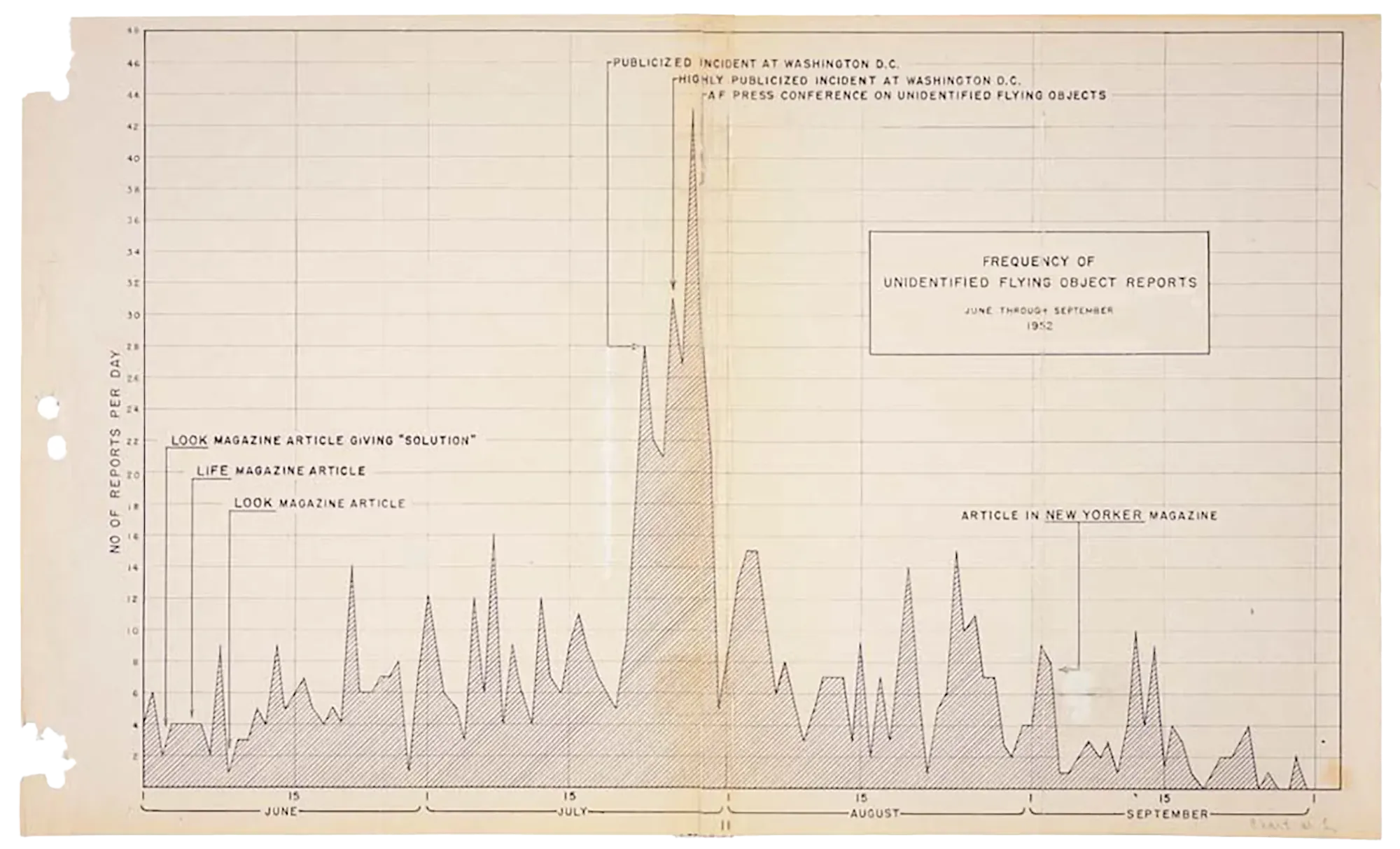
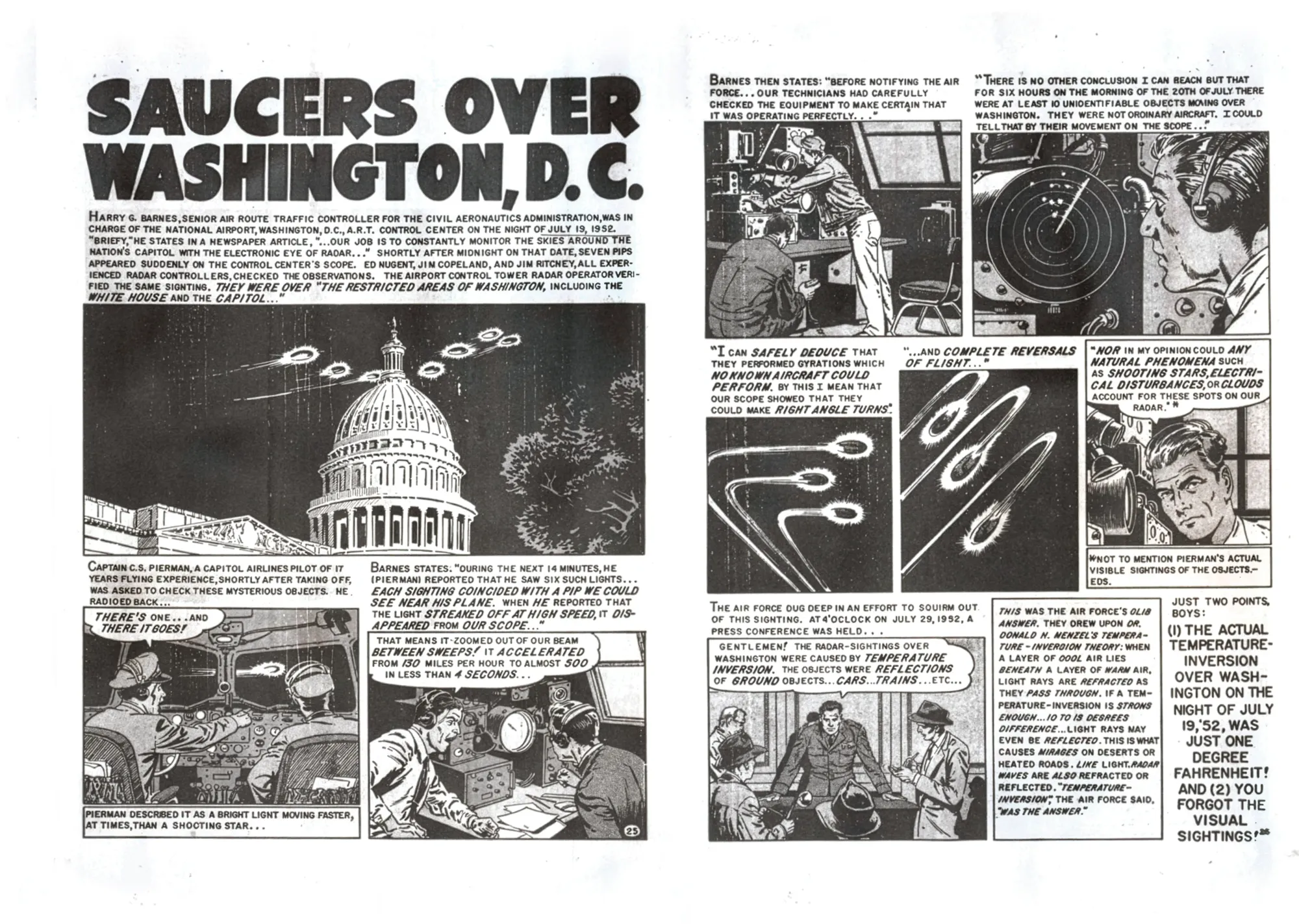
In the 1950s, you had the massive flyovers of Washington, DC, over two consecutive weekends. You had orders to scramble jets to intercept these.
I’m not saying I believe that or don’t believe it. But that fear is a legitimate concern among the individuals I’ve met with. In 2023 they tried to pass the UAP Disclosure Act, which included whistleblower protections. It passed in the Senate but not in the House.
Skeptic: In your film The Phenomenon, you end with an interview with Gary Nolan at Stanford. He says he’s seen stuff and he knows stuff. You ask him: “All right, can you tell us what you saw?” And he says he’s not going to say one way or the other.
Why would a tenured college professor be worried about telling you what he saw? Aren’t there protections in place for freely speaking his mind?
Fox: This is what I’ve been told: because it’s national security, people can just be picked up. There’s no due process. You can be taken and put behind bars. It doesn’t have to pertain specifically to UAPs or UFOs. It could be nuclear secrets or something like that. The concern is violating NDAs or anything related to national security.
Skeptic: I asked Garrett Graff about this. He has a 500-page book called UFO: The Inside Story of the U.S. Government’s Search for Alien Life, Here and Out There. He’s a good journalist and historian. He wrote books on the FBI, 9/11, Watergate, and Raven Rock—about the government’s Cold War doomsday plan, where the heads of the cabinet would go to underground bunkers.
He said, “The problem I have with government conspiracies is that they presuppose a level of competence that is not on display in the rest of the work the government does. I just don’t believe the government is capable of keeping a secret at scale like this for any meaningful period of time.”
He gave an example from his next book, a history of D-Day, Operation Overlord, the biggest and most important secret the U.S. government ever had. There were six, eight, maybe ten complete breaches of secrecy in the six to eight months beforehand. One guy accidentally mailed a copy of the invasion plans to his mom in Chicago. One officer got drunk and started talking about the invasion at a cocktail party. Another officer left a briefcase with invasion documents on a bus and had to chase it down the street to get it back.
As Graff concluded: “That’s one operation over six months. So to me, I don’t see the capability of the U.S. government to keep meaningful secrets about a UFO program over such a long period of time.”
Fox: That’s a really good point, and I do have a response to that. If you think about it, in the 1940s there actually was an admission that something of non-Earth origin was recovered. It was announced as such, and then it was covered up within 24 hours.
A lot of the people directly involved later went on the record and said the original press release was true. They said, “I was there. I touched the debris. My son touched the debris.” You can believe them or not.
In the 1950s, you had the massive flyovers of Washington, DC, over two consecutive weekends. You had orders to scramble jets to intercept these objects, with authorization to fire if they could. Then you had the huge press conference with General John Samford. It was the biggest press conference since the end of World War II, and he said quite a bit.
After that came the CIA-sponsored Robertson Panel, where the policy of ridicule was adopted. In the 1960s, The New York Times published an article quoting former CIA Director Roscoe Hillenkoetter, saying that publicly they were making fun of it but privately they were taking it very seriously.
In the 1970s, there was a United Nations event where people who had officially investigated UFOs for the U.S. Air Force participated, along with other witnesses.
So, there have been leaks for decades. People have come forward and tried to get the truth out. I think what’s different today is that in 2017 a handful of intelligence insiders, in protest of excessive secrecy, walked evidence into The New York Times, which published it on their front page. That changed everything.

You also had former Senate Majority Leader Harry Reid confirming that he launched an investigation into UFOs. So people at high levels were taking it seriously.
But I think the policy of ridicule, adopted around 1953, really stuck. It was a very effective campaign by the Air Force and the CIA. If you think about it, when military or commercial pilots report things that don’t make sense, that should be taken seriously. There’s nothing funny about that.
So that’s my response—it has been leaking.
And that doesn’t even touch on the reports of close encounters of the third kind. You have close encounters of the first kind, second kind, and third kind. That classification was designed by Dr. J. Allen Hynek, who investigated UFOs for the Air Force from 1947 to 1969. Close encounters of the third kind are when witnesses claim to see occupants associated with the craft, whether on the ground or otherwise.
Skeptic: Okay, so the three hypotheses on the table are ordinary terrestrial explanations like balloons, birds, aircraft, and so on. Then extraordinary terrestrial explanations, like the Chinese military or our own agencies developing superadvanced technology. And the third option, the “other,” maybe extraordinary extraterrestrial, but what would go into that category? Space aliens?
Fox: I like “other” because I don’t know. Maybe it’s us coming back from the future. Maybe they’re right here. Who knows?
Skeptic: None of us knows for sure, but in your work you do come across as fairly confident that this is probably not ordinary terrestrial or even extraordinary terrestrial, so that leaves … aliens.
Fox: I’d put my life on it at this point. I’m at 99 percent that something extraordinary is whizzing around in our airspace. What it is, I don’t know. But I’m absolutely convinced of that. And I didn’t start out that way.
Skeptic: So, what do we make of eyewitness accounts?
Scott Kelly, the astronaut and pilot, was asked at a NASA press conference about pilots reporting UAPs, meaning trained professionals saying they saw something.
Kelly said, “In my experience of flying over 15,000 hours in 30 something years in airplanes and in space, the environment that we fly in is very conducive to optical illusions, so I get why these pilots would look at that Go Fast video and think it was going really, really fast.”
He told a story about flying off the Virginia Beach Military Operating Area. His radar intercept officer in the back of an F-14 Tomcat was convinced they’d flown by a UFO. Kelly didn’t see it, so they turned around to look again. It turned out to be a Bart Simpson balloon.
He also said that his brother Mark Kelly, when he was commander of STS-124, saw something in the payload bay while preparing to close the doors. They thought it was a tool or a bolt and considered doing a spacewalk to retrieve it. Before doing that, they took a picture. When they enlarged it, they realized it wasn’t a tool at all—it was the International Space Station, 80 miles away.
Kelly said there are cases where pilots have tried to rendezvous with a buoy because they thought it was their wingman. He concluded that it’s a very challenging environment to work in, especially at night.
Fox: No question—many cases fall into those categories: misidentified aircraft, misidentified objects. That’s why I generally like to focus on mass sightings.
For example, I investigated a case in Australia. I went in with the same skepticism I have with most cases, because my initial reaction is often, “It can’t be, therefore it isn’t.” It seems implausible that you could have a mass sighting and the whole world not know about it.
But I investigated this case. I met with some of the witnesses almost 50 years later. The incident happened in 1966 at a school just outside Melbourne—Westall High School—and the primary school nearby. According to the teachers and students, there were almost 400 people outside in broad daylight.
There was a disc hovering above the school, doing things it shouldn’t be doing. Teachers were watching it, including the science teacher, Mr. Greenwood. Then it came down and landed.
At that point, you have to say either everyone is hallucinating, everyone is lying, or something extraordinary happened. There’s no real ambiguity. The kids ran up to it. They got within six or seven feet of it. It was sitting on the ground in broad daylight. They described it as a disc.
Those are the cases I like to dig into. You have a large number of people with everything to lose and nothing to gain. They’re not selling books. They’re just saying, “This is what I saw.”
Skeptic: Those cases are compelling because you can’t explain them away as one person having a hallucination or a nightmare.
I’m at 99 percent that something extraordinary is whizzing around in our airspace. What it is, I don’t know.
Fox: You don’t have to believe Grusch. You don’t have to believe Eric Davis, or anyone else individually for that matter. But how about this? Why don’t we lock arms, as a community of civilians, and see what we can do to rattle the cages of our elected officials?
Why not try to create an environment where immunity is provided to these individuals making these outrageous, incredible claims? The implications are global. Maybe there’s a way to create a platform and call their bluff.
We could say, “Okay, Mr. President, wave the magic wand. Provide immunity. Let’s have an open congressional hearing. Let’s bring this out.” If we could make that happen, it would be extraordinary. And why wouldn’t we at least try? Because if it’s true, then it has to come out. And if it is true, it would be the biggest story of the modern era. I can’t think of a bigger story.
Skeptic: Agreed. All the SETI scientists—people like Carl Sagan—they’ve all said this would be the greatest discovery in the history of humanity. Not just the history of science.
When you think about how fast technology advances, it’s staggering. Look at what we’ve done in a century—from the Wright brothers to the moon. From 1903 to 1969, we went from the first powered flight to walking on the moon. Or look at computers and Moore’s Law, where everything keeps doubling.
If you extrapolate that out a thousand years, or a million years, an advanced civilization could do things we can’t even imagine. Avi Loeb points out that aliens could have visited Earth two million years ago and we’d have no idea because all evidence of their visit would be erased by time.
But going back to the second hypothesis—extraordinary terrestrial—the reason to be skeptical that it’s Russian or Chinese technology is this: if Russia had something that advanced, we’d see it in Ukraine. And if China had something that far ahead, how would that even be possible? If you look at cell phones, laptops, jets, everything is roughly on par. Nobody is decades ahead. It’s not like we’re flying biplanes and they have stealth bombers. We all spy on each other. Tech companies compete fiercely, but nobody is more than maybe a year ahead of anyone else.
How would anyone develop something this advanced without the rest of the world knowing?
Fox: I remember Christopher Mellon saying to me, “Do you have any idea how our government would respond if these incursions over supersecret military installations had a Russian or Chinese flag on the tail?” He said it would be a full emergency response.
Skeptic: So if it’s real—if it’s not an illusion or misperception—it can’t be extraordinary terrestrial. It would have to be extraterrestrial. You’d need thousands of years of technological development here on Earth to do what’s being reported.
Fox: I interviewed a World War II pilot who also had a role with Project Blue Book. He had a sighting in 1955. His name was Colonel William Coleman. He later worked at the Pentagon and was a public spokesman for Project Blue Book before it was terminated.
He was flying a B-25 bomber in 1955, in broad daylight, over Alabama. I think he was either heading to Florida or coming back—I don’t remember that detail. He had a couple of engineers with him, I believe from Lockheed and Boeing.
They saw an object off in the distance and were observing it through the canopy. Then it crossed right in front of them. According to Coleman, they were completely gobsmacked. It was a disc-shaped object with no wings.
He said, “I decided to chase it.” So he pushed his B-25 to maximum continuous power. He said, “If I went any faster, the engines would blow up.”
Either everyone is hallucinating, everyone is lying, or something extraordinary happened.
They started out around 9,000 feet and ended up at treetop level. He told me, “James, we were looking out of the cockpit, and this thing was right there. We thought we were going to collide with it.”
He said he was so low that if he turned right to avoid it, the wings would have hit the treetops. So he had to pull up first, gain a little altitude, then bank to the right. He lost sight of it briefly. When they leveled off, he looked out the window and saw this disc-shaped object moving across a recently plowed field.
He said it was stirring up dust in spirals on either side of it. Then, when it decided to take off, he said it was gone in the blink of an eye.
What’s interesting is that if his account is true—and I don’t know why he would make it up, given that he was a colonel in the U.S. Air Force and a former World War II pilot—you hear the same description of the technology over and over again. It parallels what someone like David Fravor describes: no wings, no tail, maneuvering in ways that shouldn’t be possible, disappearing instantly.
You hear these accounts again and again. It really makes you wonder what on Earth these people are seeing.
Skeptic: Now, back to Roswell. What’s wrong with the explanation that it was Project Mogul: high-altitude balloons with acoustic sensors designed to detect Soviet nuclear tests? That became the official explanation later.
Fox: If you look at Project Mogul in 1947, it was essentially a series of conventional weather balloons tied together with a sensor box. Intelligence officer Major Jesse Marcel said, “I dealt with weather balloons every damn day. I know what a weather balloon looks like.”
Later, in the 1950s, Project Mogul became more advanced and looked more exotic. You could maybe argue that explanation then. But not in 1947. Back then, it was just multiple weather balloons strung together.
We really dug into that distinction when we made The Phenomenon. We had two of the three key people involved: General Roger Ramey, Colonel Thomas DuBose, and Jesse Marcel.
Jesse Marcel said it was not from Earth. DuBose said the weather balloon explanation was a cover story for what they actually picked up in the desert. He said it was so highly classified that it was beyond anything else.
There’s no single witness with a photograph that makes you say, “Okay, this is definitely alien.” But when you put all the different pieces of the puzzle together, in my opinion, it was something truly extraordinary.
Skeptic: That’s the problem. It’s almost impossible to disprove. No matter how many people you talk to—Marco Rubio says he looked into it and found nothing—you can always say, “Well, he wasn’t in the loop.”
So what would it actually take to get a final answer? Short of Marco Rubio standing in a hangar with a spaceship, with a CBS News film crew, saying, “Here it is.”
Fox: Okay. Let’s say I have a pretty good idea that photographic evidence exists—not just from doctors, but from military, firemen, police, and crash-recovery personnel. I interviewed the Chief of Police. He told me there was definitely photographic evidence. At one point, he himself had a photograph.
Now let’s say I got my hands on one of those. Maybe a short video shot in 1996. I have it analyzed, and specialists say it checks out. I put it in the film, along with all this testimony.
Would that make a difference? Or would people just dismiss it anyway?
Skeptic: Would that make a difference? Yes. But because this is such an extraordinary claim, the evidence has to be commensurate with that.
I don’t need to see it with my own eyes. I never saw the Chinese spy balloon myself, but I believe it was real because it was covered everywhere: the Pentagon, the Secretary of Defense, the President. We all saw the footage, the debris, the confirmation.
Something like that. That’s why Avi Loeb and I have our thousand-dollar bet. We agreed that two out of three major scientific institutions—NASA, the National Academy of Sciences, or the American Association for the Advancement of Science—would have to say, “Yes, we have confirmed extraterrestrial intelligence.”
This interview, by Michael Shermer, has been condensed and edited for style and clarity.
James Fox is a film director widely regarded as one of the leading voices in UFO filmmaking. He is known for documentaries such as The Phenomenon, The Program, and Moment of Contact, several of which are frequently cited among the best UFO documentaries ever made.