The Status Game of Style: Overwhelming Waste, Modular Bodies, and the Limits of Ethical Consumption
Before I get on my soapbox, it’s only appropriate that I throw the first stone. I can personally attest to shopping at Uniqlo, H&M, and Forever 21 over the course of my life. I tend to draw a hard line at direct-to-consumer brands like Shein and Fashion NOVA, but under the right set of circumstances, I could definitely envision myself falling prey to their plucky marketing campaigns and unending churn of cheap clothes.
This is a huge problem and it has a name: fast fashion—a business model of replicating recent catwalk trends and high-fashion designs, mass producing them at a low cost, and bringing them to retail quickly while demand is at its highest. Fast fashion waste contributes to 10 percent of global carbon emissions1 and is incredibly wasteful in both production and consumption. We’re drowning ourselves in landfills of clothing, with 85 percent of all textiles ending up in dumps each year.
Fast fashion waste contributes to 10 percent of global carbon emissions.
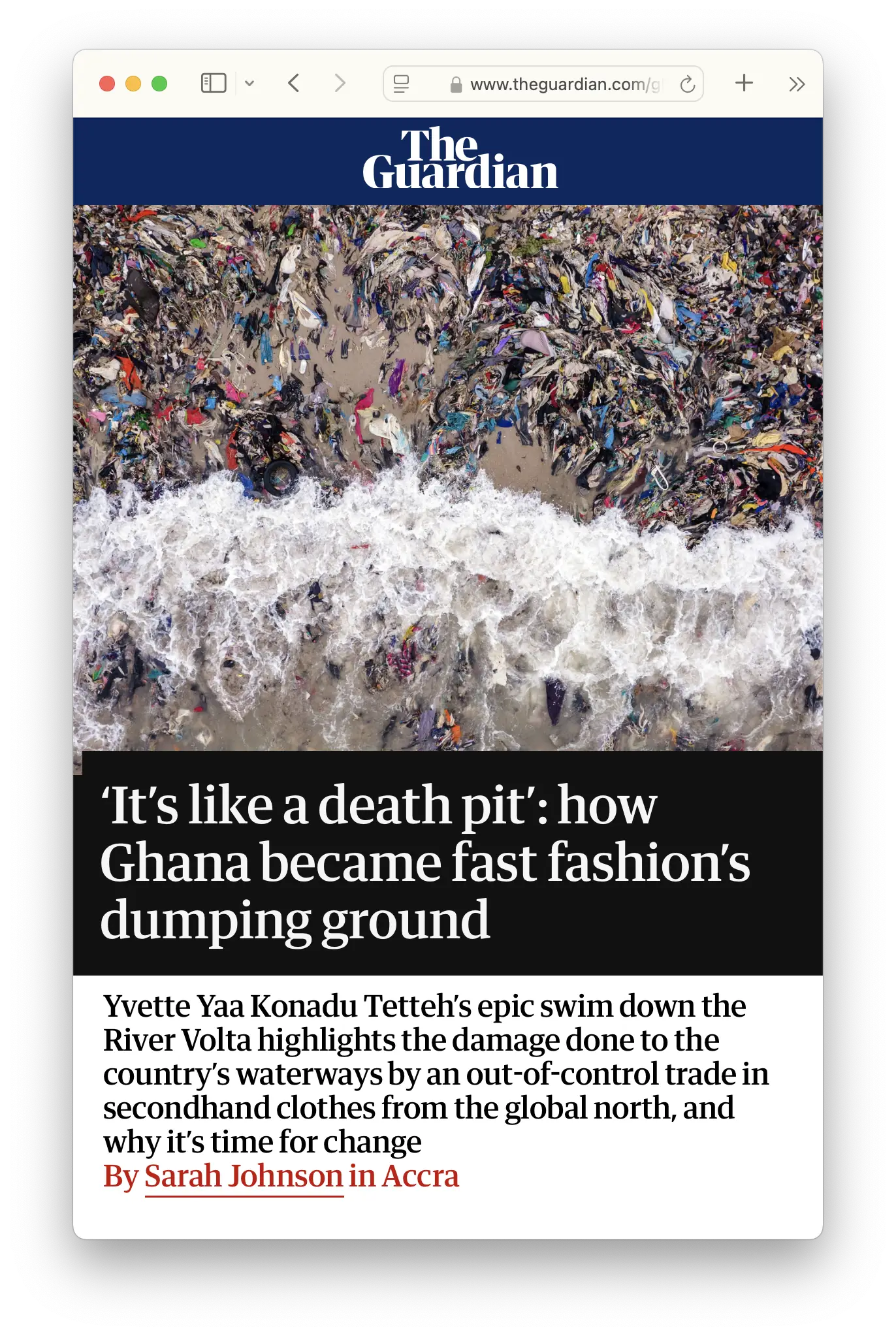
Surplus clothing is shipped off in troves to countries like Ghana, Chile, and Kenya,2 where unsold clothes slowly pile up in the likes of deserts and riverbeds. While local resellers do their best to repurpose clothing, the production of cheap clothing is only increasing, overwhelming entire communities3 with tactile clothing waste.
Most would agree that there’s little virtue in fast fashion, and yet most of us have participated in its consumption. If we’re going to have any chance at a sustainable future as it pertains to style and textiles, we must first uncover why so many of us are willing to take on this cognitive dissonance at all while the consequences of our consumption are, quite literally, piling up.
The Suffocation of Overconsumption
We live in a time when it’s perhaps easier to imagine a future of overwhelming environmental disaster than to picture world populations joining forces to address such crises head-on. And yet, we’re consuming more than ever before while using individual units of clothing for less time over the course of the garment’s lifespan.
In 2024, Americans bought an average of 53 new items of clothing per year, which is four times more than the average amount purchased in 2000. Even when purchased, clothing isn’t necessarily worn to its full capacity—it’s estimated that 65 percent of clothing is thrown away within a year of its purchase. It’s worth noting that consumption is by no means equal across demographics.4
Women are the largest consumers of fast fashion, with ages 18 to 24 serving as the highest consumers within the group. In a study conducted in Florida,5 counties with higher incomes generate more textile waste (defined as any undesirable or discarded piece of clothing or fabric) on average than counties with lower incomes, though participating in textile recycling practices is relatively evenly distributed across the two categories.
80% of L.A.-based garment-working contractors regularly violated minimum wage and overtime requirements.
The production side of fast fashion is just as harrowing: In 2022, the U.S. Department of Labor found that 80 percent of L.A.-based garment-working contractors regularly violated minimum wage and overtime requirements. One retailer was found to pay as little as $1.58 per hour.6 While unnamed, the busted L.A. contractors provided garments to well-respected brands such as Nieman Marcus, Nordstrom, Amazon, and Lulu’s.
The biggest players in the fast-fashion industry by market share7 include Shein (50%), Zara (13%), H&M (16%), Fashion Nova (11%), and Forever 21 (6%). Other common retailers include such brands as Primark, Topshop, ASOS, Mango, Uniqlo, Boohoo, PrettyLittleThing, Urban Outfitters, and Old Navy.
Most respondents perceived cost as the greatest barrier to sustainable fashion, with five out of six participants struggling to name a brand that provides “sustainable clothing.” In case you’re curious, Good On You8 is one available public sustainability index and search engine, which ranks brands on criteria relating to the treatment of the planet, people, and animals.
We’re drowning ourselves in landfills of clothing, with 85% of all textiles ending up in dumps each year.
According to the Good On You ratings guide,9 the database evaluates brands based on both self-reported and independent analysis, matching each brand’s alignment to initiatives like the World Fair Trade Organization (WFTO) and Union for Ethical Biotrade (UEBT) among others. Good on You rates both beauty and fashion brands, with ideals surrounding resource use, climate change impact, chemical and water treatment, supply chain risk, employment policies, and animal testing outlined on their site.10
I encourage the reader to search their favorite well-known clothing brand in the index. Unfortunately, I’m willing to bet you’ll receive a “not good enough.”
You would think that this flurry of disturbing statistics would scare us into positive action and decreased consumption, but as with most things, there is a noticeable disconnect between head and heart. While Generation Z (born 1997–2012) tends to be noticeably vocal about the consequences of the unsustainable state of the fashion industry, when 18 to 24-year-old Sheffield Business School students were surveyed in 2022, 62 percent admitted11 that they purchase from a fast-fashion retailer on a monthly basis.
Whether it’s a marketing problem or a prohibitive cost barrier, it’s clear that overcoming the overwhelming level of fashion waste doesn’t boil down to knowing just how bad the problem lies. We have to dig deeper to uncover why our culture rewards cheaply-produced, stylish clothing en masse.
Digital Distortion and Modular Bodies
When I was thirteen years old, I looked in the mirror, sucked in my belly, and hoped to see an obvious gap of space between my two legs in my reflection. That space, descriptively called the “thigh gap,”12 may seem strange to those not of my generation, but it was reflected across much of the media I was exposed to as a teen scrolling through Tumblr and Instagram. A quick search on Google produces a number of instructional videos on how to achieve this sometimes biologically impossible, arbitrary beauty standard through diet and exercise, before encountering any articles criticizing the trend.
There’s no denying that the widespread use of social media has led to a heightened sense of self-consciousness and scrutiny surrounding how we present ourselves. Having a thigh gap becomes as desirable as having a designer bag, and the clothes that accentuate certain body types rise in popularity along with it.
As the presentation of the digital and physical self becomes more intertwined, the way we engage in style inevitably changes. You aren’t just interested in simple, tailored clothing with a neutral color palette, you’re interested in achieving a “clean girl”13 aesthetic; that is, not just minimalist clothing, but staying well-hydrated, having impeccable skin care, eating a plantbased diet, and maintaining a luxurious lifestyle, all seemingly effortlessly.
It seems as if we’re trying on different avatars for the physical self, rather than determining style based on our own body, genuine interest, and lifestyle decisions. The “clean girl” is just one of many never-ending fashion archetypes of the 21st century, as evidenced by fashion trend cycles becoming significantly shorter14 with the proliferation of social media content. While we might look to runway seasons in the past to influence a wardrobe switch-up every four to six months, social media’s ever-evolving array of aesthetics leaves the most vulnerable users adjusting their entire wardrobe on a monthly or even shorter basis.
Whether you’re interested in becoming a member of the “coastal grandma,” “cottage core,” or “dark academia” communities, there are plenty of fast fashion retailers, beauty industry purveyors, and in some cases, pharmaceutical companies to help you fine-tune your outward presentation. Then there is the rise of fillers, or gel-like substances, injected under the skin to create a fuller or smoother appearance in the face, along with the (mostly) cosmetic weight-loss drugs Ozempic and Wegovy. Over the short course of my life, I can attest to hearing different body types discussed as desired depending on the era, whether it was “heroin chic” (rail thin) or being a “baddie” (curvier woman with a larger bust). The pendulum swings back and forth at an increasingly fast pace, leading plenty to feel shell-shocked trying to keep up with the body and accompanying style standards of the time.
It doesn’t help that many of the marketing materials used across fast fashion retailers appear to be an incredibly doctored, or at the very least an overly romanticized representation of the garment on a model. Consider some of the marketing presented on the popular sites like Shein.com and DollsKill.com.
No doubt the models in these photographs are strikingly beautiful in real life, but there is a pervasive, skin-smoothed, and unnatural softening effect that naturally makes one skeptical as to the marketing’s true-to-life nature. Consider this filter comparison, from Jonathan Haidt’s The Anxious Generation (in which he argued that such technologies set unrealistic standards that very few adolescents and young adults can achieve):
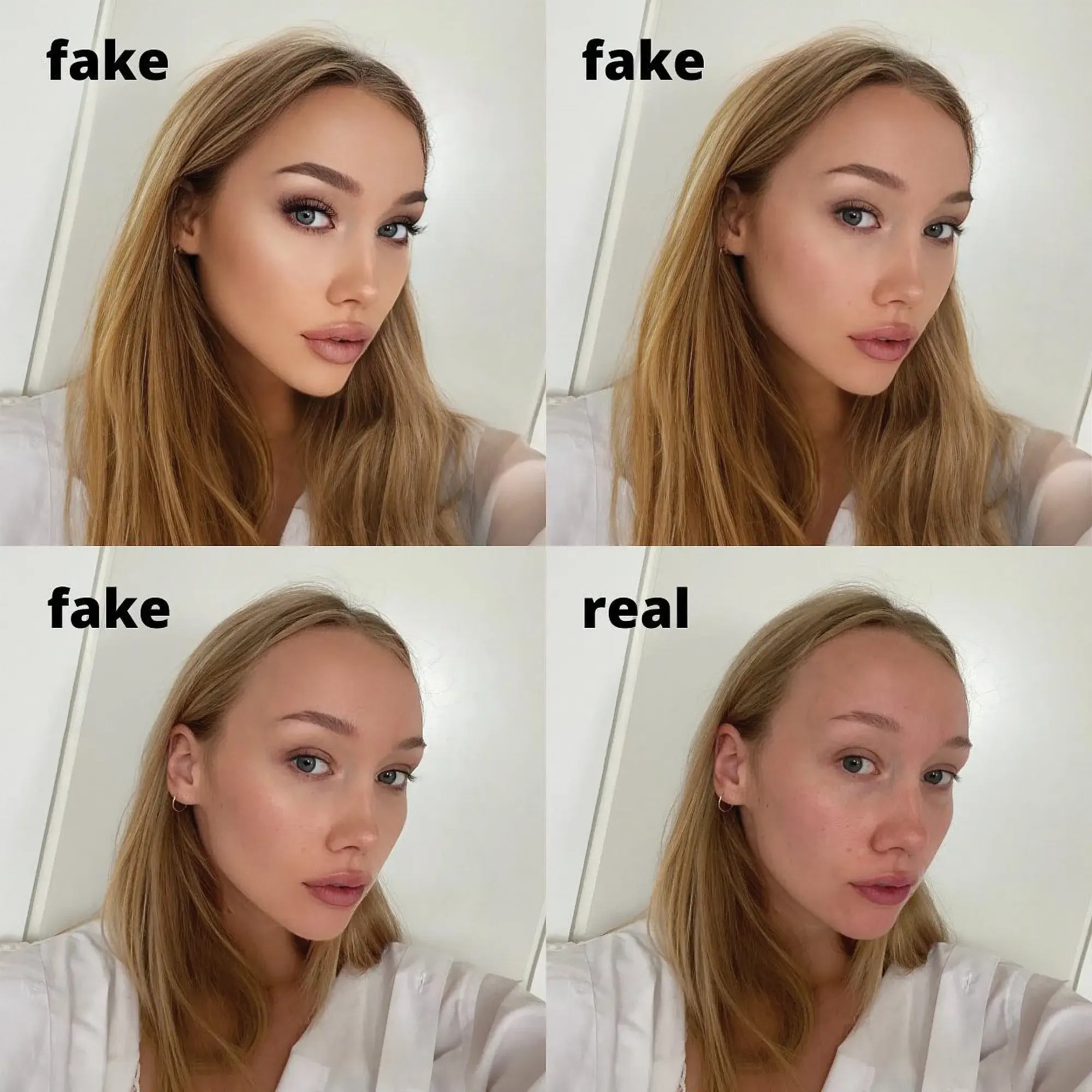
While many of us can detect some level of photo enhancement, it is much more challenging to determine the precise level of alteration: A doctored photo may be much further from the truth than what we might expect.
This intersection of perception versus reality surrounding beauty and fashion has given birth to a cottage industry of internet sleuths and influencers working to provide a more accurate view of what is true to life. Popular YouTubers like Lorry Hill15 compassionately speculate on plastic surgeries procured by the world’s biggest stars. Reddit discussion forums, such as r/InstagramReality,16 are dedicated to “Exposing edited photos and showing the truth behind them.” Alas, many customers consume ever more in their Sisyphean labor to reach a standard of beauty and style that is physically impossible.
Fast fashion companies have given way to an entirely new sector of ‘reverse logistics’—the booming business of product returns.
As a backlash, of sorts, some social media users have begun to post fast fashion fails,17 thereby shining a light on the gap between a garment’s presentation and how it looks in reality. Shopping online may be more convenient, but it does not come without risks. Improper sizing, poor stitching, and low-quality fabrics are an inevitable byproduct of a market that prioritizes profit above all else.
As a result, people are lured into purchasing clothing online that isn’t accurately represented in the marketing, or does not fit one’s body type and preference. Fast fashion companies have given way to an entirely new sector of “reverse logistics”18—the booming business of product returns. Many customers assume that returned objects are put back on the shelf at full price, though this is seldom the case.
Destruction of returned products is so common in the process that it has a handy acronym—D.I.F.— Destroy In Field. Items marked D.I.F. must be destroyed by the vendor, providing a credit to the company of origin. In many cases, clothing companies simply aren’t equipped with the technology needed to reintroduce used goods19 back into the primary market. Often, it is also cheaper to destroy a fast-fashion item than to recycle and reintegrate its materials back into the production cycle.
How pervasive is this problem? Over a third of the population20 engages in online shopping. In our age of extreme convenience, one wonders if it’s simply too easy to purchase cheap clothes online, especially with the constant barrage of marketing across Instagram, TikTok, and YouTube. Most people can admit that they’ve made a regrettable purchase online, though a recent survey found that two thirds of Americans admitted that social media encouraged their overspending.21
Online, it is simply far too easy to buy clothes, especially with the resurgence of the policy buy now, pay later (BNPL). Popular options such as Klarna22 and Affirm23 integrate directly into major online fast fashion retailers like Forever 21, which allow users to split their purchases into several payments.
Caveat BNPL emptor: Consumers who fall short on payments can quickly become subject to fees and interest (depending on their particular payment circumstances) that are prohibitively punitive. It’s also worth noting that these fairly casual-presenting BNPL companies, if misused, can have serious effects on one’s credit score (never mentioned at the time of checkout).
40% of women ages 18 to 25 feel pressured to not repeat outfits.
Trying on new aesthetics is easier than ever, with sellers taking the guesswork out of curating a look. A quick search on Etsy, for example, renders hundreds of results, allowing users to buy cascading bundles of clothing centered around a particular aesthetic. To be sure, some of these sellers go out of their way to thrift and curate items in a sustainable fashion, but others simply shop at fast fashion retailers before bundling and sending them off to a buyer. In any case, it takes time to distinguish which is which.
It’s never been easier to fill your closet, reinvent your digital self, and acquire the clothes you need—just pick an aesthetic from the word clouds of TikTok, Pinterest, or Instagram, search your chosen keywords, and “add to cart” with just a few clicks. Rinse and repeat.
The Allure of Hyperindividualism Under Capitalism
Understanding how we got here begins by taking a hard look at our allegiance to profit, efficiency, and individualism that has grown across the Western world. The existence of garments isn’t inherently harmful (obviously!), nor is the need to turn a profit to stay in business, or even justify getting into one (equally obviously!).
But the deliberate and often deceitful fostering of an insatiable appetite for novel closets is—studies show that around 40 percent of women ages 18 to 25 feel pressured to not repeat outfits.24 Another study found that 47 percent of Gen Z individuals feel pressured to buy more clothes to fit in,25 with over half stating that keeping up with trends introduces “financial strain.” While the youngest generations may be more aware of the ecological and monetary pain associated with fast fashion, there are potentially some more insidious costs associated with consuming less. The same study found that over 40 percent of Gen Z consumers admit to sacrificing essential items in favor of style and fashion purchases—maintaining a sense of status is undeniably important in a society that’s built around your avatar’s perceived relevance and capacity for wealth.
Donning clothing is not just an opportunity for self-expression—it’s also become a means of securing income. Anyone can apply to become an affiliate marketer for fast fashion brands such as Nordstrom,26 Urban Outfitters,27 and PrettyLittleThing.28 In so doing, creators are encouraged to keep up their own consumption, buying more than what is physically necessary as an increased supply of affiliate-backed garments generates more income.
There is an inherent tendency in a capitalist economy for individualism to be encouraged. As a result, the more you can delve into your self-interest, and cultivate educational resources, prestigious contacts, and status, the more likely you are to become valuable within a particular market or social media community. The means of communicating your individuality can all too quickly be commodified into shorter-trend cycles, and any garment that lands on your Instagram shop ads may prompt a “that’s so me.”
What may be innocent, sweet style inspiration for some may feel like persuasive surveillance for others. You might be more self-conscious about your appearance, especially if you live in a metropolitan city. Popular social media accounts such as @watchingnewyork29 or @ootd30 (which stands for Outfit of the Day) promote the fantastical, stylish spoils of everyday New Yorkers, not unlike what Vice magazine’s “Dos and Don’ts” did some twenty years ago in print, which led to the emergence of popular fashion movements such as hipsters.
Less than two percent of garment workers earn a living wage for their efforts.
The bar has been raised for personal style. Updating your sense of fashion could mean reworking your preexisting wardrobe to better suit your new style identity, but it’s so much easier to follow the linked garment straight to the checkout before having it magically appear on your doorstep within five to seven business days.
The Status Gap
Perhaps one of the most challenging aspects surrounding the fashion industry is that clothes serve as a major symbol of status. That status is not directly related to the perceived quality of a fabric or craftsmanship. Instead of upholding quality fabric and fair labor practices as an inherent part of a garment’s value, the allure of any particular garment is almost strictly determined by its level of influence, particularly in an online context.
For example, the simple (and deceptively expensive) luxury brand The Row saw a rise in popularity after being featured in the hit TV series Succession,31 as well as on the bodies of famous celebrities such as Gigi Hadid, Meghan Markle, and Margot Robbie.32 The Row charges well over $1,000 for most of their shirt offerings,33 with the Bozuni top34 costing $7,950. Say what you will about the absurdity of the price point, The Row has an “Avoid” rating35 on the Good On You’s sustainability index. According to Good On You, The Row uses few eco-friendly materials and does not provide evidence of ensuring a living wage for its employees or workplace protections.
Examine most designer brands and you’ll see a similar story unfold. It seems that even at the upper echelon, low-quality workplace practices and textiles can thrive. Less than two percent of garment workers36 earn a living wage for their efforts. Shein garment workers anonymously interviewed by environmental organization Public Eye37 reported working 12-hour shifts for six or seven days out of the week. Average monthly take-home pay ranged from $831 to $1,385 USD a month. By comparison, an average 1-bedroom apartment in Guangzhou, China, ranges between $360 to $1,010.38 Factor in taxes, groceries, and other essential costs, and there’s not much left to cover any other vital expenses.
The use of quality fabrics has sharply declined over the past three decades, with synthetic fabrics such as polyester dominating the market in 2023 as showcased by this Business of Fashion case study39 conducted by Textile Exchange:
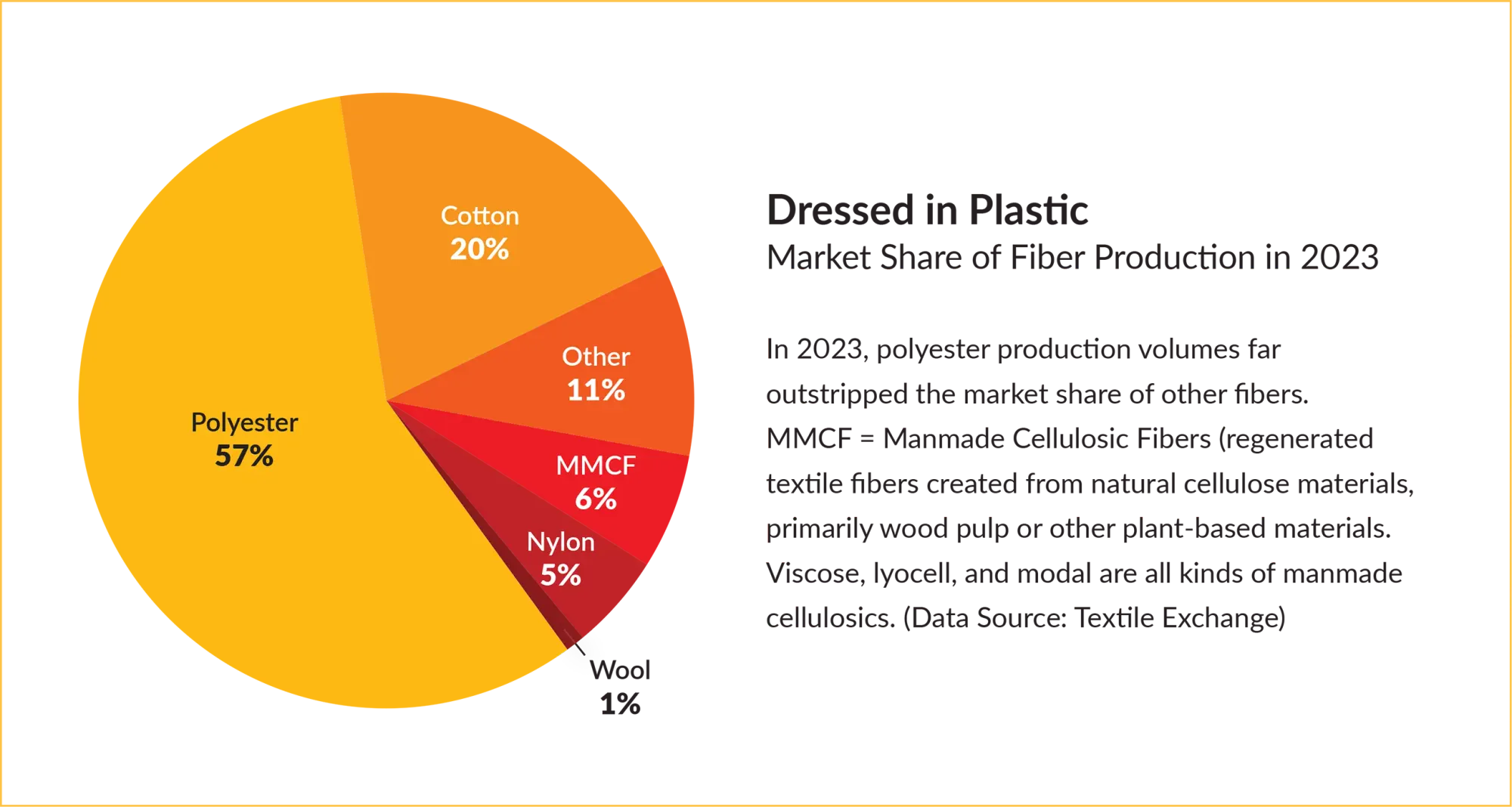
Due to supply chain constraints40 and the rising costs of fabric, it’s more expensive than ever to create a garment made out of natural fibers. Consumers can’t necessarily tell the difference between a well-made garment and one that appears to be, and online shopping makes bridging that even harder—if not impossible—to discern.
Who should pay for fast fashion?
Who exactly should bear the brunt of fast fashion? The short, somewhat trite, but ultimately truthful answer, is all of us. It’s hard to feel like we can make a significant difference when faced with such a systemic issue, but there are ways to shop more ethically on an individual basis.
Whether you vow to shop more in secondhand stores, buy less, borrow, repair, or mend old clothes—or simply take an interest in learning the origins of your clothing—you can start to pave the way for a more sustainable sense of style. As consumers, we very much vote with our wallet, and so directing our money toward more ethically produced products would be a first step in the right direction.
Even so, the issues surrounding fast fashion are not unlike other shopper conundrums in an age of unmatched consumerism and economic insecurity. The elephant in the room—or strutting down the runway—is that it can be expensive to do the right thing. Ethical (or at the very least, more sustainable or humanely-produced) clothing is more expensive than fast fashion ware.
Clothing is unique in that while it is an essential item, it can also become a luxury one, depending on the material caliber and social framing surrounding the status of the garment. If we want corporations to care, we need to change the culture. Paying workers a living wage for their labor would need to be normalized across the board, as within the fashion industry.
We must remind ourselves that everything comes with a cost, even if we close our eyes, plug our ears, and refuse to look down the barrel of the burden
I believe that one can be priced out of virtue. It’s not easy to think about the human labor that went into creating pieces of clothing for those still strapped just trying to make ends meet. The problem is that it goes both ways—not only can you be so economically strained that acting within the bounds of sustainability can prove downright impractical, but at the upper end of the economic spectrum, the hedonic treadmill can just as easily cause almost anyone to lose a sense of connection to the lives of the many individuals all along the chain of production—and consumption.
When greed consumes us to the point that we’re willing to sacrifice human dignity and decency solely for the sake of profit, we have lost the deeper plot. As the founder of Fashion Nova, Richard Saghian, noted: “We don’t want girls showing up to the club in the same outfit. We need 50 different denim jackets. Not just one.”41 Leading a company that’s entrenched in a U.S. Labor Department investigation42 for unpaid wages cannot be easy, but perhaps it’s easier to trudge on when other people become closer to being pawns in a grand master plan.
We must remind ourselves that everything comes with a cost, even if we close our eyes, plug our ears, and refuse to look down the barrel of the burden. Turning a profit may be as American as apple pie, but we all know the difference between mass-manufactured chain-store produced and mom’s homemade.