Talking to Dead Celebrities & Psychic Polaroid Photographs
Talk to a Dead Celebrity!
Sylvia Browne has yet another book out. That this one has certain magical aspects to it is apparent on the cover, as Sylvia seems to have undergone an enchanted transformation, losing at least 30 years! The book is Afterlives of the Rich and Famous, and features several accounts of celebrities who’ve passed away, and what they’re up to in heaven. Wow!
ou see, Sylvia’s “spirit guide” Francine communicates the messages of the deceased celebrities to her. Francine speaks with such luminaries as James Dean, Marilyn Monroe, and Michael Jackson. Browne recently explained such burning matters as the afterlife, where heaven is, and some heady predictions she has for the upcoming year. She even handled the question about those phony psychics who use the same techniques she does:
Oh, please. Some of them play a guessing game. One “psychic” I saw got up there and was like, “Does anyone here drive a truck?” I was like, “C’mon!” That’s what we call a generalized cold reading, like when someone says they’re sensing the initial “D.” Or to say you’re going from darkness into light. It’s just nuts.
How true. I was like, asking, you know, like, what a dumb, I mean, like, really dumb thing—you know, to do! But Sylvia also doesn’t much like, I mean, like James Van Praagh. She was like:
Van Praagh is the one that I have trouble with. He constantly wants validation. He’s always playing the guessing game. Nobody expects anyone to be 100%. Only God is.
Sylvia explained how this new book came about:
It was very strange. One night I was lying in bed and I was thinking about Clark Gable and his love affair with Carole Lombard. I asked my spirit guide Francine if they ever got together, and she said that they’re very much in love “over here.” When she says “over here,” she means the Other Side. They rowboat together, they walk together. Then I started asking about Michael Jackson, and that’s how it started. It was my own curiosity.
Sylvia tells us the bare truth about heaven—that you shouldn’t picture a place with nothing but clouds, which will be a great relief to those who expect to be there.
Or sitting on a cloud with a harp. That’s really stupid. In actuality, the afterlife is three feet above our ground level. People keep looking up to the sky, which isn’t correct. When people see “ghosts,” they always say they’re floating. They’re not actually floating, they’re walking on their own solid ground. It has libraries, it has record centers, it has concert halls, it has everything except the negativity.
And, hopefully, Starbucks and Home Depots as well, of course.
Browne seems a bit “down” on skepticism, it seems. She dismisses anything like logic and/or rationality, for some reason:
You know what? I don’t care. Everybody is skeptical on everything. Who cares? If you know, between you and God, that you’re doing the right thing, that your motives are pure, then who cares what anyone else says?
Being unenlightened and not in regular, direct, communication with God as you are, some of us actually do care, Sylvia. Ah, but how about those celebrities and their adventures three feet above ground level? Sylvia tells us:
[Michael Jackson] said that he was very maligned in this life, and he’s not holding any grudges. He feels a definite unfairness because they accused him of so many things. You’ve got to realize that he was like a 9-or-10-year-old in a man’s body. He felt more at home with children than people his own age. He’s in a healthier body now. I can say that he probably never would have made it through those concerts he had planned before he died. He was sick. [Princess Diana] is thrilled [about Prince William getting engaged]. She thinks Kate is a wonderful person for William, because she has a tougher skin than she ever had. Di was very shy and everything hurt her feelings. I don’t think Brad Pitt and Angelina Jolie are going to last. They may make it through this year, but I think they’re pretty much doomed. I’m also concerned that Liz Taylor isn’t going to make it through this year. And you know what? I don’t know why they’re keeping Zsa Zsa Gabor alive. They had to remove her leg, she had a stroke, she doesn’t remember anything or anybody—I don’t believe in Kevorkian, but when it comes time, just let them go.
Well! What a wealth of information and philosophy this woman shares with us, and I’m sure that her book has oodles of even more startling news. I can’t wait to snap it up.
How to Fake Psychic Polaroid Photographs
A news item in the February 25th issue of The Chronicle of Higher Education highlights a show at the Albin O. Kuhn Library and Gallery at the University of Maryland-Baltimore County. The article, by Dr. Mikita Brottman, a professor of humanities at the Maryland Institute College of Art, is titled, “Psychic Projections/Photographic Impressions: Paranormal Photographs from the Jule Eisenbud Collection on Ted Serios,” a display of some 60 examples of how rationality can be easily abandoned when a sufficiently attractive woo-woo subject is brought up and dignified by such individuals, colleges, and media outlets.
Academics often choose to accept statements from their peers as unquestionable, and … evidence of magic can be found where none exists.
Note, first, the title of the show clearly states that the photographs are paranormal in nature, not “claimed” or “purported” or “possibly,” and that they are “psychic.” No modifiers.
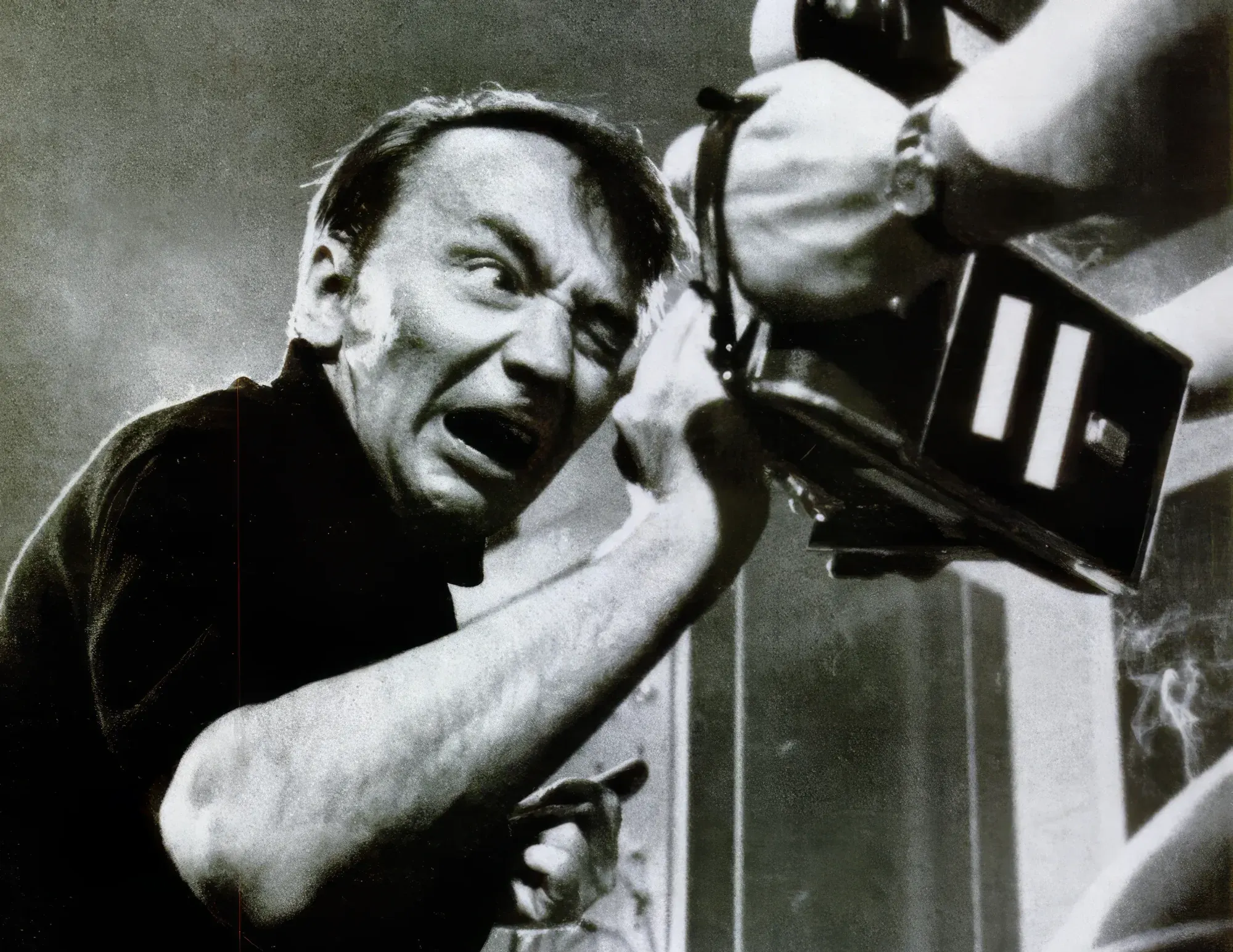
There are two actors involved in this drama: Theodore (Ted) Judd Serios (1918–2006), a bellhop from Chicago who discovered a great trick: he would have a Polaroid camera aimed at his forehead while he held a small tube of black paper in his fingers so that it pointed into the lens. Then he would instruct the person holding the camera to release the shutter and hand over the result, which he called a “thoughtograph.” These were most often blank or black, but occasionally a fuzzy image would be seen that could be interpreted many different ways, and on rare occasions a relatively clear and identifiable image showed up.
Dr. Jule Eisenbud (1908–1999), a clinical professor of psychiatry at the University of Colorado Medical School and a charter member of the Parapsychological Association, gleefully embraced the Serios “miracles” as genuine. He wrote extensively on ESP, PK, and other claimed psi phenomena, and accepted them all as proven.
Serios’ method was quite simple: the small cylinder—about ½ inch in diameter and 1¼ inches in length—concealed a smaller slide-in tube that had a simple lens at one end, and a tiny transparency at the other, exactly like the keychain attachments widely available in those days in which the owner could view Marilyn Monroe or a baseball star or whatever. When held to the Polaroid camera’s lens with the announced intention of concentrating the “thought waves” of the holder, it projected its picture onto the film.
In my 1982 book Flim-Flam! I devoted six pages to the Serios/Eisenbud matter, providing a thorough exposure and diagrams of the methodology of the trick, though I thought that to be too much space for such a trivial and transparent hoax. Now The Chronicle of Higher Education has brought attention back to the matter.
Author Brottman shows clearly that she has accepted uncritically as true, everything that Eisenbud wrote or said about these silly photos, and even mentions that the exhibit has “a short film of Eisenbud debating aspects of the Serios phenomenon with detractors.”
That film is an excerpt from a 1967 NBC Today Show episode in which I successfully duplicated the Serios trick on live TV—with him sitting right there looking very uneasy. Using a standard Polaroid camera supplied by NBC, I held a tube of black paper to the lens as Serios regularly did, then I produced an image of a child (actually of myself at six years of age) and then I stepped to a studio TV camera and similarly produced a shot of a taxi on Broadway. Though I’m sure that Ted Serios caught my “moves,” Jule Eisenbud was careful to be studiously looking away and mumbling—as if disinterested—while I did the tricks.
When Professor Brottman uses terms like “under quite stringent test conditions,” she is quoting directly from Eisenbud, to whom control of his subject was a quite foreign concept. Never wondering whether a fellow academic might have been fooled by some simple sleight-of-hand, she marvels that some of the Polaroids produced by Serios were “quite clear, particularly when Serios was attempting to produce the image of a specific physical monument or building.”
Anyone experienced with such subjects quickly recognizes that when they appear to be most impaired, that might well be because they need the grand misdirection thus invoked.
Very true, but those wonders were attained during sessions lasting several days, when Serios had been told that the following day this particular “target” would be hoped for. It was a simple matter for the wonder-worker to produce a tiny transparency of the target overnight and conjure it up to order when required. Professor Brottman also naïvely notes that Serios “was in many regards erratic and demanding, a heavy drinker who produced the most vivid and compelling of his thoughtographs when drunk.”
Also very true, but anyone experienced with such subjects quickly recognizes that when they appear to be most impaired, that might well be because they need the grand misdirection thus invoked, and can get away with much more when thought to be a little “out of it.” She tells of cases in which Serios “could produce an image on a camera that was some distance away from him (as far as 66 feet in one instance), and he even produced images when the camera was in another room altogether.”
This quotation is, again, taken directly from Eisenbud’s account. But I’m surprised when Brottman writes: “While many people, including Eisenbud himself, have produced similar images using gimmick lenses and transparencies, no one has been able to do so in an undetectable fashion.” Professor Brottman, please! At that time in my lecturing career, I was regularly doing this, as I did on that Today Show episode, very much “undetected,” thank you!
As my final comment on all this, I’ll quote a revealing statement from Brottman that clearly reveals her attitude on the matter: “Yet to my mind, the Ted Serios phenomenon goes beyond the notion of ‘real versus fake,’ providing insights into the relationships among photography, subjectivity, representation, and the unconscious.”
No, ma’m, not at all. It simply shows these three phenomena: (1) the well-known psychological effect called “expectation confirmation,” (2) how academics often choose to accept statements from their peers as unquestionable, and (3) how evidence of magic can be found where none exists.
Consider: If Ted Serios did not use a trick method, all the rules of physics, particularly of optics, everything developed by science over the past several centuries, must be rewritten to accommodate this claim. No such revisions have been found necessary.