Talking With Flat-Earthers Around the Globe
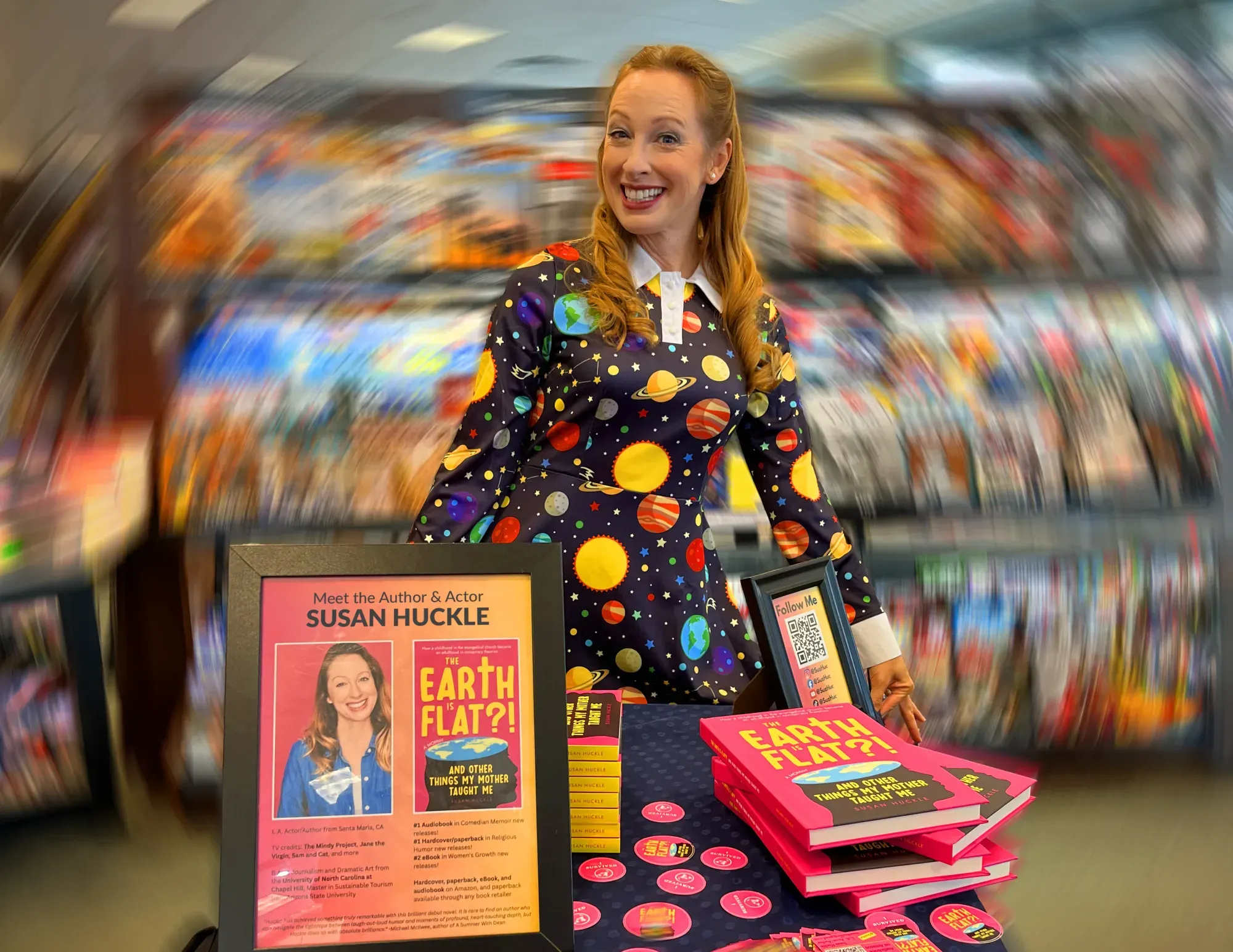
The author of The Earth Is Flat?! And Other Things My Mother Taught Me recounts her experiences on her book tour with people who appear to believe the unbelievable
When I started writing about my relationship with my evangelical-turned-flat-earther parents (yes, you read that right) in the Fall of 2020 to work through complicated, unresolved feelings after my mother’s passing, I had no idea those ruminations would turn into a published book on Earth Day 2026 called The Earth Is Flat?! And Other Things My Mother Taught Me. And I certainly didn’t anticipate that I’d be taking that memoir, which tracks my evolution from Pentecostal Christian to atheist, on the road for a national book tour that Fall. From late September to mid-November 2026, I boarded early flights, drove long hours, and hauled books across the U.S. to writers’ conferences, book festivals, and bookstores for author talks, panels, and signings.
It’s one thing to write about your most vulnerable moments alone, pouring into your laptop your childhood fears of the Rapture and the Tribulation, your shame about being a late bloomer because you were taught sex before marriage was a sin, the pain of watching your paralyzed father pray for healing year after year, and how it took your parents becoming full-blown conspiracy theorists for you to realize their judgment was suspect. It’s another thing entirely to stand up in front of strangers and speak your story or sit at an author table in a bustling Barnes & Noble all afternoon, dangerously available to the general public’s questions and comments.
Now, I know that religion and conspiracy theories are charged topics, as do readers of this magazine. People’s beliefs can define their identities, and challenging a worldview, even in the perky package that I present, complete with pink book cover and lipstick, can be perceived as a personal attack. In my naïveté, however, I thought that devout believers and flat-earthers would simply keep walking at a book fair or signing once they realized where I stood on the topics (not a Christian and not a flat-earther), because that’s what conflict-avoidant me would do.
With religious affiliation declining in America, how many people would actually want to proselytize to me? And how many flat-earthers can there be, anyway? Oh, friends. Turns out they are everywhere. Here are some verbatim interactions I had on my book tour.
♦ ♦ ♦
At my stop at Barnes & Noble in Albany, NY, I encountered not just one flat-earther, but two in a row! A bubbly young woman with two small children, one in each hand, practically ran over to my author table, dragging her children with her, when she caught a glimpse of my poster, which features my title in giant bright yellow letters.
“You know the Earth is flat, too!” she said, gleeful to find a fellow free thinker.
“Actually, my parents were the flat-earthers. I’m not,” I said delicately, careful to not offend her but also not misrepresent my book.
Her eyes darted with excitement all over my table, taking in my books, stickers, and info signs with my bio and book accolades. My words didn’t seem to register at all. Her grin never fell.
“Well, good luck with everything!” she beamed as she walked her kids toward the children’s books section.
I grew up in the church. I was intimately familiar with the Bible. I wasn’t someone who just hadn’t heard the good news yet. My problem was that I knew too much.
Before I could wrap my brain around our interaction, an older woman slowly passed my table at a distance with a suspicious look on her face. “My parents believed the Earth was flat, but I don’t!” I said with a laugh, hoping to quickly disarm her. This was becoming my icebreaker for people who didn’t immediately glean my take from my title’s punctuation (“?!”). She continued to eye me dubiously.
“Why do you think it’s round?” she said, after a beat.
Not the reply I expected.
“Oh, well, there are photos from space,” I said, trying to stay good-natured.
She took another beat before responding.
“People lie,” she said slowly, shaking her head. “Lots of people lie …” she muttered to herself as she shuffled away.
Maybe I’ll come across this more than I thought.
♦ ♦ ♦
A few weeks later, my book signing at a Barnes & Noble in Las Vegas took the cake for the most and wildest one-liners. “You don’t believe in the firmament?” a stern woman said to me when I clarified that I was not a flat-earther.
“I believe in the scientific explanation of the sphere,” I said, politely.
“So, you don’t believe in the Bible?” she said, pointedly.
“I do not.”
She huffed. I had somehow rendered a woman who lives in Sin City speechless by this.
“But I wish everybody well!” I chirped, trying to end on a positive note.
“Well … so do I!” she said, apparently compelled to match my goodwill.
An hour later, another flat-earther said to me, “How come no one’s been to Antarctica?”
“People have been to Antarctica,” I said slowly, not having heard this one before.
“Well, there’s a military base there, sure,” he said, conceding that point.
Which means people have been there, I thought.
“There are also scientists there,” I added, my brain searching for other pro-Antarctica arguments. To that, he pursed his lips and cocked his head as if to say: You really believe that?
Also in Vegas, a bald man warmly chatted with me about my story for a while, and said that when he was young, he researched a variety of religions. I asked if he landed on a particular one. He threw his hands in the air and said with a laugh, like he was a lost cause, “Oh, lady, I’m as Christian as it gets!”
A woman in old, dirty clothes with disheveled hair, pushing a full shopping cart of various items, told me that God cured her of AIDS and cancer. I told her I was happy she was well, and she continued in a stream of consciousness to tell me about her babies and relationship with God, until a store manager tactfully picked up the conversation with her and led her away from my table.
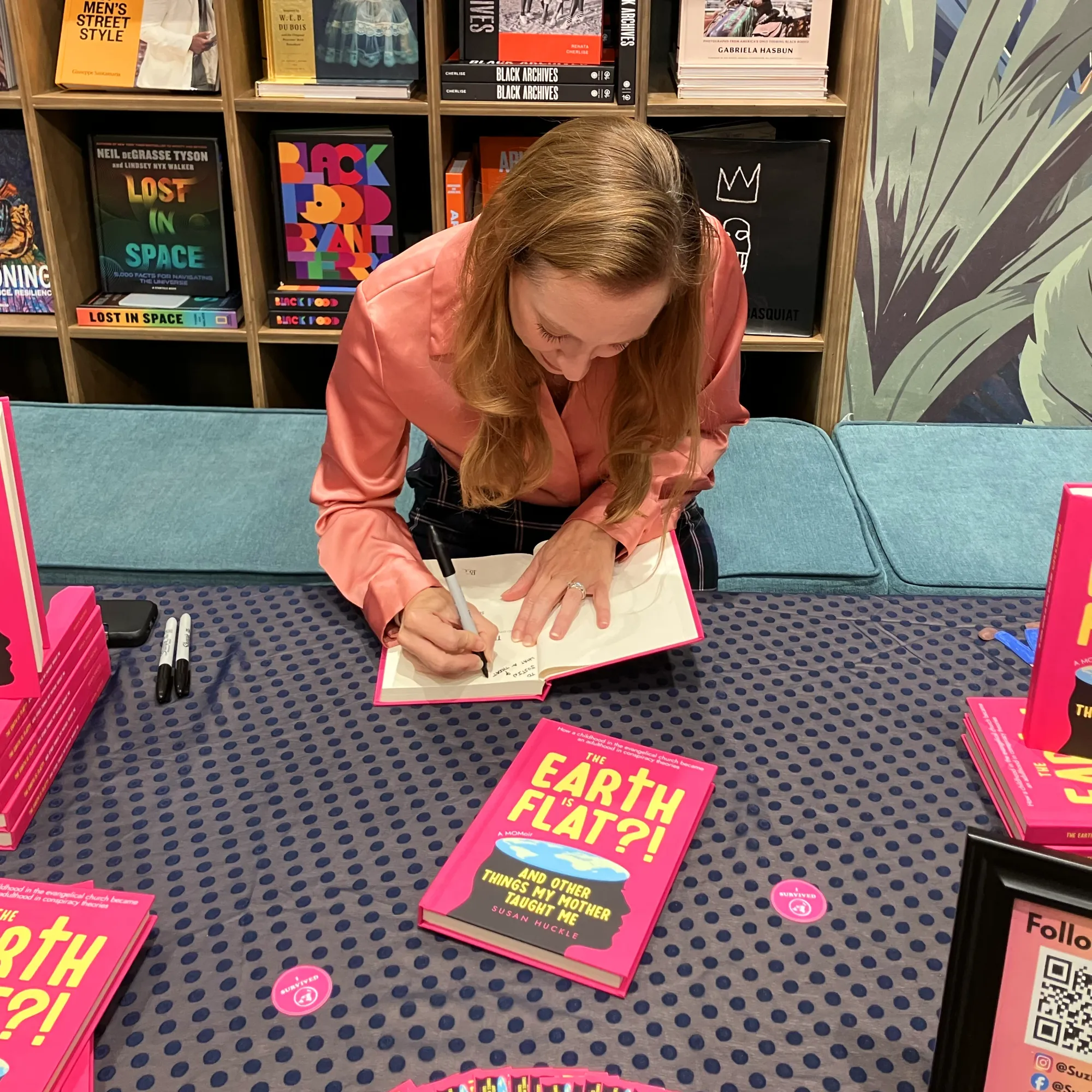
After telling an elderly man with a walker the lengths my mom went to for Y2K (stocked pantry, gallons of gasoline, rain barrels, satellite-powered radios …), he said, “Well, it sounds like your parents taught you to be prepared, and that’s a good thing.”
On his way to the self-help aisle, another man stopped by my table to say, “I’ve seen some stuff on flat earth. They make some good points.”
♦ ♦ ♦
At the Central Coast Writers Conference in San Luis Obispo, CA, once a middle-aged woman found out what my book is about, she hollered to her adult daughter at a nearby author table, “Honey, who in the family thinks the Earth is flat?” Her daughter replied, matter-of-factly, “Oh, Dad’s whole side is flat-earthers now.”
Later, a short, stocky man pointed to the flat-earth image on my book cover and said, “There’s a new map out now, ya know.” He informed me of the geoid shape: a globe but with large concave lumps everywhere. “I can’t believe you don’t know about that,” he said, walking away.
One woman’s immediate reaction to my book pitch was a knowing nod as she said, “I’m from Arizona.” I looked at her, puzzled. She explained that Arizona had a governor in the 1980s who appointed an education advisor who was a flat-earther.
At the Collingswood Book Festival in New Jersey, a quirky young woman was instantly drawn to my table and bought a book. She giggled as she told me that she had recently thrown a conspiracy theory party. Every guest had to present one, and she did her favorite: flat earth.
At Village Books in Atlanta, I listed some of the conspiracy theories my mom believed (9/11 was an inside job, the moon landing was fake, mass shootings are hoaxes or false flags …) to a woman who replied, “Your mom sounds like my kind of lady! I believe all that, too!”
♦ ♦ ♦
Not all memorable interactions were absurd, brief bursts. One of the first people I spoke with at my Albany signing was a young man who asked me thoughtful questions about my book until we reached the moment of truth when he asked, “Are you still a Christian?”
“No, I am not,” I said, carefully. He looked disappointed and pained, like he was now personally obligated to prevent me from going to hell. I knew I’d just lost a sale but handed him a card anyway. He walked away, and I assumed that was that.
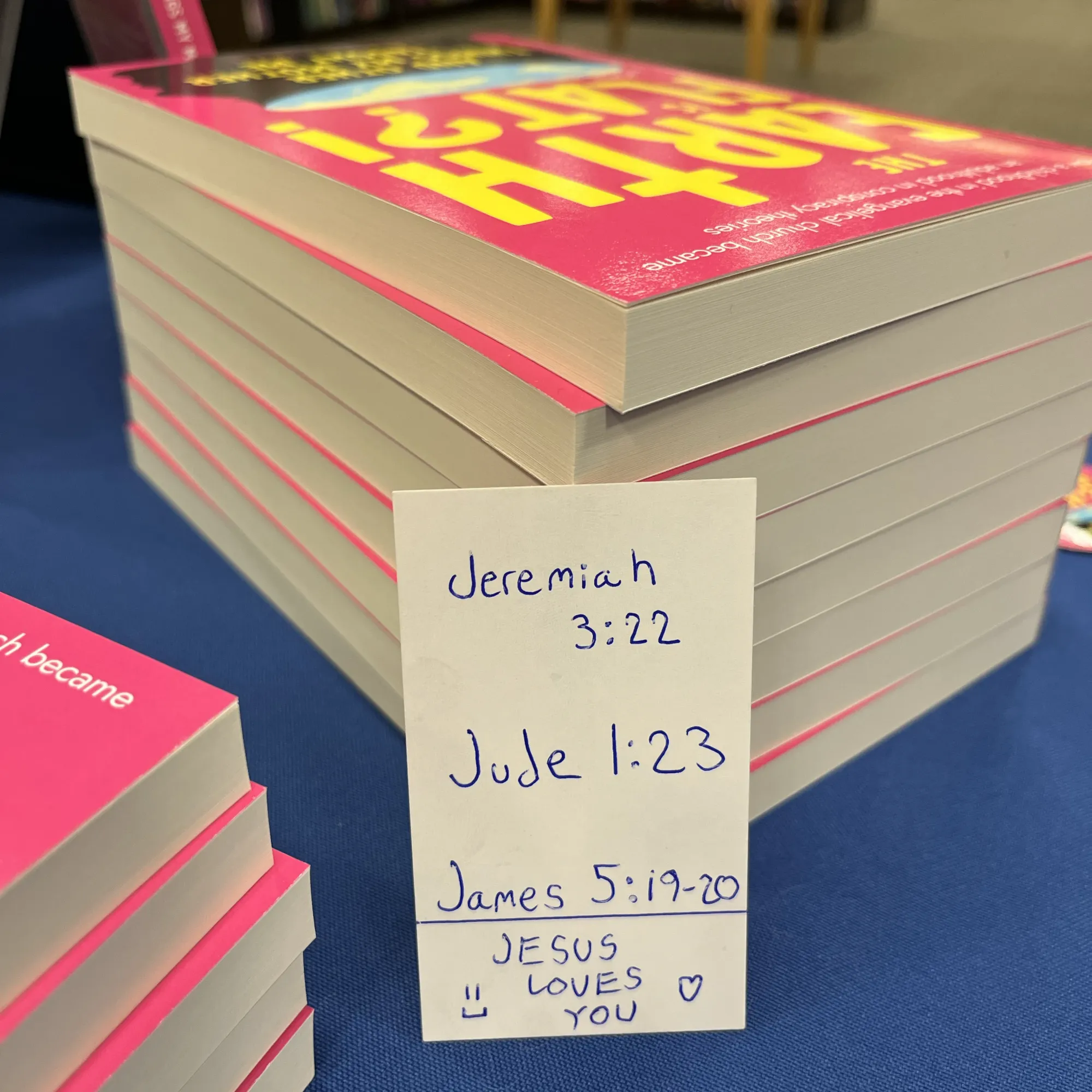
About 45 minutes later, he returned, his face still pained. “Victor! You’re back!” I said, proud of myself for remembering his name. “If it’s okay, I’d like to give this back to you,” he said, sheepishly. It was my card, but he had written on the back “Jeremiah 3:22, Jude 1:23, James 5:19–20” and “JESUS LOVES YOU” with a smiley face and heart. “I wrote down some Bible verses on your card, and I’ll be praying for you,” he stammered.
I thanked him kindly, suppressing mild annoyance at him ruining a perfectly good business card. Even though it was only my third stop on the tour, I had cumulative frustration building over this type of exchange. I knew each individual was well-meaning, but there is something condescending about someone telling you they know better for your life than you do.
At my stop in San Luis Obispo, CA, a waifish young woman said she was very sad to hear I had left the church. “I’ll be praying for you,” she said, as she floated away. She couldn’t have been more than 20 years old, and I thought about how I would have called myself a Christian when I was her age.
I was intimately familiar with the Bible. I wasn’t someone who just hadn’t heard the good news yet. My problem was that I knew too much.
At my stop in Collingswood, NJ, I had the longest debate of the tour. For over half an hour, a middle-aged Black man quoted Bible verse after Bible verse to me that, to him, were airtight, mic-drop revelations of truth. He was respectful but visibly energized by the challenge of convincing a non-believer.
I thoughtfully replied to each verse, pointing out inconsistencies between the God of the Old Testament and the New Testament, the inconsistencies in the gospels, and adding historical context. Each reply only egged him on to tell me another verse, and I reiterated that I grew up in the church. I was intimately familiar with the Bible. I wasn’t someone who just hadn’t heard the good news yet. My problem was that I knew too much. I needed to change course to conclude our conversation and make myself available to passersby who might actually buy the book. The real reason I suspect anyone is religious and stays that way is a profound emotional experience or attachment, so I asked him how he became a Christian.
He told me that he hit rock bottom and looked for answers in therapy and medicine, but nothing helped him want to stay alive until Jesus met him in his darkest hour. “Well, I’m glad you’re still here,” I said, looking into his eyes and meaning it. He smiled. “This was the best conversation I’ve had in weeks! I’ll be praying for you!”
Sigh.
I was greatly encouraged, however, by some kids’ reactions. “What’s your book about?” asked a precocious little girl at my Atlanta signing, her small fingers playing with my tablecloth. After I explained that it’s about my relationship with my parents, who believed the Earth is flat, she blurted out, “But it’s round!”
In Seattle, a 7-year-old boy asked me why my parents believed the Earth is flat. “They saw some YouTube videos about it,” I answered. “But some YouTube videos are good, and some are bad.”
Yes, kid, YES.
One woman in Durham, NC, told me her mom wouldn’t let her get vaccinated when she was a child. “But once I was old enough, I got my own vaccines!” she said, triumphantly. Also at my Durham signing, one man lit up when he read my title. “Oh, man, flat-earthers are crazy! I’ll buy your book!” he said, laughing. I signed a copy for him to check out at the register, then as he was walking away, he said, “But you have to watch ancient aliens videos on YouTube if you haven’t. Seriously. They’re on to something there!”
♦ ♦ ♦
An interaction I had at my last stop, the three-day Twentynine Palms Book Festival in California’s high desert, had the same Huh? as ones before it, but this one left me feeling strangely hopeful. I sat at my author table, road-weary, surrounded by vendors peddling UFO fiction and nonfiction, knowing it was only a matter of time before running into a flat-earther.
A petite platinum blonde young woman with perfect waves in her hair approached my author table late on the second day with stoic, cautious interest. She asked me what my book was about, and when I said my mom was a passionate flat-earther, she looked me in the eyes with a confident, subtle smile and said, “I’m a passionate flat-earther.”
“You and my mom would have gotten along great!” I replied. Upbeat spins were now second nature. Looking for common ground, I asked if she followed a particularly well-known online flat-earther, a man with whom I’d recently had a three-hour Zoom. “I don’t know who that is,” she said, surprising me. “And I don’t listen to men,” she added with a smirk. I genuinely laughed. “So, you’re more of a Patricia Steere fan?” I asked, naming a famous female (former) flat-earther. “No, I don’t listen to anybody else but myself,” she said, self-assured. We then properly introduced ourselves. I found out her name was Marissa, and she’s into astral projection. I smiled and nodded like I knew what that was.
“I’m an influencer, I guess, but I don’t like that word,” she added. “I really like your cover. Did you design it?” She picked up one of my paperbacks and looked it over with keen interest. I explained how I held a design contest through 99designs.com where artists submit their ideas, and after rounds of notes and selecting finalists, the artist of the winning design earns the prize money. “Wow. This is really well done. I’m very impressed. I’m working on a book, and I’d like it to look this good,” she said warmly.
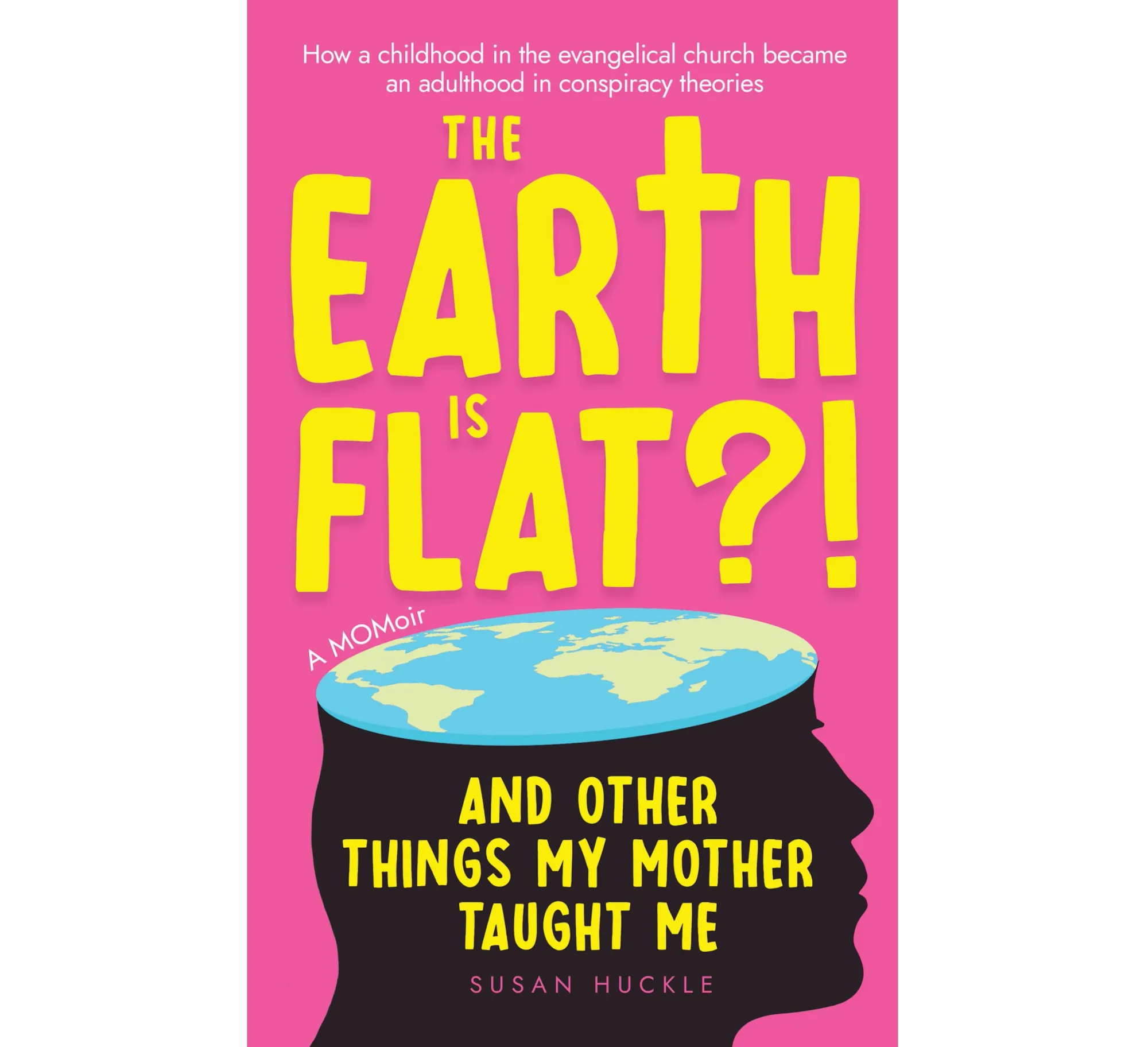
I thanked her and asked her what her book is about. She said it’s about astral projection and other terms I wasn’t familiar with. “Well, I’m just happy when people find something that really speaks to them,” I said, always grasping for harmony. “Me too,” she said. “My sister’s a really devoted evangelical Christian now. That would never work for me, but she likes it, so I’m happy for her.” I gave her my card for any future book questions, and I think we both left our interaction in, dare I say, agreement?
Of course, at all these stops, I also encountered people who related so much to my faith deconstruction and family conflict that they were visibly relieved and comforted to have found a kindred spirit. In Albany, a young woman named Abigail with curly brown hair was shopping with her grandma when she approached my table with wide eyes. She told me she was raised Christian, but she’s been writing songs since high school to help her process losing her faith and leaving the church. “I think I’m really going to relate to this,” she said, holding my book tenderly.
Moments like that make it all worth it.