The Religion of Alien Belief
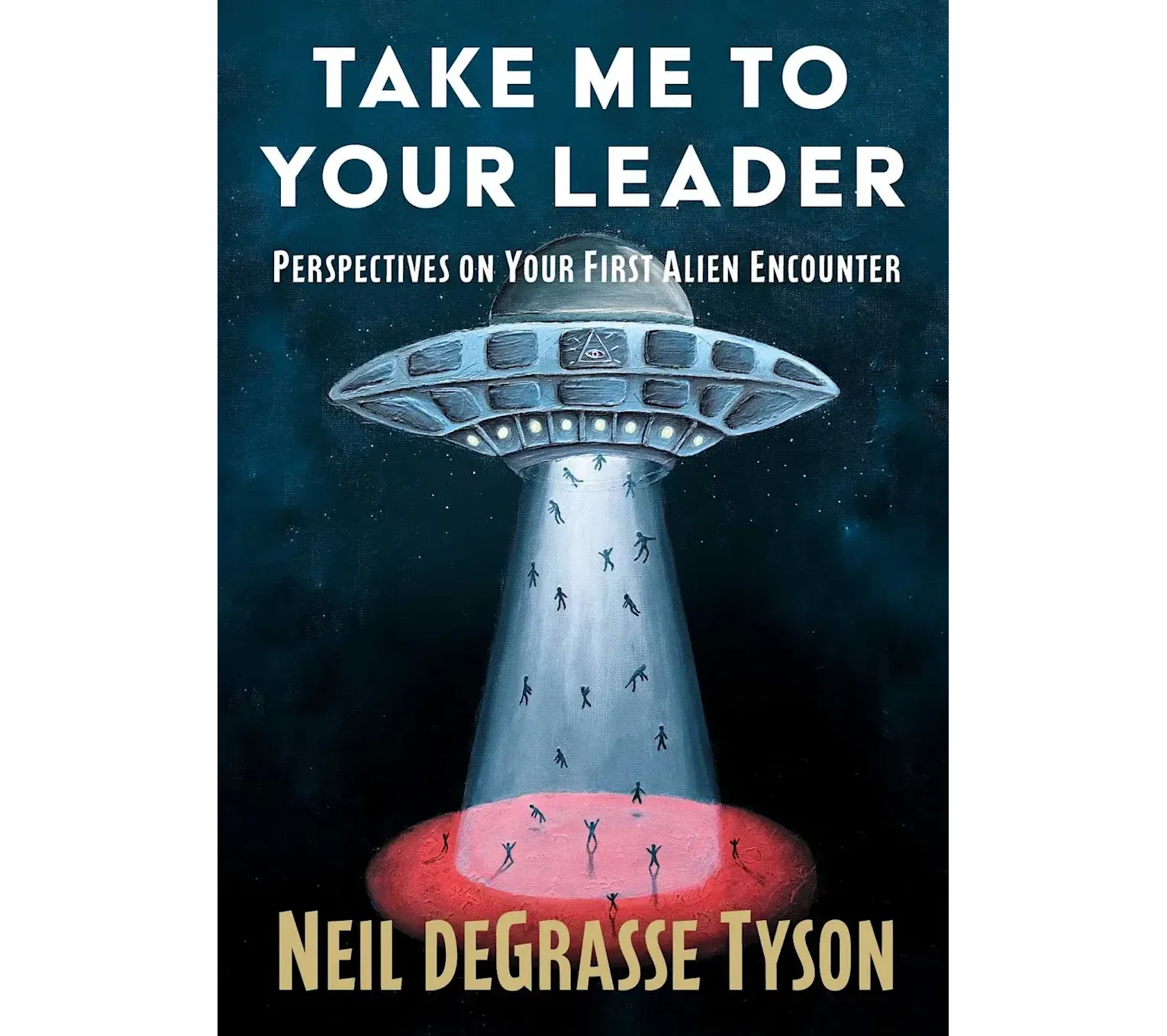
A review of Take Me to Your Leader: Perspectives on Alien Life, Belief, and Scientific Reasoning by Neil deGrasse Tyson, New York: Simon & Schuster (Simon Six Imprint), 2026.
Introduction
Neil deGrasse Tyson, Director of the Hayden Planetarium and one of the most prominent public science communicators of the twenty-first century, has built a career on the proposition that scientific reasoning should guide our understanding of the cosmos. In Take Me to Your Leader, Tyson turns his considerable intellectual resources toward one of the enduring puzzles of modern culture: why, in an era of unprecedented scientific knowledge and omnipresent smartphone cameras, does belief in the visitation of Earth by extraterrestrial beings persist, intensify, and command congressional hearings, books, articles, podcasts, dramatic and documentary films, and the credulity of otherwise rational people?
The book is sprawling, discursive, and frequently entertaining. Tyson moves with characteristic ease between astrophysics, evolutionary biology, film criticism, philosophy of mind, and cultural anthropology. His prose is accessible without being condescending, and his humor is deployed with precision. There is much here to admire. However, as a work of scientific epistemology—which is what the book’s most important passages suggest it wants to be—Take Me to Your Leader is frustratingly reticent precisely where it should be bold. This review addresses three central deficiencies:
- the author’s unwillingness to fully articulate the epistemological equivalence between UFO belief and theistic faith;
- the insufficient analysis of how non-scientific modes of inquiry obstruct empirically productive investigation of genuine atmospheric and physical anomalies; and
- the failure to draw the explicit parallel between the non-falsifiability structures that characterize both UFO culture and organized religion.
Belief Without Evidence
The most intellectually consequential thread in Take Me to Your Leader is Tyson’s sustained analysis of the epistemological foundations of UFO belief. The argument, reconstructed from across several chapters, runs approximately as follows: UFO sightings are overwhelmingly concentrated in English-speaking countries, reported by individuals who have absorbed decades of popular cultural representations of extraterrestrial life, and generated under conditions—nighttime isolation, emotionally heightened states, group suggestion—that are known to amplify perceptual error and confabulatory memory. The witnesses are often sincere, sometimes distinguished, and occasionally supported by institutional credentials. Yet not one of these factors constitutes scientific evidence for the phenomenon being reported.
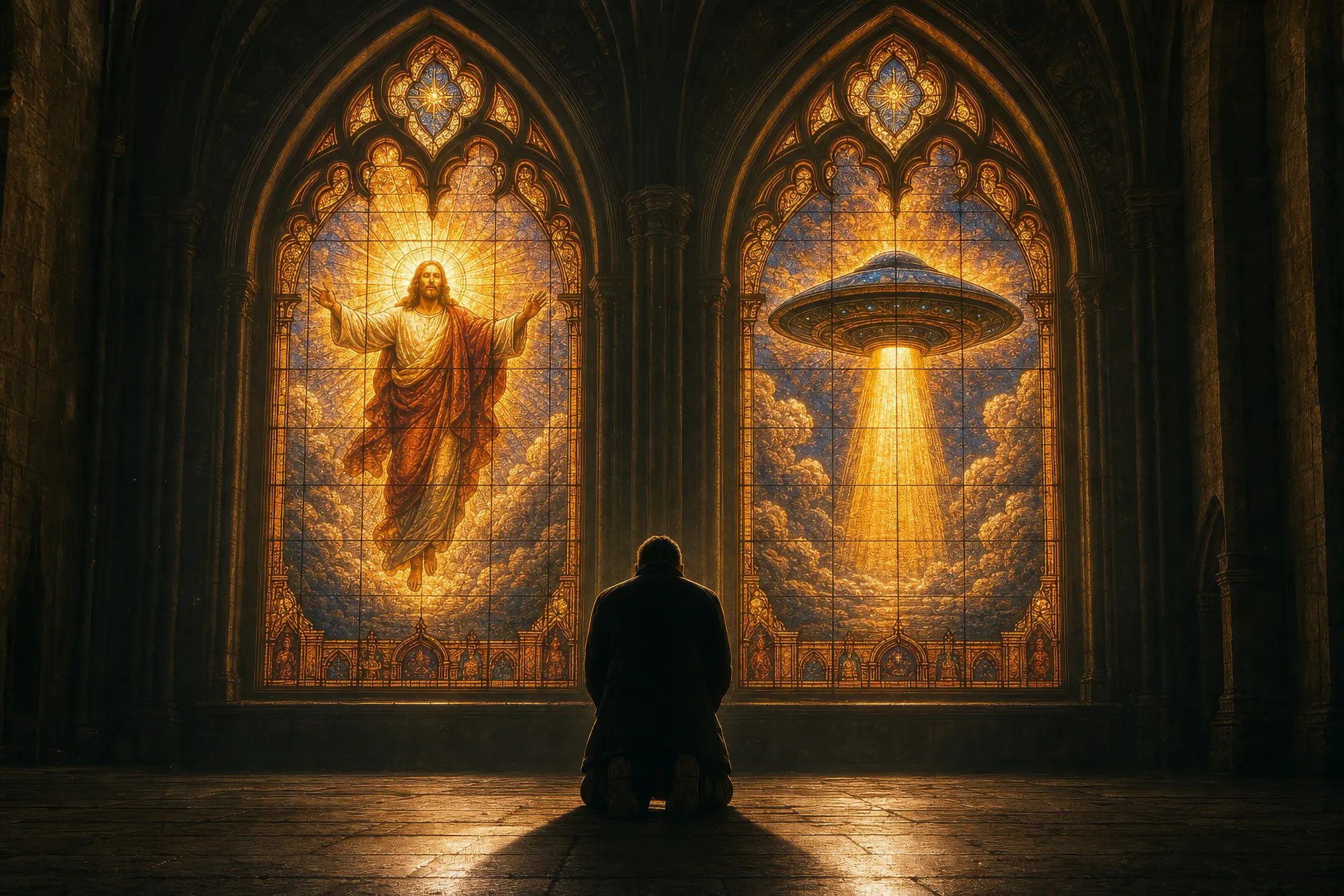
Tyson correctly invokes the psychological literature on eyewitness fallibility, pareidolia, sleep paralysis, and collective delusion. He is scrupulous in his insistence that credibility of witness is not equivalent to credibility of evidence. He notes, memorably, that “in science, there’s no such thing as a credible claim or a credible witness, only credible evidence.” This is the correct epistemological position, stated with appropriate force. What Tyson does not do—and what the internal logic of his argument demands—is state explicitly that this epistemological structure is formally identical to the one that sustains religious belief in general and theistic cosmology in particular. The reader encounters the argument in fragments: the “God of the gaps” becomes the “Alien of the gaps” (Chapter 6); the behavior of believers is analogized to religious devotion; the Raëlian faith is introduced as a UFO-based religion that explicitly replaces traditional theology. Tyson gestures toward the connection. He does not make it.
This omission is not intellectually innocent. The parallel is not merely rhetorical but structural. In both cases, a community of believers posits the existence of powerful, non-human intelligences that intervene in human affairs, whose existence cannot be empirically falsified, whose non-appearance is explained through elaborate secondary hypotheses (government cover-up; divine concealment), and whose reality is confirmed through testimony, personal experience, and the community’s shared interpretive framework.
Pew Research data cited by Tyson himself reveals that non-religious individuals are significantly more likely to believe in extraterrestrial intelligence than religious ones—a finding that strongly implies the belief in Aliens is functioning, for many, as a secular substitute for supernatural agency. The author should not concern himself with alienating religious readers by making this connection explicit. The argument does not require attacking any particular faith tradition. It requires only the observation—well within the norms of scientific communication—that belief in extraterrestrial visitation and belief in divine agency share a common epistemological deficiency: both make empirical claims that are systematically insulated from empirical testing. A peer-reviewed scientific journal would expect precisely this level of analytical precision. Tyson’s readers, whatever their spiritual commitments, are capable of following the argument. The book’s failure to make it clearly is a failure of intellectual courage dressed as sensitivity.
Who Reports UFOs and What This Tells Us
Tyson is considerably more forthcoming—and more effective—in his treatment of the social psychology of UFO reporting. His analysis of the demographic and cultural skew of reported sightings is among the book’s most valuable contributions. The concentration of reports in English-speaking countries, the feedback loops between popular media depictions and eyewitness “confirmation,” the Ruwa, Zimbabwe schoolchildren episode, the Dallas Zoo clouded leopard incident, and the Mexico City solar eclipse mass misidentification are all marshalled to illustrate how collective belief systems prime perception and manufacture consensus from ambiguous data.
The author’s analogy to a documentary about elephants that contains only sworn testimony but no actual elephants is both correct and lethal.
The author correctly identifies suggestibility and groupthink as central mechanisms. The 1947 Roswell incident and its cultural aftermath constitute a paradigm case of how an initially ambiguous event—almost certainly a classified military test vehicle—becomes crystallized into narrative form through media amplification, institutional defensiveness, and the human mind’s drive toward coherent narrative. Once the narrative exists, it functions as a template: subsequent anomalous sightings are interpreted through it, witnesses unconsciously model their accounts on existing archetypes, and the feedback loop between popular representation and reported experience closes.
Tyson also raises, without fully pursuing, the critical question of testimony’s relationship to authority. The 2023–2025 congressional hearings on UAPs are treated with appropriate skepticism. High-ranking military and intelligence officials, speaking under oath, claiming knowledge of recovered Alien craft and non-human biologics, are not thereby providing scientific evidence. The author’s analogy to a documentary about elephants that contains only sworn testimony but no actual elephants is both correct and lethal.
However, having correctly diagnosed the problem, Tyson does not complete the diagnostic. Suggestibility and groupthink are not merely unfortunate cognitive quirks that produce inaccurate UFO reports. They are, in the context of the scientific method, the specific obstacles whose elimination is the purpose of controlled experimental design, blind testing, independent replication, and peer review. The book does not make sufficiently clear that the same cognitive tendencies documented in the UFO literature—confirmation bias, pattern recognition run amok,
the authority heuristic, the need for narrative closure—are precisely the tendencies that the scientific method exists to counteract. This is not a peripheral observation; it is the epistemological center of the book’s implicit argument.
How Non-Scientific Inquiry Impedes Productive Investigation
The book’s most significant intellectual lacuna is its failure to address the opportunity costs of belief-driven rather than evidence-driven investigation of anomalous aerial and atmospheric phenomena. This failure is consequential not merely as a matter of intellectual completeness but as a matter of scientific policy.
The history of science contains numerous examples in which phenomena initially dismissed as superstition or pseudoscience—ball lightning, meteorites, continental drift, prion disease—were ultimately explained through rigorous empirical inquiry and yielded significant scientific and technological benefit. The inverse is equally documented: when anomalous phenomena become the property of a belief community rather than a scientific community, the phenomena cease to be investigated and become instead maintained as mysteries that, for the belief community, is not a problem to be solved but a feature to be preserved—because the mystery is constitutive of the belief.
Tyson acknowledges the existence of genuinely unidentified aerial phenomena. He cites the discovery of Sprites—large-scale atmospheric electrical discharges above stratospheric storm systems, first photographed only in 1989—as an example of a real and previously unknown atmospheric phenomenon that, to the untrained observer, was for decades indistinguishable from anomalous reports. This example is exactly right. It is also exactly the argument the book should be making more forcefully: the correct response to genuinely anomalous observational data is not to conclude that it confirms extraterrestrial visitation but to apply systematic empirical methods that might identify what the phenomenon actually is.
The culture of UFO belief does not merely fail to contribute to scientific understanding of anomalous atmospheric and sensor phenomena—it actively prevents it.
The 2022 NASA UAP panel, whose findings Tyson cites approvingly, reached precisely this conclusion. Its recommendations—systematic data collection, crowdsourced smartphone-based reporting, standardized observation protocols—are the recommendations of scientists who recognize that genuine anomalies deserve genuine scientific attention, and that the current UFO culture, dominated by belief, testimony, and conspiracy thinking, is actively impeding that attention.
The book should state this directly: the culture of UFO belief does not merely fail to contribute to scientific understanding of anomalous atmospheric and sensor phenomena—it actively prevents it. Resources, institutional attention, and public interest are captured by an interpretive framework that treats scientific skepticism as denial and demands that anomaly be explained as visitation before it has been explained at all. This is not a harmless epistemological preference. It has measurable costs in terms of what does not get investigated, what data does not get collected, and what discoveries do not get made.
Here again the parallel to theistic epistemology is directly relevant. The assignment of unexplained natural phenomena to divine agency—the God of the gaps—has historically functioned to halt rather than advance inquiry. Newton’s appeal to God’s reforming hand as an explanation for perturbations in planetary motion was not merely incorrect; it was a scientific dead end that remained so until Laplace’s perturbation theory provided a mathematical framework adequate to the data. The “Alien of the gaps” operates identically: genuine atmospheric, electromagnetic, or sensor phenomena that might, under systematic investigation, reveal something scientifically interesting are instead filed under the heading “Alien activity” and removed from empirical inquiry.
This is the argument I think Tyson should have made.
Non-Falsifiability in UFO Culture
The most philosophically rigorous version of the argument Tyson is circling concerns the formal structure of non-falsifiability. A claim is non-falsifiable when no possible observation could count as evidence against it. Non-falsifiability is not a logical fallacy but it is, in the philosophy of science following Karl Popper, a criterion for distinguishing scientific from non-scientific claims. Claims that cannot be falsified are not thereby false; they are simply not scientific. UFO belief, as Tyson’s evidence makes clear, has a non-falsifiable structure.
The absence of clear photographic evidence is explained by alien camera-shyness or government suppression. The absence of alien artifacts is explained by government sequestration. The absence of alien bodies is explained by classified facilities with restricted access. The implausibility of interstellar travel at observed speeds is explained by alien physics beyond human comprehension. Each potential falsifying observation is absorbed by an auxiliary hypothesis that preserves the core belief. The system is unfalsifiable, and therefore, by the criteria of scientific epistemology, the belief in alien visitation is not a scientific hypothesis.
Both UFO conviction and traditional theism are, in this technical sense, faith commitments rather than empirical hypotheses.
The structural identity with traditional theism is exact and has been noted by philosophers of religion for generations. The non-appearance of God is explained by divine hiddenness. The existence of evil is explained by divine permission for human freedom. The apparent contingency of natural processes is explained by God’s sustaining action in and through natural causes. Each potential falsifying observation is absorbed. The system is unfalsifiable. Traditional theistic belief, whatever its spiritual or ethical value, is not a scientific hypothesis.
This parallelism is not an attack on religion. It is a claim about the epistemological category of certain kinds of belief. Both UFO conviction and traditional theism are, in this technical sense, faith commitments rather than empirical hypotheses. They rest on the same cognitive infrastructure—the need for agency, narrative, and meaning in the face of uncertainty—and they are sustained by the same mechanisms of communal reinforcement, interpretive charity toward confirming evidence, and resistance to disconfirmation. A book about the epistemology of UFO belief that does not make this argument explicit is a book that has found its most important idea and declined to articulate it.
Tyson, for his part, is not a theist—this is well established in his public record—and the book’s prologue and epilogue both reveal a scientist who yearns for genuine extraterrestrial contact and recognizes no tension between that yearning and his epistemological rigor. The reticence about making the God parallel explicit is therefore not self-protective. It appears, rather, to reflect a strategic decision to avoid controversy. This is an understandable editorial choice, but in this reviewer’s opinion, a regrettable intellectual one. Scientific communication that softens its epistemological conclusions to accommodate potential offense is scientific communication that has already compromised its most important function.
What the Book Does Well
Tyson’s survey of the astrophysics and biology relevant to extraterrestrial life is excellent. His treatment of the Drake equation, Fermi’s paradox, the Goldilocks zone, and the diversity of potentially habitable environments in the outer solar system is current, accurate, and elegantly communicated. His demolition of the Ancient Aliens genre—the persistent attribution of ancient human engineering and art to extraterrestrial architects—is both well-argued and well-timed, given the phenomenon’s cultural persistence.
The book’s comic voice is, on balance, an asset rather than a liability. The exchange of correspondence with the Peruvian mummy researchers, the taxonomy of cinematically dumb aliens, and the extended meditation on the flying saucer as a wheelchair-accessible vehicle are genuinely funny in ways that serve, rather than undermine, the book’s serious purposes. Humor is a legitimate tool of scientific communication when it is used, as Tyson largely uses it, to dissolve pretension rather than to avoid argument.
The chapter on Alien intelligence—exploring the humbling implications of a species just two percent more cognitively advanced than humans—is among the best popular science writing on the philosophy of mind published in recent years. The thought experiment about a species standing in the same cognitive relation to Homo sapiens as Homo sapiens stands to Pan troglodytes is both intellectually rigorous and appropriately unsettling.
The Future of Aliens
Take Me to Your Leader is a significant and valuable contribution to the literature of popular science communication. Tyson is one of a very small number of scientists capable of writing with this combination of rigor, erudition, and wit about phenomena that sit at the intersection of astrophysics, psychology, epistemology, and culture. The book is worth reading, worth assigning in courses on the public understanding of science, and worth taking seriously as a document of our current epistemological moment.
A book about the failure of evidence standards that itself softens its epistemological conclusions for strategic reasons has, at some level, enacted the problem it diagnoses.
It is, however, a lesser book than it could have been. Its most important argument—that UFO belief and theistic conviction are epistemologically equivalent faith commitments that share not only a cognitive architecture but also a documented tendency to impede rather than advance genuine empirical inquiry—is present throughout but never fully articulated. The author appears to have concluded that the readers who most need to hear this argument are the readers least likely to continue reading if it is stated plainly.
This may be a correct assessment of the popular science market. It is not, however, a correct assessment of the book’s intellectual obligations. Scientific communication at its most effective does not merely inform; it models the epistemological standards by which claims should be evaluated. A book about the failure of evidence standards that itself softens its epistemological conclusions for strategic reasons has, at some level, enacted the problem it diagnoses. Tyson knows where the argument leads. He should take it there.