The Science of the Declaration of Independence
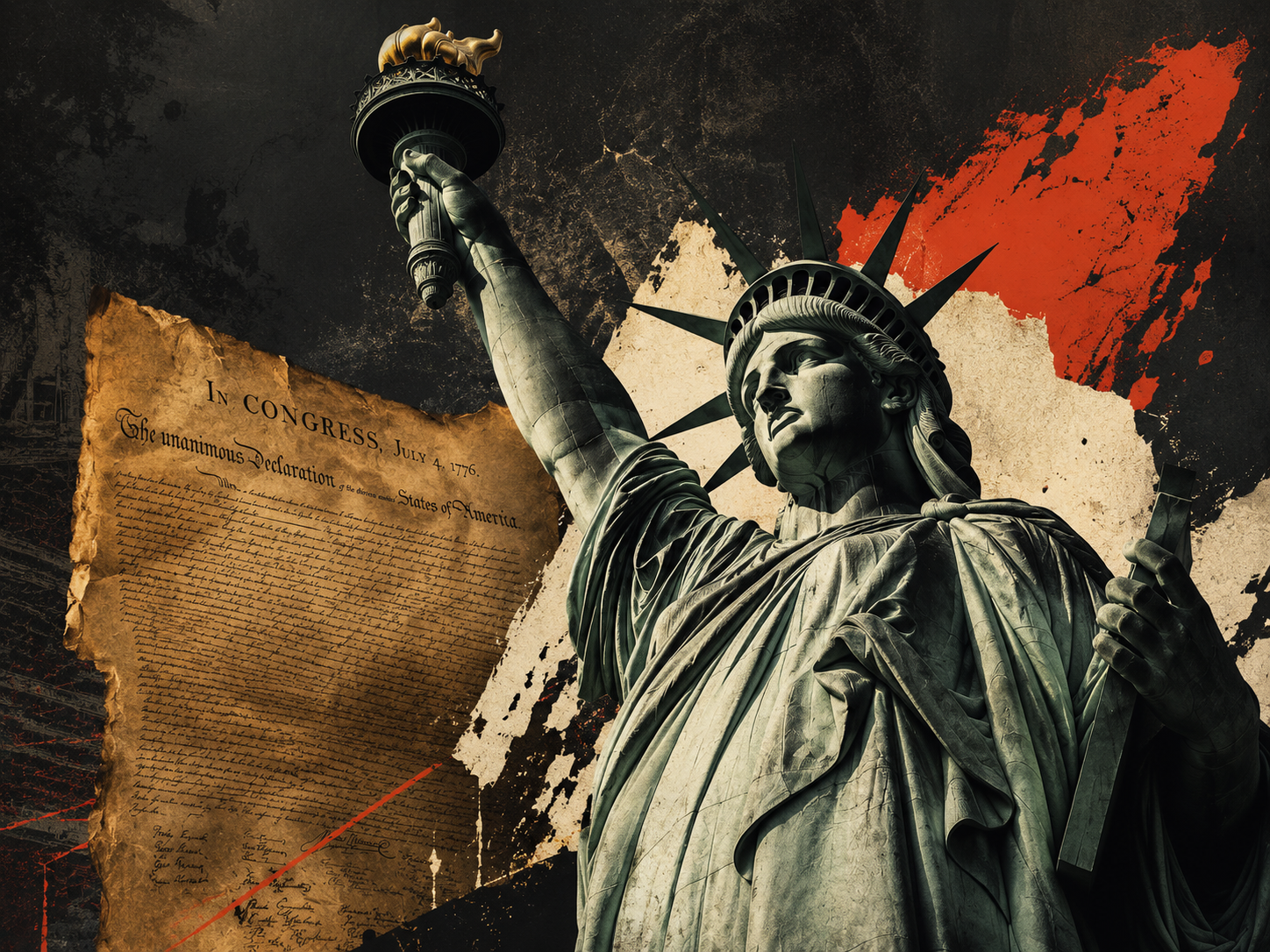
On America’s 250th Anniversary, a New Look at its Founding Document
It is altogether proper for so many commentators on this 250th anniversary of the nation’s founding to treat the Declaration of Independence as a work of political philosophy unprecedented in history—drafted, edited, and approved as it was by Thomas Jefferson, Benjamin Franklin, John Adams, James Madison, and the other Founding Fathers, who were the intellectual heirs of the Enlightenment. I would like to consider this document, and the founding of the United States, one level deeper, namely as a product of not only the Enlightenment, but the Scientific Revolution that preceded it as well.
Many of the Founding Fathers were, in fact, natural philosophers—scientists in today’s jargon (the word wasn’t coined until 1834)—who deliberately adapted the method of data gathering, hypothesis testing, and theory formation to their nation building. Their understanding of the provisional nature of findings led them to develop a social system in which doubt and dispute were the centerpieces of a functional polity. Jefferson, Franklin, Adams, Madison, and the others thought of social governance as problems to be solved rather than as power to be grabbed. They thought of democracy in the same way they thought of science—as a method, not an ideology. They argued, in essence, that no one knows how to govern a nation, so we have to set up a system that allows for experimentation. Try this. Try that. Check the results. Repeat. As Jefferson wrote in 1804:
No experiment can be more interesting than that we are now trying, and which we trust will end in establishing the fact, that man may be governed by reason and truth.
Think about the 50 different states, each with its own constitution and set of laws. These are 50 different experiments in taxation, regulation, gun control, abortion, and the like. However, Jefferson noted, as in science where open peer criticism and the freedom to debate increases the probability of discovering provisional truths, this daring new political experiment depended on open access to knowledge and the freedom of its citizens to see and to think for themselves:
Our first object should therefore be, to leave open to him all the avenues to truth. The most effectual hitherto found, is the freedom of the press. It is therefore, the first shut up by those who fear the investigation of their actions.
Even the fundamental principles underlying the Declaration of Independence, which is usually thought of as a statement of political philosophy, were in fact grounded in the type of scientific reasoning that Jefferson and Franklin employed in other sciences. Consider the foundational line, “We hold these truths to be self-evident….” Jefferson’s original phrase was “We hold these truths to be sacred and undeniable.” Why was it changed?
Jefferson’s original phrase was “We hold these truths to be sacred and undeniable.” Why was it changed?
According to author Walter Isaacson, on June 21, 1776, in reviewing the Declaration Franklin “crossed out, using heavy backslashes that he often employed, the last three words of Jefferson’s phrase, ‘We hold these truths to be sacred and undeniable’ and changed them to the words now enshrined in history: ‘We hold these truths to be self-evident’.” Isaacson explains why in his book The Greatest Sentence Ever Written:
The idea of “self-evident” truths was one that drew less on John Locke, who was Jefferson’s favored philosopher, than on the scientific determinism espoused by Isaac Newton and on the analytic empiricism of Franklin’s close friend David Hume.
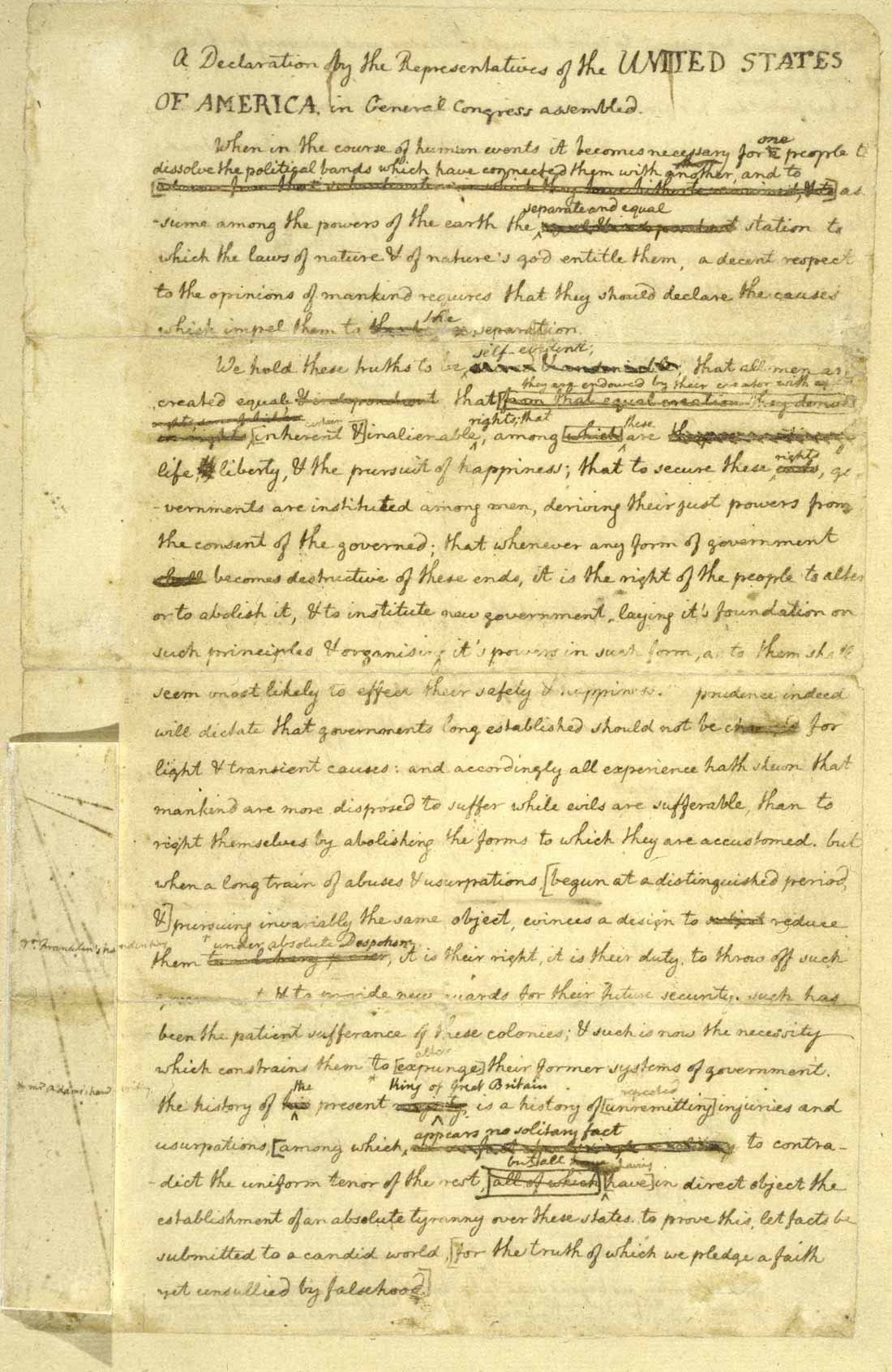
Hume, the great Enlightenment philosopher whose writings were well-known to the Founding Fathers, famously made a distinction between analytic truths that are self-evident by definition (cardiologists are doctors) and synthetic truths for which you need to check the evidence to see if they are true (cardiologists are rich). By using the word “sacred,” Isaacson continues, “Jefferson had asserted, intentionally or not, that the principle in question—the equality of men and their endowment by their creator with inalienable rights—was an assertion of religion. Franklin’s edit turned it instead into an assertion of rationality.”
As for the Declaration’s claim “all men are created equal,” far from religion being the source of this greatest of all moral precepts, Jefferson explained in a letter its inspiration half a century later:
Neither aiming at originality of principle or sentiment, nor yet copied from any particular and previous writing, it was intended to be an expression of the American mind, and to give to that expression the proper tone and spirit called for by the occasion. All its authority rests then on the harmonizing sentiments of the day, whether expressed in conversation, in letters, printed essays, or in the elementary books of public right as Aristotle, Cicero, Locke, Sidney, &c.
This shift from religious faith to scientific rationality was the result of two intellectual revolutions: (1) the Scientific Revolution, dated roughly from Copernicus’ On the Revolutions of the Heavenly Spheres in 1543 to Isaac Newton’s Principia in 1687; and (2) the Enlightenment, dated from approximately Newton to the French Revolution.
The first revolution led directly to the second, as intellectuals in the 18th century sought to emulate the great scientists of the previous centuries in applying the rigorous methods of the natural sciences and philosophy to explaining human and social phenomena. This marriage of philosophies resulted in Enlightenment ideals that placed supreme value on reason, scientific inquiry, human natural rights, liberty, equality, freedom of thought and expression, and on a diverse, cosmopolitan worldview that most people today embrace.
Newton, in particular, was exalted by the Founding Fathers as one of the greatest minds of all time, and by the late 18th century in diverse fields strove to be the Newton of their time. In his 1748 work The Spirit of the Laws, for example, the French philosophe Montesquieu consciously invoked Newton when he compared a well-functioning monarchy to “the system of the universe” that includes “a power of gravitation” that “attracts” all bodies to “the center” (the monarch). By “spirit” Montesquieu meant “causes” from which one could derive “laws” that govern society.
Following Montesquieu, a group of French scientists known as the physiocrats declared that all human societies are “regulated by natural laws.” One of these physiocrats, François Quesnay—a physician to the king of France who later served as an emissary to Napoleon for Thomas Jefferson—modeled the economy after the human body, in which money flowed through a nation like blood flows through a body, and ruinous government policies were like diseases that impeded economic health. He argued that even though people have unequal abilities, they have equal natural rights, and so it was the government’s duty to protect the rights of individuals from being usurped by other individuals, while at the same time enabling people to pursue their own best interests. This led them to advocate for minimum government interference in the economy, private property, and the free market, which they called laissez faire.
The physiocrat movement grew into the school of classical economics championed by David Hume, Adam Smith, and the Founding Fathers that form the basis of the free market economic policy of the United States today. The very title of Adam Smith’s classic 1776 work, An Inquiry into the Nature and Causes of the Wealth of Nations, reveals that it was a work of science in its search for the “nature” and “causes” of wealth. The founders had all read it and understood its underlying premise that natural laws govern economies, that humans are rationally calculating economic actors whose behaviors can be understood, and that markets are self-regulating by an “invisible hand,” which Smith analogized to Newton’s gravity.
The concept underpinning the Declaration of Independence is known as moral realism, which is central to how we think as a nation and our way of life. Moral realism says that right and wrong, just and unjust, moral and immoral, are not the whimsical products of power or culture, but discoverable through reason and science. In the same way that Galileo and Newton discovered physical laws and principles about the natural world that really are out there, so too did the founders purport to discover moral laws and principles about human nature and society that really do exist. As James Madison wrote in Federalist Paper #51:
But what is government itself, but the greatest of all reflections on human nature? If men were angels, no government would be necessary. If angles were to govern men, neither external nor internal controls on government would be necessary. In framing a government which is to be administered by men over men, the great difficulty lies in this: you must first enable the government to control the governed; and in the next place oblige it to control itself.
Just as it was inevitable that the astronomer Johannes Kepler would discover that planets have elliptical orbits—given that he was making accurate astronomical measurements, and given that planets really do travel in elliptical orbits, he could hardly have discovered anything else—scientists studying political, economic, social, and moral subjects will discover certain things that are true in these fields of inquiry, such as that democracies are better than autocracies and that market economies are superior to command economies.
Just ask yourself, where would you rather live, North Korea or South Korea? The answer is obvious. Would you rather be fed or starving, educated or illiterate, free or enslaved? As Abraham Lincoln articulated the principle four score and several years after the Declaration of Independence (in his 1858 debate with Stephen A. Douglas):
As I would not be a slave, so I would not be a master.
And in his Annual Message to Congress in 1862:
In giving freedom to the slave, we assure freedom to the free.
Our founding ancestors discovered these rights and principles as self-evident truths about our nature, and their application has led to the abolition of slavery, torture, cruel-and-unusual punishment, capital punishment, corporeal punishment, witch crazes, inquisitions, and pogroms, and were the legal foundation for civil rights, women’s rights, gay rights, children’s rights, and even animal rights.
So, on this 250th anniversary of the founding of our nation, let us all remember these political principles were also grounded in rational and even scientific truths about the human condition.
This article originally appeared in The Boston Globe on July 5, 2026.
Note from author: The original published version in The Boston Globe does not contain the quotes from Walter Isaacson about Franklin’s edits of Jefferson’s original statement “We hold these truths to be sacred and undeniable” to “We hold these truths to be self-evident” as it may be disputable as to whether or not those are Franklin’s back-slashes in the draft. I am leaving it in here in hopes that some historians can comment on the controversy, and await Walter Isaacson’s response to my query. As he wrote an entire book on that one sentence, one presumes that his confidence is high that those are Franklin’s edits.