Transgenderism Is in Rapid Decline Among Young Americans

Transgenderism is in rapid decline among young Americans, indicating it was a social contagion.
A few weeks ago, I published results from six waves of the massive Foundation for Individual Rights and Expression (FIRE) annual survey of undergraduates. The data were unequivocal: the share of students identifying as a gender other than male or female—that is, as non-binary—peaked in 2023 and has halved in the two years since. This is a stunning reversal in the culture that will reverberate through society and politics in the coming years.
The Findings
The survey captures over 50,000 students per year from nearly 250 leading American universities. Its size guarantees statistical power and enables us to look at small subgroups like trans or queer people. FIRE data are random samples, small percentages of each university’s student body, and I wanted to be certain it triangulated with two surveys capturing a much greater share of the total. One comes from the elite Andover Phillips prep school near Boston; the other is run by Brown University’s student newspaper. Both interview a far higher share of their target pool than FIRE surveys (up to 50 percent for Brown freshmen, and 75 percent in the Andover case). As Figure 1 shows, these surveys corroborate the “peak trans” pattern in the FIRE data, revealing a rapid decline since 2023.
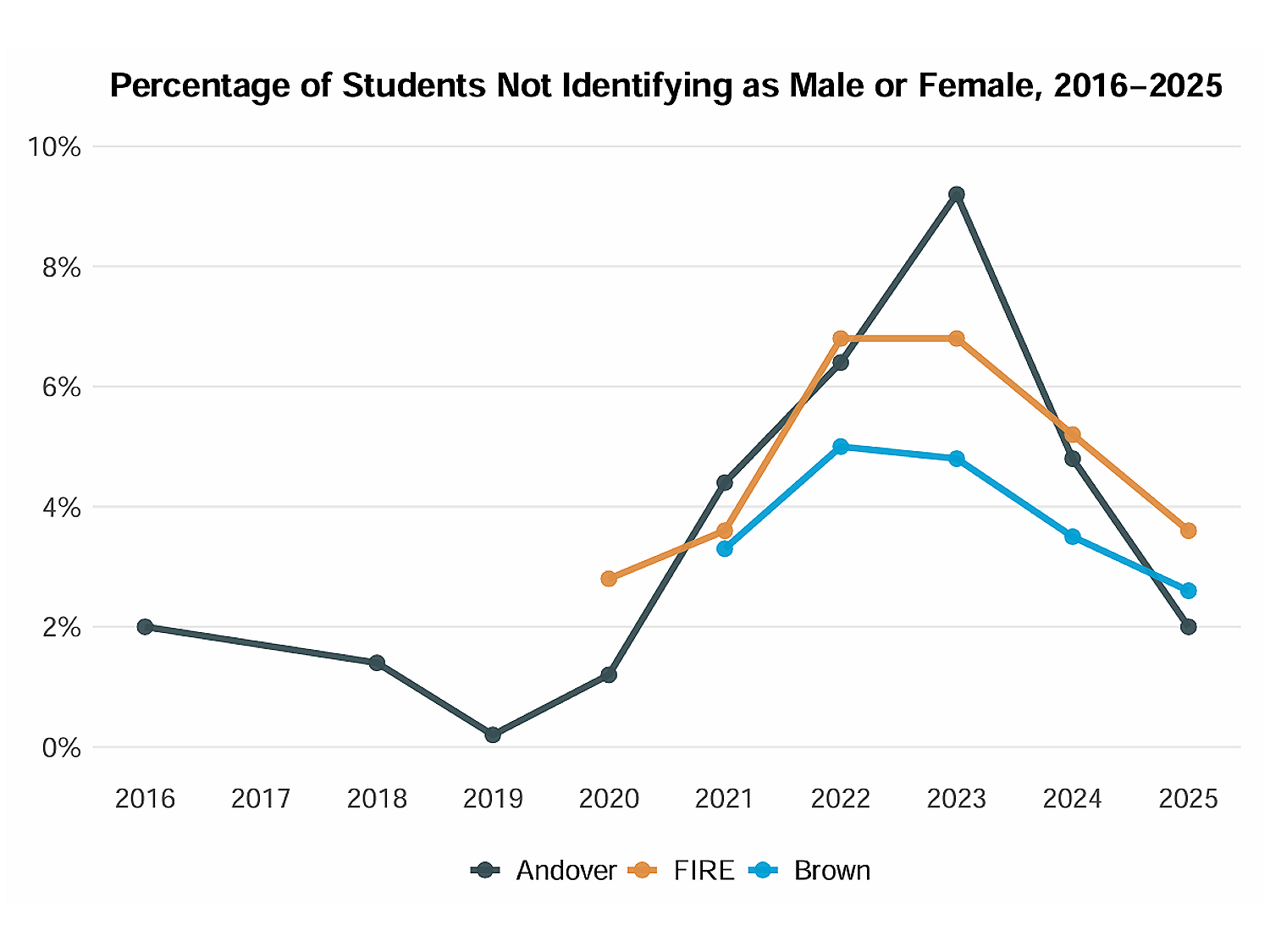
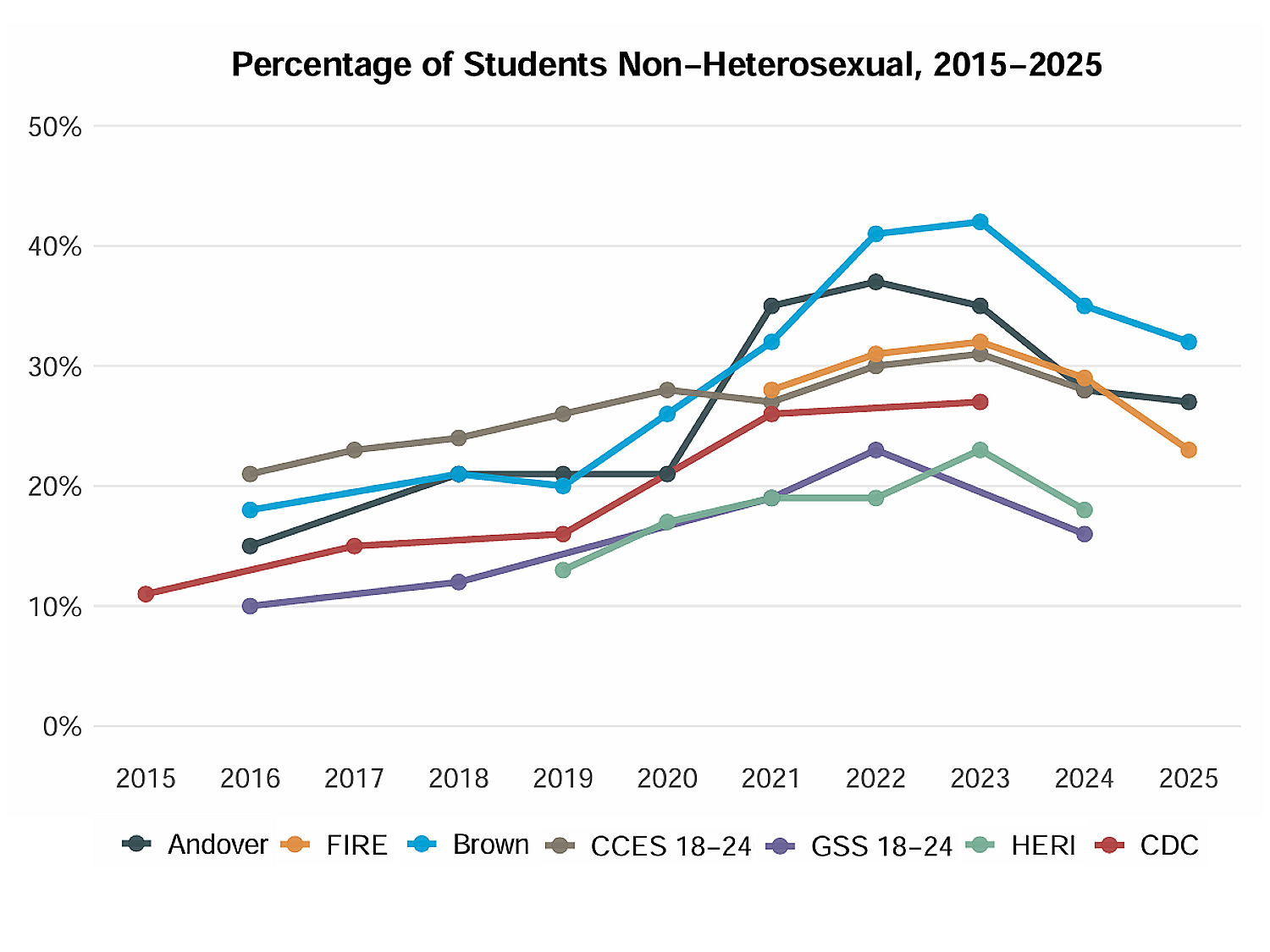
I expand more fully on these findings in my University of Buckingham Centre for Heterodox Social Science report, which also found that the decline in non-binary identification was matched by a 10-point drop in unconventional sexual identification. These students identified their sexual orientation as something other than heterosexual or homosexual—such as pansexual, queer, questioning, bisexual, or asexual. Many students who identify as neither male nor female also identify as sexually nonconforming, so the correlation trend is unsurprising.
Sexual orientation has been measured in more youth surveys for longer than gender identity has been. While gay and lesbian share remained flat from 2020 to 2025, Figure 2 shows that the broader non-heterosexual group—covering bisexual, queer, pansexual, asexual, questioning, and other labels—rose steeply to 2023 and then fell across a wide range of surveys. The non-heterosexual proportion peaked at around 30 percent overall, reaching as high as 40 percent at progressive-leaning Ivy League schools like Brown and 50 percent in liberal arts colleges such as Smith College. Importantly, the decline in nonconforming sexual orientation parallels the decline in nonconforming gender identity, suggesting a common underlying dynamic.
The Reaction
A thread on 𝕏 summarizing my findings went viral—retweeted by accounts such as Elon Musk, Donald Trump Jr., Matt Walsh, and others—and has been viewed 19 million times. The National Review, Laura Ingraham (Fox News), and other outlets covered my piece and interview in UnHerd.
Two main critiques followed. First, that “non-binary isn’t trans.” Second, the analysis was criticized for not using weighted data. Let’s consider both.
Are “non-binary” and “trans” distinct?
Some trans-skeptical activists such as “Billboard Chris” Elston worried that declaring “trans decline” could undercut the political momentum behind the campaign against gender ideology. Their substantive argument is that non-binary people who do not identify as male or female differ from binary trans individuals who do identify as male or female, just the opposite sex from the one in which they were born. Benjamin Ryan, a health and science journalist, added that the findings were based on the “false presumption” that trans and non-binary were linked.
However, in practice, trans advocacy organizations explicitly include non-binary identities as part of the trans community. Second, even if one restricts “trans” to binary switchers, many who change their gender from female to male, or vice versa, are likely to pass through a non-binary stage of gender indeterminacy. Conceptually, non-binary identity functions as a gateway to binary transition.
Trends in the two should, and do, correlate. In the Cooperative Election Study (CES), where people are asked whether they are trans separately from their gender, those who identify as trans are nearly 70 times more likely to identify as non-binary than a person who does not identify as trans, a monumental correlation. While it’s possible for non-binary to fall while binary trans holds steady, the CES data, summarized by Jean Twenge, shows that the two trends move together, with trans and non-binary both in decline.
The Weighting Dispute
Progressive commentators, led by Erin Reed, who based her rebuttal on the analysis of blogger Jacob Eliason, claimed the analysis was “dead on arrival” because it did not use survey weights. (Weights correct demographic imbalances in the survey sample to approximate population-level estimates.) Eliason applied weights and showed that doing so flipped my trend. Now, instead of trans decline, non-binary was stable at 2 percent from 2020 to 2023 and then surged to 10 percent in 2024–25. Alongside some friendly statisticians commenting generally about the importance of weighting and FIRE statisticians saying weights should be applied, they felt they had a “gotcha.”
But weighting can distort rather than clarify when applied to small subgroups like trans respondents. Weights artificially adjust samples to match population demographics by sex, race, and institution. That’s useful for FIRE when comparing institutions in particular years in college free speech rankings. Over time, however, changes in sampling frames and weighting formulas can introduce arbitrary noise, rendering weighted data considerably more error-prone than raw unweighted results.
Eliason’s weighted time series produced an erratic spike in 2024 because College Pulse, which conducts the FIRE surveys, suddenly revised their gender weights. I had run the data both ways and found that weighting produced erratic results while unweighted data aligned with the more representative Andover and Brown trends.
After I explained these issues in a rebuttal, Eliason conceded that the weighting was problematic. He then pivoted to claim that unweighted samples overrepresented certain graduating classes. Yet a fixed-effects regression controlling for college, cohort, financial aid, socioeconomic background, race, religion, and ideology can account for these factors and yields the same profile as the chart I initially circulated.
Meanwhile, FIRE, having examined the assumptions underlying their data over time, revised their view, cautioning that weighting was not actually the recommended approach in this case.
Jean Twenge weighs in.
Following the heated debate sparked by my 𝕏 thread, Jean Twenge, professor of psychology at San Diego State University and arguably the leading quantitative youth trends researcher in the country, made an important discovery. Using data from the CES that I had overlooked, she was able to examine the question of transgender identity separately from gender identity. Her conclusion:
Among 18- to 22-year-olds, trans identification fell by nearly half from 2022 to 2024. Nonbinary identification dropped by more than half between 2023 and 2024.
These findings echoed the Census Bureau’s official Household Pulse survey, which revealed a large decline in youth non-binary identification in the first half of 2024. More than that, Twenge found, as I did, that the youngest cohorts were least likely to identify as trans, portending future decline in transgenderism. Her intervention shifted the perspective of skeptics like Benjamin Ryan and influenced Colin Wright’s subsequent opinion editorial in The Wall Street Journal, which labeled trans as a social contagion.
A few weeks later, Twenge analyzed data from the Monitoring the Future survey, which surveys teens as young as age 13. The share of 8th, 10th, and 12th graders identifying as neither male nor female dropped in half between 2022 and 2024, with the change sharpest among the 8th graders. Twenge writes that the trends confirm a broader pattern in which new patterns arise first among the youngest, spreading later and less forcefully to older teens.
Altogether, Twenge’s analysis and my data, spanning six major youth surveys, present a robust and compelling case against attempts to downplay the reality of the decline.
Interpreting the Trend
Why is the trans curve bending downward? Are young people becoming more conservative and religious? No. The same FIRE student surveys that show a significant decline in non-binary gender and queer sexuality also indicate that there has been no shift to the political right over time and no increase in the percentage of students affiliating with religion. Students are also no more supportive of free speech and no more opposed to shouting down speakers than they were in 2020. They are as woke as ever, just less trans and queer.
The rise-and-fall pattern for gender nonconformity took place on both red and blue state campuses.
Not only that, but the rise-and-fall pattern for gender nonconformity took place on both red and blue state campuses, among both liberal and conservative students, albeit from different baselines. At ultra-liberal Oberlin College, for example, the share of students identifying as non-binary plunged 20 points between 2023 and 2025. On Ivy League campuses, the collapse was more pronounced than it was among students at less prestigious institutions.
Could a decline in mental health issues explain the decline in trans identification? There is evidence that student mental health improved substantially between 2023 (when five mental health questions were first introduced in the FIRE data) and 2025. The share of those who said they were anxious most or all of the time declined from 38 to 28 percent, while the share of those who said they were depressed fell from 17 to 10 percent. The CDC finds an improvement in mental health among high school students between 2021 and 2023, the latest data point. Statistical analysis shows that better mental health helps to explain only part of the decline in non-binary gender identification.
Most of the change in gender identification is due to factors other than better mental health, even though mental health issues declined among non-binary students. Instead, it appears to be primarily a youth fashion trend that exists independently of politics and mental health.
Faced with mounting evidence that trans is in decline, some progressive and transactivist writers have shifted to arguing that Republican attacks on their movement have pushed trans people back into the closet. However, the FIRE data shows that non-binary students self-censor their opinions less than other students and feel as free as anyone else to voice their views on transgender issues, with no change after Donald Trump took office for the second time. Accounting for the political views of non-binary students and their peers, there is no evidence that the speech climate for non-binary students worsened on red state campuses more than blue state campuses after 2024. This is not about trans people going back into the closet.
Implications
The trans downturn might not have been caused by politics, but it has major political implications. First, the data suggest that trans was a social contagion that rose and fell. That means health practitioners prioritized transitioning ideology over their responsibility to protect patients from a fad and to do no harm.
Secondly, since the 2010s, the rise of trans and queer identity has been umbilically connected to a progressive story of the inevitable progress of marginalized groups remaking the mainstream. Cultural reversals profane the progressive left’s eschatological “arc of history overcoming resistance” narrative. A movement based on millenarian inevitability cannot afford to lose public support without jeopardizing its sacred narrative. Youth gender identity and public opinion toward natal males accessing female spaces have both recently moved against the progressive narrative. This shift has opened up a cleft between an insurgent anti-woke center-left and the establishment‑woke left that continues to roil the Democratic Party.