The Truth About Vaccine Schedules: An Injection of Politics?

We spent the twentieth century beating measles, polio, and newborn hepatitis B into statistical irrelevance. In 2025, the man who fought hardest against that victory was put in charge of federal vaccine policy. How did this happen? And what is going to happen now?
Vaccines have worked, spectacularly, for a hundred years.
It’s far too easy to forget a war we won so thoroughly that most people alive today have never seen a casualty.
Before the measles vaccine was introduced in 1963, the disease killed an estimated 2.6 million people worldwide every year. Afterward, U.S. case counts fell more than 90 percent within five years, and by the early 1980s, they had dropped by 99 percent. This decline held even through a mid-1970s rebound when vaccination coverage briefly slipped. Smallpox, a disease that racked up a body count in the hundreds of millions in the twentieth century alone, was declared eradicated from the planet in 1980. This may be the only time in human history we have ever actually defeated a disease rather than just managing it. Polio went from paralyzing tens of thousands of American kids every year in the 1950s to hiding out in only a handful of countries because of political conflict. Globally, the WHO’s immunization program is credited with saving something on the order of 150 million lives over the last fifty years; the overwhelming majority of those were infants and children under the age of five.
This is not a controversial scientific claim. It’s closer to the idea that infectious diseases are caused by germs rather than swamp vapors or curses. Vaccines don’t just prevent death. A much larger number of people live their lives without disability as a result. Every case of paralytic polio we didn’t get, every child who didn’t go deaf from mumps, and every baby who didn’t develop the liver damage that comes with chronic hepatitis B is a life that doesn’t show up as a morbidity statistic. When people talk about the “cost” of vaccination programs, they sometimes forget the other side of the ledger: the daily count of children who never got sick. How did we ever decide this was a bad idea?
Andrew Wakefield
One man, a British gastroenterologist named Andrew Wakefield, is almost single-handedly the reason “vaccines cause autism” is a sentence that exists in the English language at all.
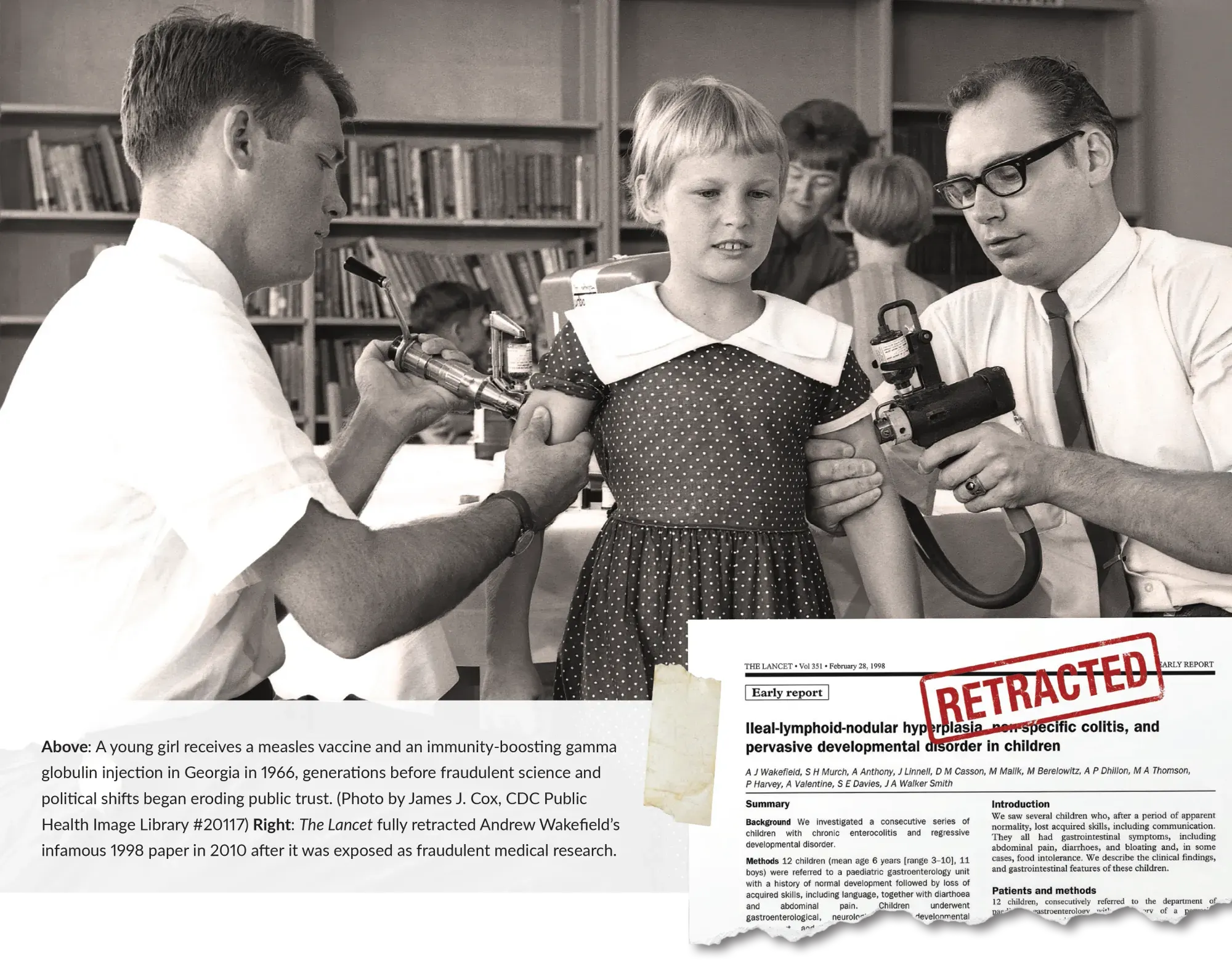
In 1998, Wakefield published a paper in The Lancet claiming a link between the MMR vaccine and autism in only twelve children, with no control group. Twelve. It has since been shown to be a fraud from top to bottom, including undisclosed payments from a lawyer building a case against vaccine manufacturers, manipulated case histories, and ethics violations that got Wakefield stripped of his medical license. The Lancet fully retracted the paper as “utterly false” in 2010. Most of his coauthors distanced themselves from the paper years before The Lancet retracted it.
“Falsehood flies, and the truth comes limping after it.” —Jonathan Swift
None of this mattered, because by the time careful research had gotten around to debunking it, the story had already escaped the lab and gone feral in the press. British and Irish measles vaccination rates cratered, falling as low as 61 percent in parts of London. Inevitably, measles came roaring back hard enough that the UK lost its WHO measles-elimination status for the first time in 2018–19, just two years after finally earning it. The UK regained the status in 2021, then lost it again in January 2026—a pattern we might be seeing develop here on the other side of the Atlantic. Paul Offit, a pediatrician who has spent his career watching this unfold, put it about as bluntly as a professional can: “That paper killed children.” Children were dying of vaccine-preventable diseases because parents declined vaccination based on a fraudulent paper. That’s about as clean a causal chain as epidemiology ever hands you.
The measles vaccine scare hit the U.S. less like a tidal wave and more like a slow-acting toxin. It fed the “vaccine court” litigation boom of the 2000s, which saw nearly 5,000 claims that vaccines caused autism. Every single case failed when the evidence was examined. It’s worth pausing to consider that: the legal system, using a lower evidentiary bar than a peer-reviewed journal, still couldn’t find a single case where this held up. It just doesn’t happen.
A Cochrane review of roughly 14.7 million children found no connection between vaccines and autism. A Danish study followed over 650,000 kids, including those with autistic siblings who were presumably at higher risk, and found nothing. But litigation losses don’t kill beliefs; simply debunking them with evidence is not enough. As of a 2024 survey, roughly one in ten American adults still believe vaccines probably or definitely cause autism, and about a quarter of the public still doesn’t believe the CDC has ever clearly said otherwise. Twenty-eight years of unanimous negative studies, and the belief just sits there. And now it is being fed by the highest medical authority in the land—a branch of the federal government.
RFK Jr.
To be fair to Robert F. Kennedy Jr., he did not invent vaccine skepticism. He just climbed on for the ride. For roughly twenty years before he became Secretary of Health and Human Services, Kennedy ran an organization called Children’s Health Defense, whose entire business model was convincing people that vaccines are dangerous, that HIV doesn’t cause AIDS, and, memorably, that airplane contrails are a secret chemical weapons program. Scientific American ran a piece in 2017 cataloging a decade of vaccine science distortion under his byline. This is not a man who earned his way into the job with an open mind; he came in with a set of beliefs he has been spreading for years.
Kennedy said his own kids were vaccinated, and he told the public that the MMR shot was the most effective way to stop the disease from spreading.
Here’s the genuinely strange part, though—the part that should make anyone do a double take: during his confirmation hearings and at times during the current measles outbreak, Kennedy said his own kids were vaccinated and called the MMR shot the most effective way to stop disease spread. Officially, he offers science-backed guidelines the barest support; elsewhere, he questions them and tells people to decide for themselves. In the same news cycle, he’d write an op-ed framing vaccination as a personal choice, suggest on TV that healthy kids can’t die of an infectious disease, or praise a doctor treating measles with cod liver oil and an antibiotic that has no effect on a virus. It’s a strange rhetorical move unless your goal is plausible deniability.
Secretary Kennedy also fired all seventeen members of the Advisory Committee on Immunization Practices (ACIP), the independent experts who write the actual vaccine schedule. He justified this by citing a 2009 report claiming 97 percent of its members had financial conflicts of interest. This sounds reasonable until you learn that public health officials pointed out the 97 percent figure was about missing paperwork signatures, not money, and that only one of the seventeen members had a real, disclosed conflict. Then, months after the firing, a peer-reviewed JAMA study came out showing that conflicts of interest on the committee had fallen from 42.8 percent in 2000 to about five percent by 2024. Secretary Kennedy purged the committee for alleged corruption at the exact historical moment it was cleaner than it had been in a generation. Unfortunately, several of his own hand-picked replacements turned out to be vaccine “skeptics” who were paid expert witnesses in lawsuits against vaccine manufacturers.
The Purge, the Panel, and the Fictional Citation
Once Kennedy sat behind the steering wheel at the U.S. Department of Health and Human Services, the changes came fast. The new panel’s first real act was voting to strip a preservative called thimerosal out of flu vaccines, based on a presentation from a former colleague of Kennedy’s anti-vaccine group that reportedly cited a study that does not exist. Not a flawed study. Not a study since retracted. A study that, as far as anyone can determine, was never published because it was never conducted. That slide was quietly pulled before the final presentation, but the vote happened anyway, thimerosal’s actual decades of safety data notwithstanding.
By September 2025, the panel terminated its recommendation for the combined MMRV shot in kids under four. By December, it voted to scrap the universal recommendation that newborns get a hepatitis B vaccine at birth—a policy that had driven a 99 percent drop in pediatric hepatitis B cases since 1990—replacing it with a system based on testing the mother’s infection status, a policy known to greatly decrease the uptake of the vaccine. One of the panel’s own members, who voted against the change, said the quiet part out loud: “We are doing harm by changing this, and I hope the committee accepts responsibility when that harm shows up.”
In August 2026, the Trump administration released its own “Gold Standard” guidelines by executive order. Among other changes, it recommends splitting the MMR into separate shots to be given at separate visits, even though no single-disease vaccines for measles, mumps, or rubella are licensed in the United States and there is no scientific evidence of any benefit to splitting them. The order’s own fact sheet leans on the one argument in this whole saga that might sound reasonable to a layperson: that the U.S. recommends more vaccine doses than any peer nation. That’s true, and it’s also meaningless. The vaccine schedule is based on what diseases we are trying to protect against and how our health system works. More on that later.
This executive order triggered an exodus among career health officials. The CDC director was ousted in August. The FDA’s top vaccine official resigned, writing that the administration wanted subservient confirmation of its preferred narrative rather than actual transparency. Nine former CDC directors, spanning both parties, wrote publicly that the agency’s shakeup was unlike anything the country had experienced.
We can skip the theoretical debate about what happens when you weaken a vaccine schedule, because now we are running the experiment on our own children.
So far, several medical and scientific organizations have decided that it is worth taking up this fight. The American Academy of Pediatrics sued over the ACIP overhaul. In March 2026, a federal judge issued a preliminary injunction, finding the government had disregarded the scientific process and undermined the integrity of its own actions. The new committee’s votes were stayed. HHS has since appealed the ruling to the First Circuit. This is an ongoing story and worth following in the news.
Measles, Meet 2026: A Controlled Trial You Didn’t Ask For
We can skip the theoretical debate about what happens when you weaken a vaccine schedule, because now we are running the experiment on our own children.
The U.S. declared measles eliminated in 2000. In January 2025, an outbreak started in an under-vaccinated Mennonite community in West Texas, where kindergarten measles vaccine rates had fallen to 77 percent—well below the 95 percent needed for herd immunity against a virus this contagious. By the time Texas declared its local outbreak over in August, it had logged 762 cases. The CDC tallied 2,289 cases across 44 states and nearly 50 separate outbreaks last year, the worst record in 25 years. Three Americans died. All three were unvaccinated; two were children. So far this year (writing in September 2026), there have been 3,134 cases—the highest annual total in more than 35 years. And this time, nearly 1,000 cases in South Carolina show that it won’t be confined to one insular community. No 2026 death has been officially confirmed yet, but Pennsylvania reported two measles-associated deaths on August 25, and Reuters reported that Secretary Kennedy himself asked his own CDC director to strip any reference to them from the agency’s public case tally while their cause is “under review.”
Secretary Kennedy’s initial public response to the first child’s death was to describe the outbreak as “not unusual,” and to claim, incorrectly, that hospitalized patients were mostly there for quarantine rather than because they were struggling to breathe. Infectious disease specialists pushed back immediately and specifically: the death was preventable, full stop. Describing a first pediatric measles death in a decade as business as usual is not a scientific position; it’s a statement of belief. Meanwhile, real children were showing up in Texas hospitals with vitamin A toxicity because their parents had been told, by the Secretary of Health and Human Services, that vitamin A was a near-miraculous measles treatment. It is not. It has a narrow, legitimate role for the rare child who is already deficient. It is not a substitute for a vaccine with decades of safety data behind it. Using it as a treatment poisoned kids who were already sick with a dangerous disease.
Doing the Math
Before universal hepatitis B vaccination, about 18,000 American infants and children were infected every year. The policy of giving it to all children at birth decreased this number by 99 percent between 1990 and 2019. A policy that delays this by testing the mother first sounds reasonable but runs directly into the reality that testing takes time, results get lost, and follow-through is not guaranteed. Move the vaccination rate down even modestly and you are looking at thousands of preventable chronic infections a year, each one requiring a lifetime of monitoring, potential liver disease, and costs that dwarf the price of the shot it replaced.
Measles math is even less forgiving. The virus is one of the most contagious pathogens known to exist. Every case will infect 8 to 18 others in an unprotected population. That’s why the herd-immunity threshold—the amount of the population that needs to be vaccinated to prevent spread—sits at roughly 95 percent. Most U.S. states have now slipped below this. With a documented case-fatality rate in the 2025 outbreak of roughly one to three deaths per thousand cases, and a much greater number suffering pneumonia or encephalitis (brain infection) severe enough for hospitalization, the honest forecast isn’t one dramatic national epidemic. It’s what we’re already seeing: a steady toll of smaller, geographically scattered outbreaks, each one arriving after a community’s coverage dips below the threshold. One unsettling part of this is that tracking immunity levels is the work done by epidemiologists rather than cabinet secretaries. Many of those scientists were on the ACIP staff whose jobs were “reorganized” out of existence.
What do other countries do?
One of the claims of the August 2026 “Gold Standard” executive order is that other countries recommend fewer vaccines against different diseases on different schedules.
This is based on several easy-to-understand reasons. Different countries are burdened with different diseases and have differing resources to combat them. If TB is prevalent, then the BCG vaccine is often used—not so in the U.S. In South Korea and Japan, Japanese encephalitis is common, so a vaccine against it is routine. So far, it isn’t here.
Before the 2026 executive overhaul, the U.S. schedule recommended vaccination against 18 diseases. A STAT News analysis of 38 countries put the average at 14 diseases. Several wealthy peer nations were close behind the old U.S. number: Greece recommends 17, Germany and the Netherlands cover 14 to 15, and South Korea recommends 18. The UK, after adding rotavirus, RSV, and a combined chickenpox shot over the past two years, covers essentially the same list as the U.S.
The “Make America Healthy Again” report was found to cite studies that don’t exist, in a pattern researchers flagged as characteristic of unedited generative-AI output.
There is exactly one wealthy country that is an outlier: Denmark, which vaccinates against 10 diseases. Curiously, one of the authors of the “Gold Standard” order is a dual U.S.-Danish citizen who trained there. Comparing a country with a population of six million, a single-payer health system, and national electronic health records to one with 343 million—including tens of millions of uninsured—is not good epidemiology. For example, Denmark can vaccinate only at-risk pregnant women against RSV rather than all children, as is the case in the United States.
That’s the actual answer to why countries differ: not because there is any evidence that more vaccines or more diseases covered in one vaccine are dangerous. Many countries have decided that they just can’t afford vaccination against some diseases like flu and rotavirus. Every country in this comparison, Denmark included, still universally vaccinates against the diseases that actually kill and disable children at scale—measles, pertussis, and polio. Nobody is skipping those. Which answers the question of outcomes too: there are no major differences in schedule for the diseases the whole world has agreed to fight. But decreasing this schedule will matter a great deal. Kate O’Brien, WHO’s director of immunization, put it about as plainly as an international health official ever does: “When we stop using the vaccines, these diseases are coming back. There’s no ambiguity about that.”
There’s a final irony worth reviewing. By cutting the schedule to 11 diseases to resemble a supposed international norm, the new U.S. schedule doesn’t land near that norm but drops below nearly every country in the 38-country analysis—ahead of only Denmark and Vietnam, and now behind Israel, Turkey, Saudi Arabia, Brazil, China, and Guinea-Bissau, a West African nation nowhere near the United States’ economic weight class. The U.S. didn’t converge with its peers; rather, it became the new outlier.
An Intellectual Vaccine
This ongoing story highlights another epidemic that I think we desperately need to be vaccinated against. News media have been infected with a “balance bias.” This is the same trap that led to the spread of the Wakefield hoax back in 1998. Back then, the media inflated a 12-person study into a national panic. Now, they are giving equal time to a fringe political point of view against the massive weight of an effective scientific consensus. An advocacy group’s talking points are given the same presentation as research-supported scientific evidence. The public is being left to “decide for themselves,” or even worse, “do their own research.” Opinions are held equal to experts. And here’s a distinctly modern wrinkle: The administration’s own “Make America Healthy Again” report was found to cite studies that don’t exist, in a pattern researchers flagged as characteristic of unedited generative-AI output, complete with a citation format traceable to a specific AI company’s tools. Wakefield only needed a fraudulent lab and a compliant journal to fake credibility.
The Bottom Line
There is a pattern here. Every individual decision—firing a clean committee for alleged corruption, pulling a preservative based on a nonexistent study, ending a birth-dose policy that had driven a real disease toward the vanishing point, and rewriting a federal website to say the opposite of what the evidence says—points in the same direction. We are moving away from safety.
We achieved the eradication of smallpox and the near-elimination of measles through a slow, unglamorous accumulation of evidence, regulation, and expertise nobody paid much attention to until ignorance started dismantling it. We may be the victims of our own successes.
♦ ♦ ♦
CODA: The Making and Unmaking of Andrew Wakefield
Andrew Wakefield’s measles theory didn’t start with vaccines. He had been a well-known transplant surgeon when he noticed that the lesions of Crohn’s disease, an inflammatory bowel condition, looked something like the lesions that can occur when measles infects the gut. He managed to overlook the fact that measles also causes identical lesions in the eyes, nose, throat, and lungs—tissues with nothing to do with Crohn’s disease. Rather than testing to see if the idea was wrong, he went looking for evidence it was right.
In 1993, he claimed to find measles virus in 13 of 15 gut samples, confirming his hunch. However, no other lab has ever replicated this finding, including, notably, a molecular biologist inside Wakefield’s own research group who used more sensitive, specific methods and found nothing. The original result is now understood to have come from antibodies that weren’t actually measles-specific—a false positive dressed up as a discovery.
Two years later, he extended the claim from finding wild measles virus in the gut to finding the vaccine strain itself. This led him erroneously to think that if the natural virus could harm the gut, perhaps the weakened version in the live MMR vaccine could too.
In 1996, he filed a patent for a laboratory test to detect the virus—wild or vaccine strain—in bowel tissue as a diagnostic for Crohn’s and ulcerative colitis. The test had no value unless doctors came to accept that a vaccine-derived measles virus persisting in the gut was real and worth testing for. He filed the application from his home address rather than his university’s.
In February 1996, a lawyer named Richard Barr was constructing a lawsuit against MMR manufacturers on behalf of parents who believed the vaccine had harmed their children. He hired Wakefield on retainer at £150 an hour. Wakefield ultimately collected £435,643 plus expenses—close to $900,000 today—for research to support that litigation. He disclosed this to neither The Lancet nor his own coauthors.
Describing a first pediatric measles death in a decade as business as usual is not a scientific position; it’s a statement of belief.
At that time, Wakefield extended his claims that the measles vaccine was the cause of Crohn’s disease to also assert that it was responsible for the increasing incidence of autism. To justify his hypothesis connecting gut damage to the brain, he promoted a long-simmering theory of “alternative” medicine known as the “leaky gut” hypothesis: that inflamed intestines “leak” undigested proteins into the bloodstream that cross into the brain and trigger developmental regression. This hypothesis, the one piece of the theory trying to link the vaccine to autism, has never been demonstrated at any point, before or after.
When he applied for funding for the study that was ultimately published in The Lancet, he already asserted the conclusion: “The evidence is undeniably in favour of a specific vaccine induced pathology.” The children in the study weren’t an ordinary clinical sample. Journalist Brian Deer later established that eleven of the twelve had been steered to Wakefield through anti-MMR campaign groups tied to Barr’s lawsuit. Several had documented developmental problems prior to their vaccination, contradicting the paper’s claim that they’d been developing normally until the shot.
Slowly, as is often the case with good research, each hypothetical link in this causal chain was tested and found to be broken. No measles virus in Crohn’s tissue, no measles virus in the guts of autistic children, and no leaky-gut pathway to the brain that anyone could show. Wakefield’s patented measles gut test hadn’t followed from evidence that vaccines were dangerous. It had preceded the evidence—which he then spent the next decade trying, and failing, to manufacture.
None of this surfaced for years. The Lancet’s reviewers missed it. The press ran the story exactly as pitched: a lone doctor blowing the whistle on a vaccine cover-up. It took The Sunday Times reporter Brian Deer, digging on his own initiative from 2003 onward, to track down medical records, court filings, and funding documents Wakefield never intended to surface. Deer’s first exposé ran in February 2004; ten of Wakefield’s twelve coauthors formally retracted the paper’s interpretation within weeks. Wakefield did not.
The official reckoning took six more years. Britain’s General Medical Council opened its investigation in 2007 and ran the longest fitness-to-practice hearing in its history. It concluded in January 2010, finding against Wakefield on more than 30 charges, including dishonesty and a dozen counts of “callous disregard” for the children. This included: general anesthesia, colonoscopies, lumbar punctures, and barium X-rays that weren’t clinically indicated. The Lancet fully retracted the paper, and Wakefield’s license to practice was revoked.
He has never been criminally charged. A regulatory fraud finding isn’t a conviction, and losing his license didn’t stop him from working. He relocated to Austin, Texas, in 2001, years ahead of the GMC’s ruling, and ran a clinic there treating children for his invented diagnosis until he resigned in 2010. He went on to write and direct the anti-vaccine documentary Vaxxed, which Robert De Niro initially programmed into the Tribeca Film Festival. Nearly three decades after the paper, he remains a headline draw on the anti-vaccine conference circuit—not as a discredited researcher in exile, but as the founding martyr of a movement his own fraud helped create.