Why Airport Rules (Almost) Never Change
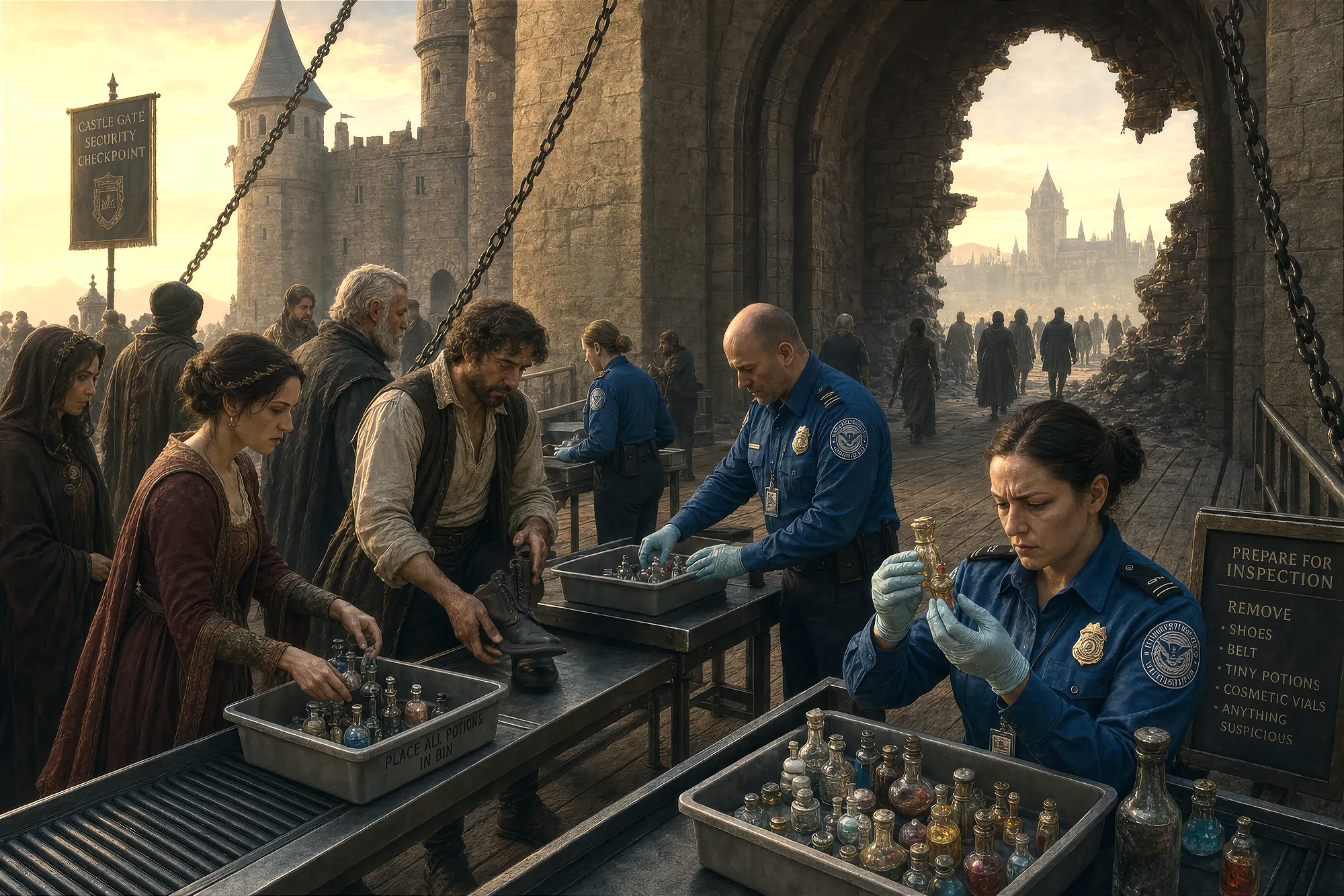
Once rules are introduced, they are difficult to change—especially when they’re of the bureaucratic variety.
What got me thinking about this was a recent trip where security forced me to throw away an assortment of fancy hair products. They did not conform to the rules, I was told. I spent the rest of my vacation enduring perpetually bad hair days. Thanks, TSA. You’re the reason I’m still single.
What made things worse: if you were to combine all my liquids into a single container, they would have fit within the limit. But the individual containers were too large to all squeeze into the delicate plastic bag presented to me. Illegal, apparently. The monotone security agent surveyed my belongings and even labelled some solids as liquids. I was in no position to argue. But my inside voice screamed: This is dumb. Like I’m going to kill someone with my extra 5 mL of eye cream, mixed with 10 mL of hair gel and 20 mL of deodorant.
The truth is, on this particular trip, I was unlucky. It’s not the first time I’ve crammed a bunch of tiny containers into my carry-on. It’s a bit like Russian roulette: will they let the items through, or won’t they? Travel sure is fun these days.
Historically, airport security rules have been reactionary—instituted in response to specific terrorist threats or plots, and once implemented, nearly impossible to walk back. But not always. After nearly two and a half decades, the TSA ended the “shoes off” rule in July 2025, and Canada said it would follow suit. Though, enforcement remains somewhat airport and even security lane dependent.
The shoes off policy was directly linked to Richard Reid, an al-Qaeda operative, who in 2001 boarded an American Airlines flight from Paris to Miami with plastic explosives hidden in his shoes. He attempted to ignite them mid-flight before passengers and crew overpowered and restrained him. So not only did Reid try to murder people, his legacy is years of stinky security lines.
The liquid restriction traces back to a 2006 transatlantic aircraft plot, in which terrorists planned to smuggle liquid chemicals onboard disguised as drinks or toiletries and mix them in-flight. The plot was foiled before it even got off the ground: MI5 and police had spent months gathering intelligence and monitoring suspects. The attack was stopped through investigation—not airport checkpoints. And yet, almost overnight, a global 100 mL / 3-1-1 rule was put in place.
Could the attack have succeeded? Yes. And that’s the argument for keeping the rule. Surely the inconvenience of restricting toiletries and buying overpriced airport water is worth it if it saves lives, right? It’s a reasonable position.
Except that technology has largely made it unnecessary. Some Irish airports installed advanced 3D CT scanners capable of analysing the chemical composition of liquids, briefly allowing passengers to carry larger quantities onboard. Standardization and certification issues led the EU to temporarily reinstate the 100 mL limit in 2024, but Dublin fully lifted the restriction again in September 2025.
Some UK airports briefly tested relaxed liquid rules before the government paused the rollout in 2024, but as of January 2026, Heathrow Airport is allowing passengers to bring up to 2 L of liquids in their carry-on and not have to take out their electronics.
The direction of travel (so to speak) points toward eventually relaxing these rules globally—but the journey has been slow, contingent on the widespread installation of standardised 3D CT scanners, and complicated by cost (the tech upgrade at Heathrow cost around $1.35B).
Perhaps most instructive is Israel … the focus is on the person, not the contents of their bag. Security officers ask probing questions to profile each traveller and assess behaviour.
Australia permits liquids above 100 mL on domestic flights, which are considered lower-risk; the Australian Security Intelligence Organisation focuses on early plot detection, while airports use randomised screenings, explosive residue swabs, advanced scanners, and behaviour-trained staff.
Perhaps most instructive is Israel. Given the constant threat of terrorism, security at Ben Gurion Airport is extraordinarily rigorous—and yet the 100 mL rule isn’t applied particularly strictly. The focus is on the person, not the contents of their bag. Security officers ask probing questions to profile each traveller and assess behaviour. Low-risk passengers are processed faster with fewer restrictions; higher-risk passengers face far more thorough inspection. There are also multiple security layers, including checkpoints before you reach the airport and an embedded security presence within the terminal itself.
Profiling—which is done in all airports to different degrees—isn’t always so considerate of deontological ethics, weighing utilitarian security above that of individual rights or fairness. As those who tend to frequently be picked for additional searches and checks know, they are rarely as random as is claimed—and not always particularly comfortable (ask me how I know!). People are generally profiled on two things: behavior (like signs of stress, fear, agitation, deception) and demographics (real or perceived). The latter cannot be helped. It is, of course, not fair for the individual traveller to be profiled based on their race, religion, appearance, or age—and in practice people get wrongly sorted into these categories all the time as well. At the heart of the debate is the collective benefit versus the violation of certain rights for groups or individuals.
There are also, of course, debates on the effectiveness of profiling and whether it provides a false sense of security when we should be instead investing in better security systems that don’t rely on neither discrimination nor human intuition, as security expert Bruce Schneier argued in his widely publicized debate with Sam Harris. Harris argued that profiling is reasonable given the strong likelihood that threats of terrorism come predominantly from Muslims and urged Schneier not to underestimate the “talent that neurologically intact observers (not to mentioned trained screeners, like those who work for El Al) have for spotting high-risk individuals.”
The problem is that once a safety rule exists, removing it becomes its own political liability. Imagine a politician signing off on lifting the liquid restriction—and then someone detonates a plane using liquid explosives.
Ultimately all security requires us to complete a cost-trade analysis. What’s the cost? What’s the level on the infringement on universal and individual rights? Potential for abuse? Discrimination?
I, for one, have no interest in undergoing a strip search every time I fly. But I’m willing to undergo a scan at the airport, even if it doesn’t make me particularly enthused. Such are trade-offs.
What’s striking is that most of these measures were introduced as temporary responses to threats the public could understand as credible. The problem is that once a safety rule exists, removing it becomes its own political liability. Imagine a politician signing off on lifting the liquid restriction—and then someone detonates a plane using liquid explosives. Their political career would be over.
“The reason why once a rule is introduced, it stays is because there is a slanted accountability system in airport security,” says Justin Crabbe, commercial pilot, travel expert, and CEO and founder of private jet booking platform Jettly. “Regulators face grave repercussions if restrictions are removed. But they are not punished for retaining inconvenient rules. Security agencies know they would be blamed if an attack occurred after a rule was dropped.” Bureaucratic inertia compounds this, he argues: “Coordination between the TSA and ICAO takes years. Any change in protocol must be thoroughly tested and backed by solid evidence.”
Security theatre also plays a role: the visible performance of safety makes people feel protected, giving politicians a further incentive to retain policies even when their practical value is limited. And frustration, Crabbe notes, won’t actually drive change—because it won’t keep people from flying. “The industry would rather avoid regulatory battles than focus on customer convenience,” he says.
So for now, we put up with the inconveniences.