Xenu Marches On
I often celebrate the fact that I’ve been fortunate enough to meet and touch the minds of a great number of celebrated intellectuals. Richard Dawkins, Isaac Asimov, Richard Feynman, Carl Sagan, and so many others shared themselves with me, and left me giddy with new ideas, inspiration, and excitement. Wow. How lucky can a guy get?
But then there were the tramps, the rascals, the lowlifes who I’ve had to handle—gingerly—as part of my existence. I won’t name them all, because those who are still around tend to run to lawyers when I mention their names. I’m sure you’ll understand. One of these, a man who just knew he was an intellectual giant, was Lafayette Ronald Hubbard (1911–1986). Yes, he’s the one who created the Church of Scientology (COS)—a favor we could all do without.
I actually met Hubbard twice, both times at meetings of The Trapdoor Spiders, an assembly of authors—mostly of science fiction and fantasy. John Dickinson Carr, Lester Del Ray, George O. Smith, Fred Pohl, and Isaac Asimov were prominent members. They got together sporadically in New Jersey to discuss matters of interest. Though I’d only written two eligible stories—”Dear Editor” and “Dionaea,” both published to no great acclaim—I was allowed to attend. Hubbard not only smelled bad, he was inebriated and ignored at these meetings.
To serious critics and those who know the other version of his life story, Hubbard was essentially a literary hack, a silver-tongued bum, a college drop-out
L. Ron was born in Nebraska, he claimed. His life story is told in two very different versions. According to the official COS story, he was an explorer, a war hero, a scientist, and “the most published and translated author of all time.” Whether that last claim was true or not, we discovered that the “most published” aspect may have been accomplished by the Scientology adherents who—in response to urging from the church leaders—go out and buy up quantities of Hubbard’s books to fluff up the market and thereby bring up the initial sales ratings, then they distribute the books to local libraries—it’s a popular way of inflating an author’s ranking. I first became aware of this when I asked the Fort Lauderdale Public Library why they had so many copies of LRH books on sale at every book-surplus sale they held.
To serious critics and those who know the other version of his life story, Hubbard was essentially a literary hack, a silver-tongued bum, a college drop-out. He’d been a junior Navy officer who had the unique distinction of having opened fire on some Mexican islands during World War II. The 1950 publication of his book Dianetics gave the public a glimpse of his thoughts on the workings of the human mind, but at that time had no religious message, being a sort of amateur psychiatric view that traumatic events in one’s past are the source of all mental—and most physical—problems. Hubbard wrote that an auditor trained in the “science” of Dianetics, could neutralize those events, and thus the problems could be “cleared.”
As with any such cult, there are exotic invented terms to express the variety of specialized notions that students are required to learn and use. These are part of the highly secret inner workings of the COS, guarded by a huge legal network that does not hesitate to issue injunctions against anyone who offends their mythology, which is a colorful, juvenile, sci-fi narrative that is only revealed, bit-by-bit, dollar-by-dollar, to those who have paid their way into the advanced sectors of the religion. The COS seeks—through scary litigation and harassment—to limit access to its materials and to discourage outsiders’ discussion of its teachings, but a worldwide regiment of computer moles has found and published this material via the internet, so that the whole comic/cosmic opera is now easily available to everyone. Go to http://theunfunnytruth.ytmnd.com/
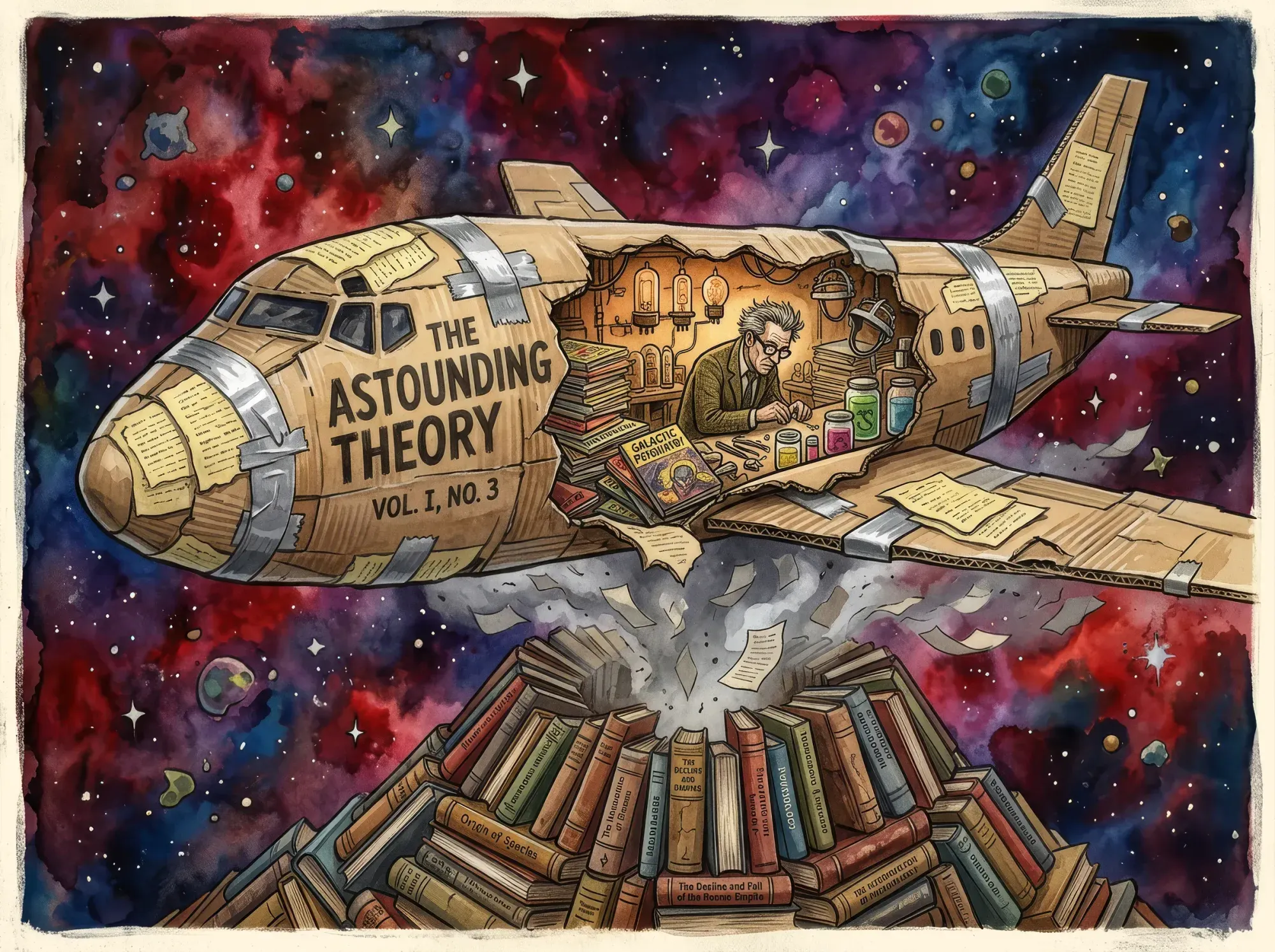
You see, the basic premise of Scientology—the copyrighted myth upon which it’s all constructed—is that some 75 million years ago, there were differences of opinion among the civilizations living around the 26 stars that made up the Galactic Federation. This meant that Xenu, the Federation Leader of the average 178 billion “people” per planet (and there may have been more than one planet per star, remember!) had to rally his Galactic Patrol—dressed up in their white uniforms and silver boots—to find what he deemed to be the “surplus” population and dispatch them by injecting ethylene glycol (on Earth it is called antifreeze) into their spinal cords, after which they were all loaded like cordwood onto space ships that looked just like Douglas DC-8s, and shipped off to Teegeeack, the former name of Earth, our planet. According to Hubbard, these literal “stiffs” were piled up on mountaintops and dumped into volcanoes, then vaporized with 17—no more, no less—hydrogen bombs. Of course, the thereby-released “body thetans” had survived this experience and so had to be electronically trapped, after which they were each implanted with bad ideas, immoral thoughts and opinions, and then set adrift to be distributed around the planet by riding on slow-moving glaciers. These critters are now trying to get back into regular human bodies—ours, don’tcha know?—and when they do, only the “clearing” procedure administered by Scientology—for a price—can save those occupied bodies.
As with any such cult, there are exotic invented terms to express the variety of specialized notions that students are required to learn and use.
Now, if that scenario doesn’t sound like the most inane idea you’ve ever heard, a juvenile sci-fi scenario, I can offer you no hope except a thorough “auditing” at your local Scientology outpost. But bring lots of Earth-style money.
Hubbard’s real knowledge of science was a joke. What did this genius really know about it? In his 1957 book All about Radiation, he wrote:
The Question Mark: All this leaves us with an enormous question mark. Whether radiation travels around the world is beside the point. It’s the question mark that flows around the world. And the question mark, if there, is the radiation itself.
The Effects of Radiation on the Human Body: At what point is radiation harmful to the human body? No one knows, but we can state the following: a wall fifteen feet thick can’t stop a gamma ray. On the other hand, a body can. Which leads us to pose this medical question, of the greatest significance: why can gamma rays go through walls but not through the body? Clearly, a body is less dense than a wall. As we do not find an answer in the material domain, we must therefore enter the mental domain.
Umm, before we enter another even fuzzier place, Ron, that paragraph is what any high school student would call “BS.” No references to what the wall is made of, for one thing. Plywood? Styrofoam? Cast iron? Old copies of sci-fi manuscripts? Ah, but LRH knows, and imparts this to his readers:
I can fortunately tell you what is happening when a body gets hurt by atomic radiation. It RESISTS the rays! The wall doesn’t resist the rays and the body does.
This Hubbard book—one of the basic books of the Scientology sources, remember—also claims that radiation poisoning and cancer can be cured by taking masses of vitamins. That, too, is simply nonsense. The author states that the Sun is powered by nuclear fission (which it’s not—it uses fusion), that “the unit of human memory” is the tiniest particle in the universe, and that radiation is either a particle or wavelength but that no one can say for sure which it is, which is also wrong.
A glance at the history of this collection of L. Ron’s wisdom is most revealing. The early printings were credited on the cover as simply “By a nuclear physicist and a medical doctor,” while later editions credited Hubbard as being the “nuclear physicist,” and an unidentified “Medicus” as being the “medical doctor.” By 1979, that doctor was said to be a Richard Farley, who often used the ostentatious pseudonym Medicus, while the most recent edition lists the authorship as Hubbard, a Dr. Gene Denk and a Dr. Farley R. Spink. This is obviously an attempt, following intensive criticism of Hubbard’s hilarious errors, to allow these vaporous authorities to take responsibility for the boo-boos. Denk was actually Hubbard’s personal physician, with no knowledge of physics but willing to lend his name as an author of the book. And Spink, allegedly of the University of Cambridge, England, may have actually existed, either as an instructor or a student, though direct inquiries to Cambridge bring denials of any such person existing. Hubbard’s own degree—a Ph.D.—was totally bogus, being conferred on him in the 1950s by an L.A. chiropodist (?) in the name of Sequoia University, for a fee. Sequoia University? That was a diploma mill that simply sold degree certificates, and was eventually shut down by the courts. In 2009, the UK released documents from a California agency stating that Sequoia University was never approved nor recognized as a school, and then revealed that, in fact, the “University” was personally owned by L. Ron Hubbard and that Hubbard had therefore awarded himself his own “Ph.D.”!
Interestingly enough, Sequoia University is also part of a controversy surrounding the credentials of a Dr. Kelly Segraves, director of a creationist organization that preaches that giant-sized humans once roamed the Earth and coexisted with dinosaurs. Segraves claims to have received his Masters degree from Sequoia University in 1972. So much for his education and validity. Be assured, however, that there are literally hundreds of these diploma mills all over the world.
The dust jacket of Hubbard’s supposedly scientific All About Radiation book states:
L. Ron Hubbard, who was one of the first nuclear physicists in the United States, has interpreted these facts and related them to human livingness, governments and the control of populations.
Umm, “one of the first nuclear physicists”? Put down that pipe, Ron. An independent 1965 inquiry into All About Radiation in Australia ended with this:
The Board heard evidence from a highly qualified radiologist who has made a special study of radiation and its effects. He said that Hubbard’s knowledge of radiation, as displayed by his writings in All About Radiation, was “the sort of knowledge that perhaps a boy who has read Intermediate Physics might, with a lot of misapprehensions and lack of understanding, demonstrate.”
Presently, only Australia, Italy, New Zealand, Portugal, South Africa, Spain, Sweden, and the United States of America, grant Scientology the privileges of a legitimate religion, while other countries, notably Belgium, Canada, France, Germany, Greece, and the United Kingdom, refuse Scientology that status. Georges Charpak [1924-2010] a Nobel Laureate in Physics, and Professor Henri Broch, in their 2004 book Debunked!, commented on Hubbard’s abysmal ignorance of science, particularly physics:
A powerful sect like the Church of Scientology still builds a religion around the pseudoscientific writings of its founder. The falsehood of these writings is so patent that they’d be touching coming from the pen of a ten-year-old. Everywhere there is a torrent of words, words, and more words borrowed from elementary science books—all devoid of meaning … How can such stupid things influence anyone of even average education?
I have no answer to that question.