physics
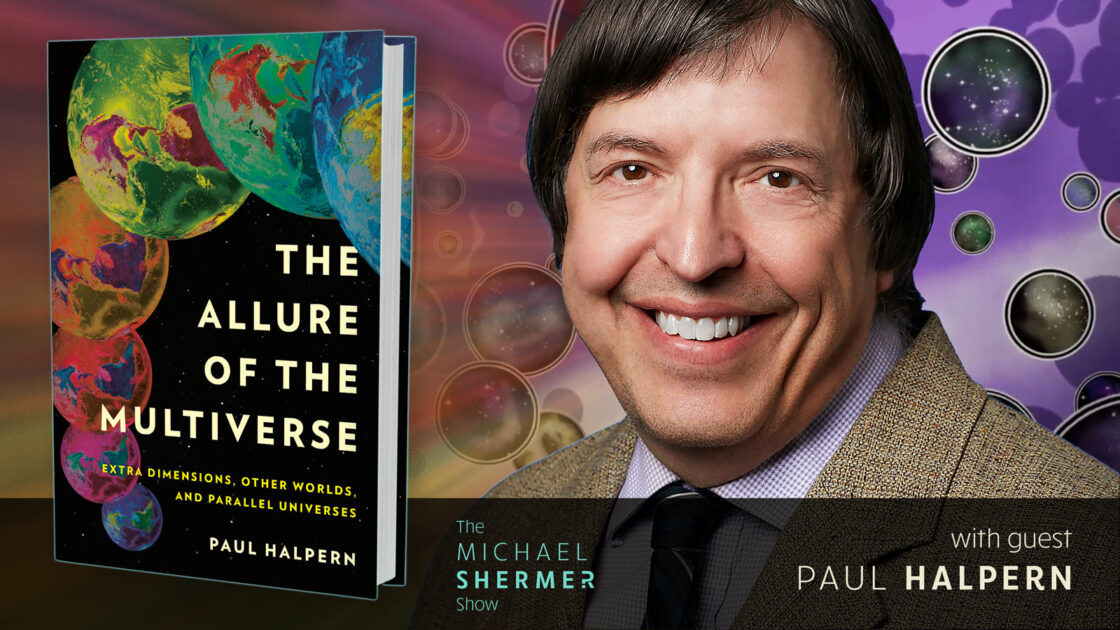
Shermer and Halpern discuss: definitions of universe and types of multiverses • Is the multiverse science, metaphysics, or faith? • theists claim the “multiverse” is just handwaving around the God answer • many worlds interpretation of quantum mechanics? • inflationary and Darwinian cosmology • infinity and eternity • multiple dimensions • string theory • cyclical universes • Big Bounce • Anthropic Principle (weak, strong, participatory) • time travel • sliding doors, contingency, and the multiverse.
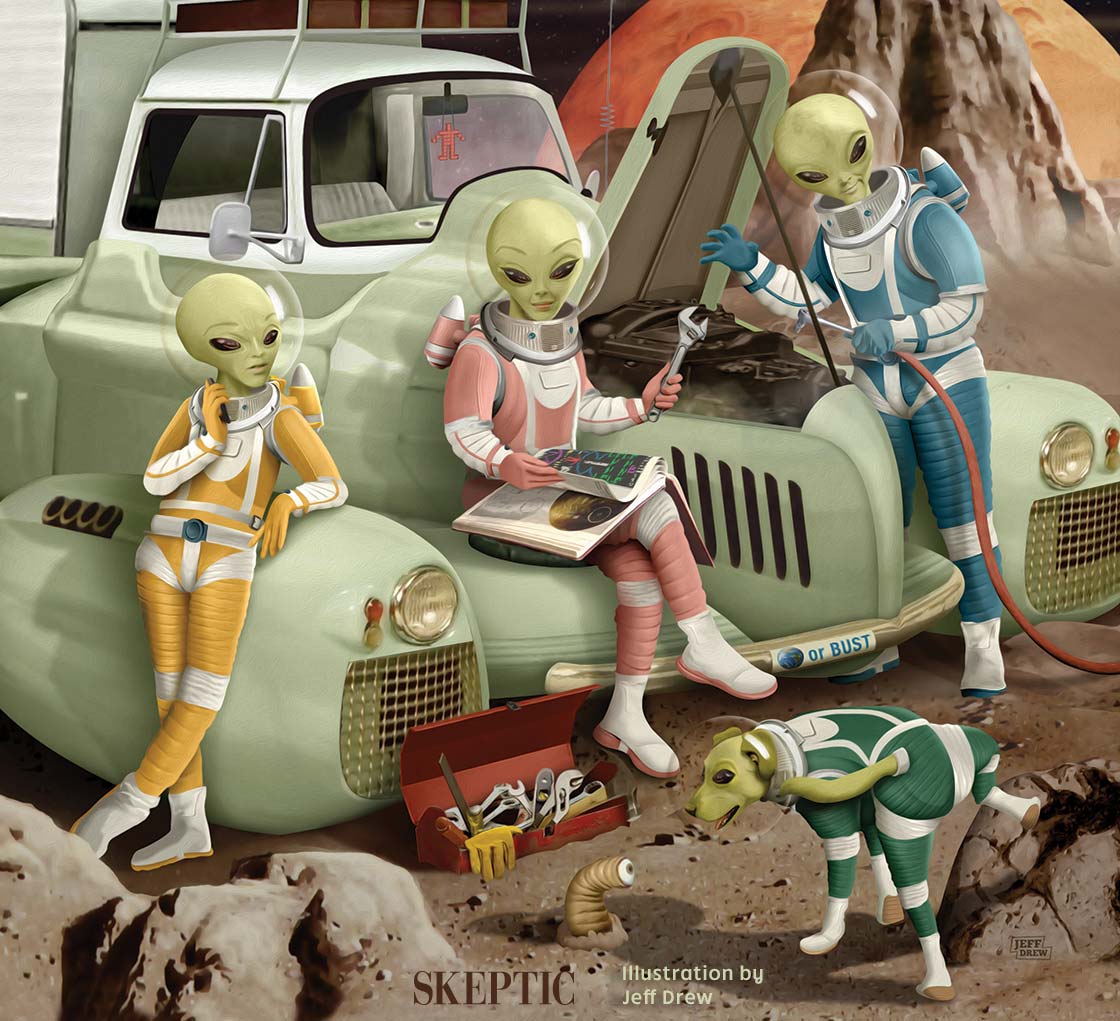
Despite much ballyhoo in the media, all efforts thus far have failed to provide substantive evidence that might link the appearance of UFOs, now called UAPs (unidentified aerial phenomena), with aliens from other planets. This failure results from limitations imposed by both biology and distance. As Morton Tavel explains, when these factors are combined, they render any such contacts virtually impossible.
Shermer and Hertog discuss: what it was like working with Stephen Hawking • Darwinian model of cosmology • time • What banged the Big Bang? • cosmic inflation and multiple universes • how to reconcile Einstein’s relativity theory of gravity and quantum theory • Hawking’s no-boundary theory • why the universe appears designed • Feynman’s sum over histories approach to quantum physics • Is there purpose in the cosmos? • Why is there something rather than nothing?
Shermer and Goodenough discuss: origins of her personal beliefs • origins life, RNA, DNA, consciousness, language, morality • myths and religions • what it means to be “religious” • religious naturalism • where the laws of physics came from • why the universe seems so strange • chance and evolution • fine tuning of the cosmos • autocatalysis and emergence • purpose of religion • ethics and morality without religion.

Entropy keeps the arrow of time moving; today is less ordered than yesterday, and this is certain. If we extrapolate this concept backwards, through our scientific narrative to the origins of the universe, then we must postdict a universe that was once ordered only through its lack of movement, which means it was frozen. But even then, as Galileo once said of the Earth, eppur si muove, but it does move. And if it moves, it creates heat, and understanding…

Shermer and Päs discuss: monism vs. dualism • What is time? • What is a field? • Is math all there is? Is math universal? • the double-slit experiment • superposition • metaphors in science • limitations of models and theories of reality • limitations of analogies between western physics and eastern mysticism • What banged the Big Bang? • Are we living in a matrix? • the Second Laws of Thermodynamics and directionality in nature • Model Dependent Realism • string theory, the multiverse, consciousness, the origin of the universe, and why…
Shermer and Sheehy discuss: what it’s like being a female physicist in a mostly male field • Does science progress through falsification, confirmation, consensus, or Bayesian reasoning? • atoms, light, Higgs Boson, time, gravity, dark energy, dark matter, string theory, radioactivity • Gold Foil Experiment • cloud chambers • particle accelerators • splitting the atom • Is there a place for God in scientific epistemology? • Is math all there is? Is math universal? • other universes, dimensions, and the multiverse.
What is time? Does the past still exist? How did the universe begin and how will it end? Do particles think? Was the universe made for us? Why doesn’t anyone ever get younger? Has physics ruled out free will? Will we ever have a theory of everything? To examine these ideas, Shermer speaks with Sabine Hossenfelder, a research fellow at the Frankfurt Institute for Advanced Studies, Germany. She has published more than eighty research articles about the foundations of physics,…

A three-part debate between Steven Pinker and Brian D. Josephson, initiated from a private email exchange in which Josephson challenged Pinker’s claims in a BBC radio program that there is no rational reason to believe in ESP. Here, Pinker first makes his case, followed by Josephson’s critique, and then Pinker’s response to that critique. As is our custom, we prefer to steel-man a position someone else holds, especially with a controversial subject like ESP, but better still is to have…
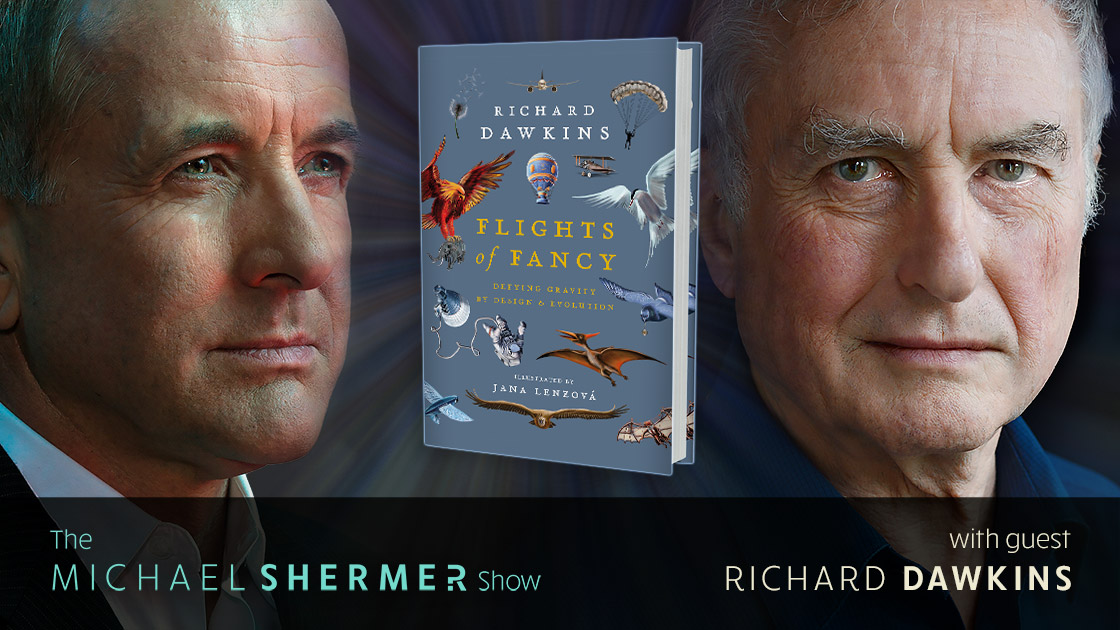
Michael Shermer speaks with Richard Dawkins about his new book Flights of Fancy: Defying Gravity by Design and Evolution. They also discuss: nationalism; Russian revanchism; the recent rise of authoritarianism and autocracies; U.S. acceptance of the theory of evolution surpassing 50%; E. O. Wilson; and more…

Michael Shermer and Fritjof Capra discuss: the making of a California holist • the influence of Werner Heisenberg’s Physics and Philosophy • 50 years of progress or regress • the 1960s counterculture and challenges to authority • metaphors in science: world as machine, world as alive • limitations of models and theories of reality • limitations of analogies between western physics and eastern mysticism • mind and consciousness • the Santiago theory of consciousness • what it means to be…
In episode 229, Michael Shermer speaks with Fritjof Capra on Patterns of Connection. PLUS for the next 12 days, now through December 4, 2021, shop our biggest sale ever! Get 40% off digital subscriptions via pocketmags.com, and get 25% off everything at shop.skeptic.com including magazine print subscriptions and back issues!
From teleportation and space elevators to alien contact and interstellar travel, science fiction and fantasy writers have come up with some brilliant and innovative ideas. Yet how plausible are these ideas? In this lecture from our archives, recorded in February 2014 as part of The Skeptics Society’s Distinguished Science Lecture Series, professor of physics, Dr. Charles Adler, delves into the most extraordinary details in science fiction and fantasy.
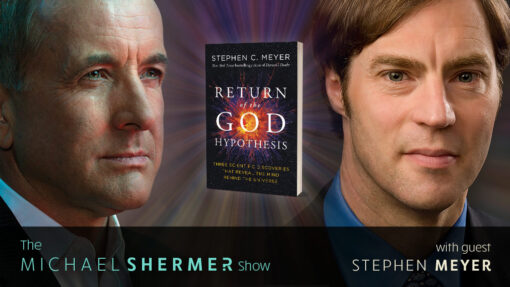
In episode 185 of Michael Shermer’s podcast, Michael speaks with Stephen Meyer about his best selling book: Return of the God Hypothesis: Three Scientific Discoveries that Reveal the Mind Behind the Universe. Shermer responds to each of his claims and a stimulating and enlightening conversation ensues.
In episode 185 of Michael Shermer’s podcast, Michael speaks with Stephen Meyer about his best selling book: Return of the God Hypothesis: Three Scientific Discoveries that Reveal the Mind Behind the Universe. Shermer responds to each of his claims and a stimulating and enlightening conversation ensues.
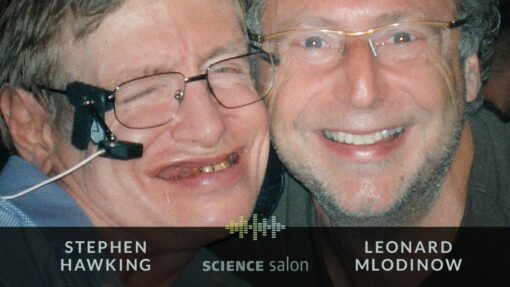
In Science Salon podcast # 132, Michael Shermer speaks with Leonard Mlodinow about his new book in which he recounts, in a unique and deeply personal portrayal, nearly two decades as Stephen Hawking’s collaborator and friend.
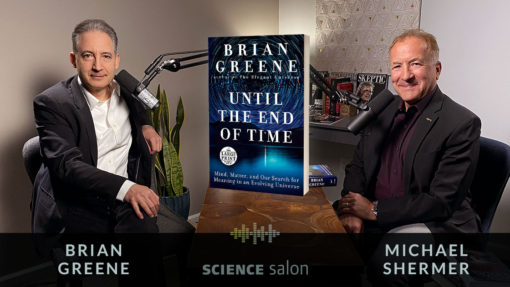
Until the End of Time is Brian Greene’s breathtaking new exploration of the cosmos and our quest to find meaning in the face of this vast expanse. Greene takes us on a journey from the big bang to the end of time, exploring how lasting structures formed, how life and mind emerged, and how we grapple with our existence through narrative, myth, religion, creative expression, science, the quest for truth, and a deep longing for the eternal.
In Science Salon # 108 Michael Shermer speaks with Brian Greene about his book Until the End of Time: Mind, Matter, and Our Search for Meaning in an Evolving Universe. PLUS, during the Coronavirus outbreak, while many schools are closed, Shermer shares one of his Chapman University lectures, taught remotely, free for everyone to view.
There have been many arguments for the existence of God. In this cover story from our just-released issue Skeptic magazine 23.4 (2018), Michael Shermer delves into the question that underlies all the arguments: Why is there something rather than nothing?

There have been many arguments for the existence of God. In this cover story from our just-released issue Skeptic magazine 23.4 (2018), Michael Shermer delves into the question that underlies all the arguments: Why is there something rather than nothing?
NEXT →