Brain-Dependent Dualism: Why the Hard Problem Isn’t Hopeless
I’m grateful to Skeptic for publishing my article “The Hard Problem of Consciousness is a Soluble One,” along side Michael Shermer’s article “The Hard Problem of Consciousness Is an Insoluble One” (September 2026). Michael and I agree on many points but differ in a few key areas.
First, we agree on what consciousness is and that we cannot know what it is like to be a bat, a dolphin, or any other animal. We cannot have the consciousness of another animal or even of another person, although we might imagine to some extent what it would be like. And I mostly agree with Michael here: “the problem is trying to explain how we are able to experience the world from inside a wet neurochemical brain machine … The hard problem is explaining how it is that we can experience ‘redness.’”
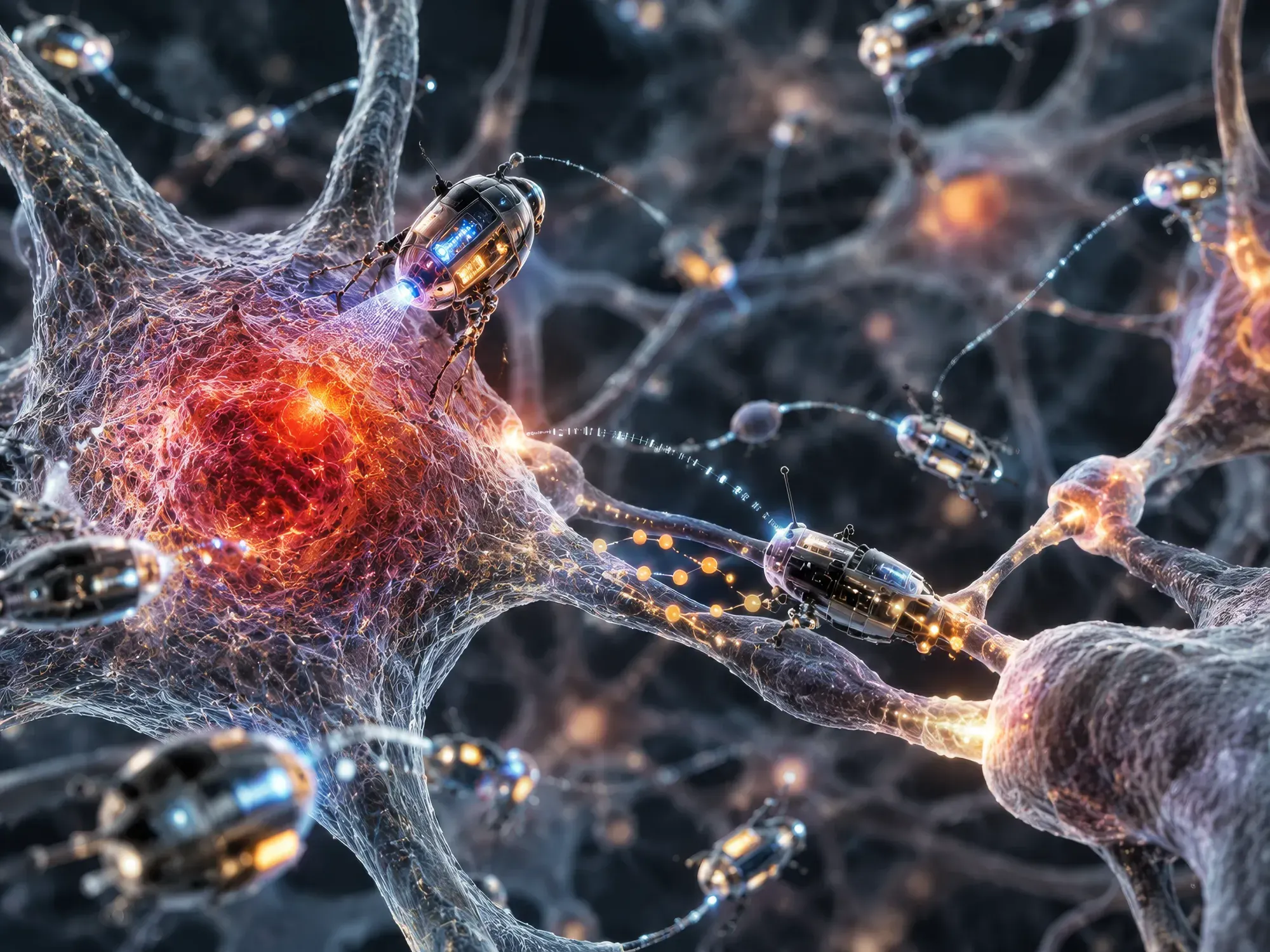
But there is a sense in which we are the machine rather than being inside the machine. I think we would know how we experience “redness” when we identify the neuronal activity pattern present when we do experience it. However, in my article I suggested that finding precise experiential-neuronal correlates will probably require vast improvements in our monitoring of the brain. We need some kind of “brainscope.” For this I envision billions of nanobots that attach themselves to neurons and send wireless signals whenever the neurons fire, but there could be other ways to do it.
Michael seems to agree with Thomas Nagel who reflected, “Without consciousness the mind-body problem would be much less interesting. With consciousness it seems hopeless.” I disagree with Nagel and Shermer on this point. I don’t think it is hopeless. I think we are finally cracking the problem. For example, Michael quotes Christof Koch: “How can activity in the brain trigger feelings? … Putting it more generally, how can anything physical give rise to something nonphysical, to subjective states?”
There is a sense in which we are the machine rather than being inside the machine.
I think the answer to Koch is “It just does! It is a brute fact.” I believe that when a sufficient number of neurons are “wired” in a certain way, they just give rise to consciousness. In other words, although brain and mental processes are ontologically different, mental processes naturally emerge from and are totally dependent on brain processes. I believe this emergence could not have been different from what it is, and thus there is no explanation of why it is the case. There is some point at which explanation just ends. I think another example of this kind of “end of explanation” is to say “The universe just exists. It could not have been otherwise. There is no explanation for it.”
Michael said “I put it [the hard problem] into the category of a known unknowable because it is logically impossible to solve for the simple reason that it would violate Aristotle’s Law of Identity—A is A. Thus: A cannot also be non-A.” I think the solution here is that mental (M) and brain (B) processes are ontologically different. M is M, and B is B, but M is not B. Mind emerges from and is totally dependent on Brain. I believe that’s just the way it is, and it could not have been otherwise. I could be mistaken, but that is my current view. Can I prove this? No, not now, but I think my view is coherent and consistent and is supported by much evidence. The proof will need to wait on the invention of the equivalent of a “brainscope.”
In my assessment of the hard problem, consciousness is knowable and partly known, and we are on the road to knowing much more about it.
Michael writes: “Understanding how the brain machinery works is different from experiencing the brain machinery itself.” I mostly agree. However, I think the brain machinery produces a flow of mental contents of which we are aware.
Descartes believed there were two substances, mental and physical. I think he was mistaken on this point. I believe that there is one substance, the physical, and two processes, the physical (neuronal) and the mental, and the latter is fully dependent on the former.
Michael refers to Franz Kafka’s Metamorphosis (from person to cockroach). I don’t think the mind of one human being could be transferred to the brain of a cockroach or could be separated from the brain of that same human being. However, I think that it might be possible, in theory at least, to transfer the brain and mind of one human being into the skull of another human being.
Michael quotes Paul Bloom who says “Most people believe that when the body is destroyed, the soul lives on. It might ascend to heaven, or descend to hell, go off into some sort of parallel world, or occupy some other body, human or animal. Even those of us who do not hold such views have no problems understanding them …” I think the best definition of a “soul” is “a hypothetical mind which is not dependent on a brain, which is inserted in a brain at birth and removed from a brain at death, and which then exists on its own in some unknown realm after death.” Although the idea of the soul has been around a long time, at least since Plato, there is just no good evidence that a soul exists. The idea is probably a product of wishful thinking.
Michael says “Dualists believe that we consist of two substances—body and soul, brain and mind (called “substance dualism”). Monists contend that there is just one substance—a body and a brain—from which consciousness is an emergent property.” But I am a different kind of Dualist! I believe that there is one substance, i.e. energy-matter, represented here by the brain, and two processes, i.e. the neuronal and the mental. But yes, consciousness naturally emerges from the brain.
I agree with Paul Bloom that we are “natural-born dualists.” However, in my view we think that way because we are that way! The dualism is real!
Cartesian Dualists believe that when the brain dies the soul is released and continues to exist. However, we Brain Dependent Dualists do not engage in this wishful thinking. We believe that when the brain dies, mental life and consciousness end. In my opinion, beliefs in souls, afterlives, resurrections, reincarnations, heaven, and hell are all superstitions.
I agree with Paul Bloom that we are “natural-born dualists.” However, in my view we think that way because we are that way! The dualism is real! The error which many people make, however, is to think that there is a soul, i.e. a mind which can exist independently of a brain. Just because we can imagine a soul is no guarantee that it actually exists.
In his article Michael presents a brief but useful discussion of “The Weak Consciousness Principle vs. the Strong Consciousness Principle.” On the topic he cites Deepak Chopra who said “Consciousness is fundamental and without cause. It is the ground state of existence. As conscious beings, humans cannot experience, measure, or conceive of a reality devoid of consciousness.” I think Deepak is about half right here. In my view, energy-matter is the “ground state of existence,” but some brains, which consist of energy-matter, of sufficient size, complexity, and arrangement naturally produce consciousness. Thus, I think the Weak Consciousness Principle is correct, and the Strong Consciousness Principle is incorrect. The best evidence from neuroscience finds a strong correlation of brain and mind states.
However, Michael goes too far when he says “In other words, brain activity = conscious experience.” I disagree. I think the relation is “produces,” not “is equal to.” Later he says “In other words, neural activity = qualia.” Once again, I disagree. I think the relation is “produces,” not “is equal to.” But however one phrases it, I agree with Shermer and Steven Pinker (from his book Enlightenment Now) that brain processes produce mental processes. That’s just the way it is. It’s a brute fact. It could not have been otherwise. Explanation stops here.
In conclusion, Michael opines “In my assessment of the hard problem, then, consciousness is a known unknown that is very likely unknowable, at least as the concept is conceived of at present.” However, in my assessment of the hard problem, consciousness is knowable and partly known, and we are on the road to knowing much more about it.
Read Michael Shermer’s response to this essay.