A Skeptic’s Response to Marc Defant’s Call for Us to Be Skeptical of Environmental Alarmism
In his October 26, 2026 article, “A Skeptic’s Guide to Environmental Alarmism,” Marc Defant asks us to be skeptical of calls for action on what many scientists predict is a looming climate crisis. The rest of the article is a set of past examples of “environmental alarmism” that offered incorrect predictions.
First, Defant’s article suffers from confirmation bias. Scientific research is always updated with new information. Defant cherry-picks wrong predictions but provides no examples of correct predictions. Nor does it update readers on how quickly these wrong predictions were updated. For example, the much-publicized 1970s global cooling scare he cites was never the scientific consensus. A review of the peer-reviewed literature from 1965 to 1979 found that papers predicting warming outnumbered those predicting cooling by more than six to one.
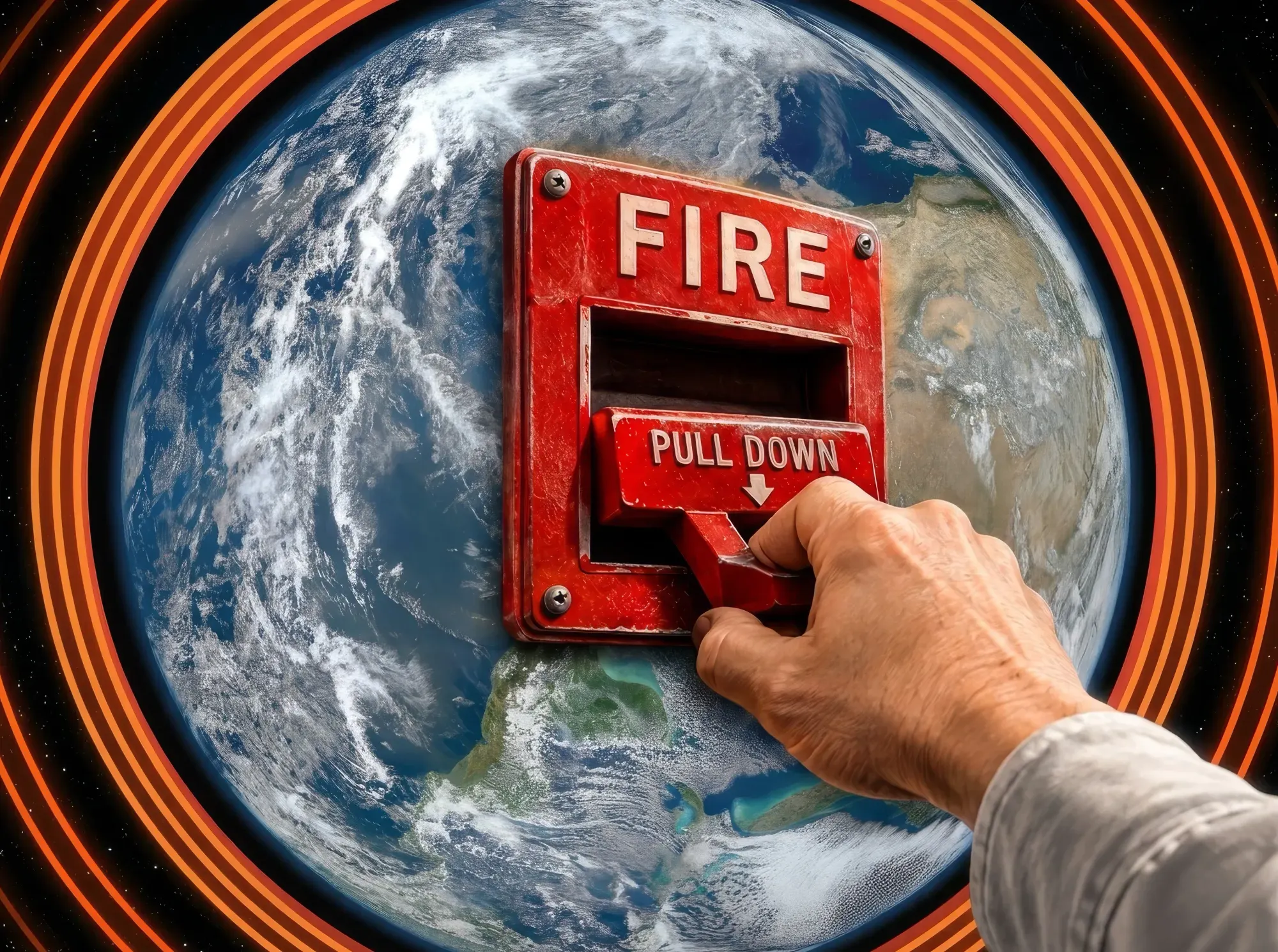
When I pull a fire alarm I am not predicting the building will burn down. I am trying to prevent that from happening.
More importantly, people issue alarms not to make predictions, but in hopes of changing the future. When I pull a fire alarm I am not predicting the building will burn down. I am trying to prevent that from happening. As Defant eventually admits, the alarms about pollution resulted in bipartisan efforts to reduce toxic emissions. NASA climate scientist James Hansen presented compelling evidence of human-caused climate change to the Senate in 1988. That produced early bipartisan efforts to solve the problem through cap-and-trade legislation—the same as what had successfully reduced sulfur dioxide pollution.
But the emergence of the Tea Party movement, together with organized opposition funded by fossil-fuel interests, helped derail bipartisan climate legislation. Industry-backed organizations also promoted misleading claims about climate science and the economic costs of addressing it.
Defant then presents the views of a professor named Antero Ollila, who claims that only a small amount of carbon in the atmosphere is from humans, and “contends that recent warming is largely driven by natural factors—long-term oceanic and solar cycles—while human-emitted greenhouse gases play only a modest role.” But Antero Ollila is not a climate scientist, so he may be forgiven for making a critical mistake: Confusing how quickly individual CO₂ molecules leave the atmosphere with how much total CO₂ stays in the atmosphere. Imagine a bathtub with the tap and drain open. Individual water molecules rapidly leave the tub, but the water level can still rise.
Defant selectively compares Michael Mann’s 1999 data with Fredrik Ljungqvist’s 2010 data to make the point that the climate swings of the past thousand years “are a recurring feature of the climate system,” which suggests that “at least part of the warming over the past century could reflect a phase of natural variability.” But Ljungqvist himself supports Mann’s updated 2008 data, which suggests global warming is mostly caused by human activity (anthropogenic global warming).
The point is to prevent such disasters before they happen to reduce the amount of suffering.
Bjørn Lomborg is not mentioned in the article, but in personal discussion with Michael Shermer, Shermer indicated Lomborg’s influence on him. When Lomborg entered the environmental debate in 1998, he characterized the greenhouse effect as “highly questionable.” He has since acknowledged it is real and at least partly human caused. But he claims that the money needed to get off of fossil fuels would be better spent on alleviating poverty in poor countries.
First, the Lomborg model (that Shermer supports) assumes that any money saved would go for that purpose of alleviating poverty in poor countries. But it also makes powerful assumptions about economic time discounting: That we should drastically limit how much we spend today to prevent a future disaster. This raises a number of scientific, economic and ethical challenges.
The Intergovernmental Panel on Climate Change (IPCC) reviews estimates of future economic harm caused by the climate crisis, but it does not give an exact number. There are too many scientific and policy unknowns. Lomborg uses a discount rate of about 5 percent. At a 5 percent annual discount rate, a trillion dollars in damage a century from now is valued at just $7.6 billion today. Such assumptions can dramatically reduce the apparent economic benefits of preventing long-term climate damage. But we have no idea how big the potential harm might be. Sea level rise could put vast urban coastal areas underwater. There is no precedent for dealing with such economic harms.
And not all harms are economic. How do you measure the loss of habitat or species extinction economically? How do you measure the stress of tens of millions of people being forcibly relocated? Of resulting violent conflicts over limited environmental resources?
Past problems like pollution or overpopulation are very different than climate change. There may be some lasting harms, but when the problem is removed, things mostly return to previous conditions. Climate is different. That is why there is talk of “tipping points.” If I tell you that there is a hypothetical tipping point in 2035, for example, this does not mean the world ends in 2035, any more than if I step off the roof of a tall building I instantly die. It means that we have until that date to prevent irreversible, catastrophic harm perhaps much further in the future.
Lastly, I should note that climate scientists never use descriptive lines like “end of the world.” Obviously, the world will survive without us, and we probably won’t go extinct from catastrophic climate change any more than from nuclear war. The point is to prevent such disasters before they happen to reduce the amount of suffering.
I first pulled the fire alarm on the climate crisis in 1981. By then the evidence was quite solid. Internal memos at Exxon showed they believed the evidence by then. As early as 1896, Swedish scientist Svante Arrhenius calculated how increasing atmospheric carbon dioxide could warm the planet. The implications of burning fossil fuels were recognized long before modern climate science emerged. This is not some new discovery promoted on a whim. It is firmly established by a consensus of actual climate scientists based on decades of research, and on a vast body of evidence.
Not all harms are economic. How do you measure the loss of habitat or species extinction economically?
As Defant acknowledges, sustainable energy is already price competitive with unsustainable, subsidized fossil fuels. This did not happen because of free market capitalism. It happened because China and Germany made policies to spend tens of billions of dollars investing in sustainable energy. We get a free ride off of their visionary investment that the US refused to make for decades.
Fossil fuels are a finite resource that eventually must be replaced. As Defant notes, increased use of sustainable energy has not yet significantly reduced our burning of fossil fuels. That is why the alarm needs to keep ringing ever louder until we make those necessary investments now that we have to make at some point anyway. Sustainable energy has many other benefits, including reduced international tensions and an immediate drop in air pollution deaths.
My wife and I recently spent nine hours driving 200 miles back from San Diego. The cause of the mass traffic was extensive fires, which were possibly attributable to the climate crisis. Such attribution is becoming a solid science now. We made similar travels in Japan in 90 minutes on high-speed rail. Thus, investing in high-speed rail is a win-win.
The question is not whether every prediction has been correct, but whether we will act on the overwhelming evidence before the damage becomes irreversible.
A final point on a consequence of fossil-fuel burning that is often overlooked: ocean acidification. The oceans absorb about 30 percent of our CO₂ emissions, changing seawater chemistry. Since the Industrial Revolution, average surface ocean acidity has increased by about 26 percent, making it harder for corals and many shell-forming organisms to survive and reproduce. And as the oceans absorb more CO₂, they become less efficient at absorbing additional CO₂. What economic value do we place on the health of the oceans and the ecosystems that depend on them?
The question is not whether every prediction has been correct, but whether we will act on the overwhelming evidence before the damage becomes irreversible. How about if we invest the money now in clean energy and clean transportation jobs and create a brighter future for everyone?