Intelligent Design
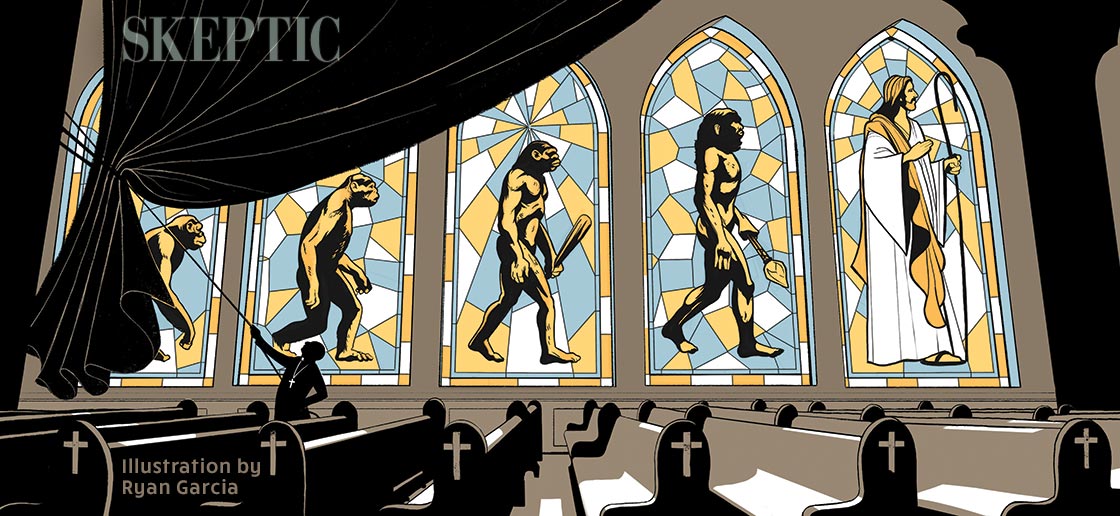
If you give Christians a choice between Jesus and Darwin by telling them that the theory of evolution means you have to be an atheist, they’re going to pick Jesus every time. In this article, Larry Arnhart argues that Christians should accept the theory of evolution not only because it’s true but also that it does not mean they have to give up their religion.

In this AMA Dr. Shermer answers questions from listeners about evolution and creationism, intelligent design theory, the hard problem of consciousness, the origins of morality, how science deals with anomalies, to what extent humans are naturally rational or irrational / skeptical or gullible, and why there is something rather than nothing.
In this AMA Dr. Shermer answers questions from listeners about evolution and creationism, intelligent design theory, the hard problem of consciousness, the origins of morality, how science deals with anomalies, to what extent humans are naturally rational or irrational / skeptical or gullible, and why there is something rather than nothing.
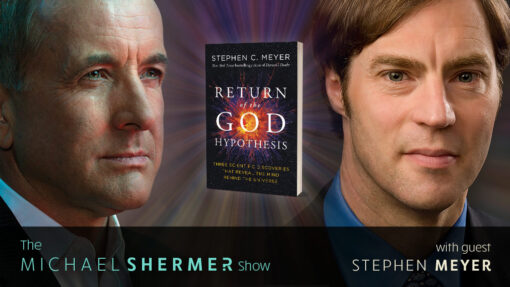
In episode 185 of Michael Shermer’s podcast, Michael speaks with Stephen Meyer about his best selling book: Return of the God Hypothesis: Three Scientific Discoveries that Reveal the Mind Behind the Universe. Shermer responds to each of his claims and a stimulating and enlightening conversation ensues.
In episode 185 of Michael Shermer’s podcast, Michael speaks with Stephen Meyer about his best selling book: Return of the God Hypothesis: Three Scientific Discoveries that Reveal the Mind Behind the Universe. Shermer responds to each of his claims and a stimulating and enlightening conversation ensues.

Shermer and Loeb discuss: anomalies in science and astronomy in particular • Galileo and Saturn • Signal Detection Theory • face on Mars • Is Oumuamua ETI in origin? • Intelligent Design • Carl Sagan and SETI • Law of Very Large Numbers • How many unknown knowns could account for Oumuamua? • Kip Thorne • gravitational waves • multiverse theory, and more…
In episode 157 of The Michael Shermer Show, Dr. Shermer speaks with Avi Loeb about his new book Extraterrestrial: The First Sign of Intelligent Life Beyond Earth which outlines his controversial theory and its profound implications for science, religion, and the future of our species and our planet.
In this eSkeptic: Science Salon # 56: Dr. Tyler Cowen — How an Economist Views the World; Announcing Skeptic Magazine 24.1, Available Now in Print & Digital Editions; Behe’s Last Stand: The Lion of Intelligent Design Roars Again.

Intelligent Design advocate, Dr. Michael Behe, has recently written his third book attacking modern evolutionary theory called Darwin Devolves: The New Science About DNA that Challenges Evolution. In this article from Skeptic Magazine 24.1, Professor of Biology Dr. Nathan H. Lents points out some of the many flaws in Behe’s book.
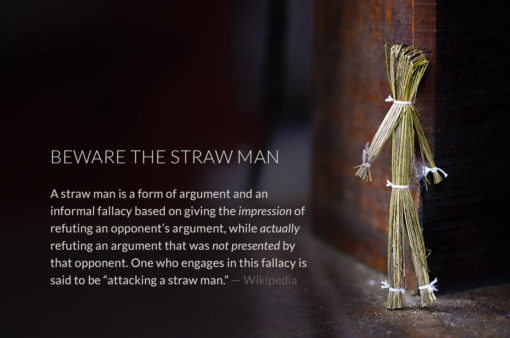
How do arguments for evolution used by mainstream scientists differ from arguments employed by creationists and proponents of Intelligent Design? Ralph M. Barnes sheds some light on this question in this article from Skeptic magazine 23.4 (2018).
How do arguments for evolution used by mainstream scientists differ from arguments employed by creationists and proponents of Intelligent Design? Ralph M. Barnes sheds some light on this question in this article from Skeptic magazine 23.4 (2018).
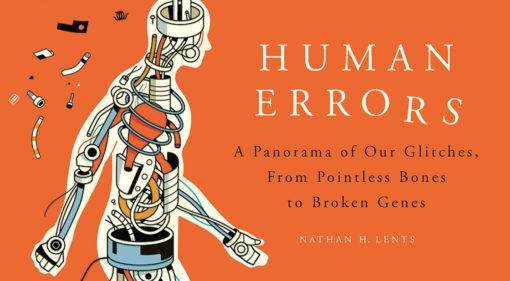
Nathan H. Lent asks five pointed questions of proponents of Intelligent Design that are inevitably raised by examples of poor design in the human body; Michael Shermer is featured in a New York Times article by Bari Weiss on the Intellectual Dark Web, a growing movement that is bypassing the mainstream media to engage in rich intellectual dialogue.
Nathan H. Lents asks five pointed questions of proponents of Intelligent Design that are inevitably raised by examples of poor design in the human body. Lents’s new book, Human Errors: A Panorama of Our Glitches, From Pointless Bones to Broken Genes, is now available.

Ever since Michael Shermer wrote Why People Believe Weird Things he has been asked to list the strangest beliefs he’s come across in his quarter century as a professional skeptic. We have compiled this list into The Top 10 Weirdest Things… DOWNLOAD the free PDF

In this essay, as a follow-up to his book, The Fallacy of Fine-Tuning: Why the Universe Is Not Designed for Us (in which he showed that, based on our knowledge of this universe alone, divine fine-tuning claims are without merit), Victor J. Stenger brings the arguments up-to-date with a discussion of the eternal multiverse hypothesis. This article was published in Skeptic magazine issue 19.3 in 2014. Order this back issue.
Mike McRae provides a glimpse into the history of two competing systems of biology: life as complex chemistry, and the abandoned theory of vitalism. (Part 3 of 3.)

Mike McRae provides a glimpse into the history of two competing systems of biology: life as complex chemistry, and the abandoned theory of vitalism. (Part 2 of 3.)

Mike McRae provides a glimpse into the history of two competing systems of biology: life as complex chemistry, and the abandoned theory of vitalism. (Part 1 of 3.)
In this week’s eSkeptic, in celebration of Darwin Day, we present an excerpt from Michael Shermer’s book, Why Darwin Matters: The Case Against Intelligent Design, from Chapter 4: “Who the Designer Is.”
In this week’s eSkeptic, Donald R. Prothero reviews Darwin’s Doubt: The Explosive Origin of Animal Life and the Case for Intelligent Design by Stephen Meyer (HarperCollins, 2013).
NEXT →